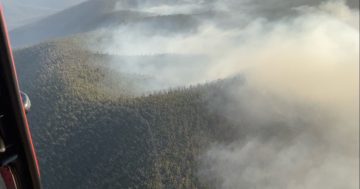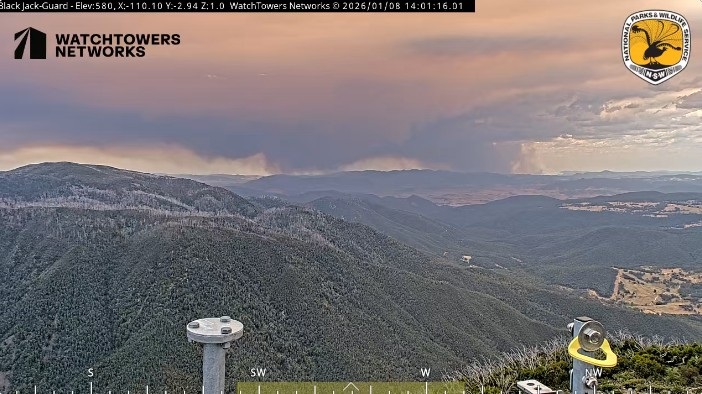
Kosciuszko National Park’s Black Jack fire tower captured this photo of bushfire smoke from a blaze near the NSW-Victorian border last week. Photo: NSW RFS.
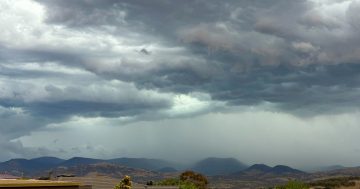
Damaging wind and heavy rain are set to arrive in the south-east, as NSW firefighters push ahead with controlling several fires.
Bureau of Meteorology meteorologist Belinda House said a low-pressure trough would arrive today (14 January) and last until the weekend.
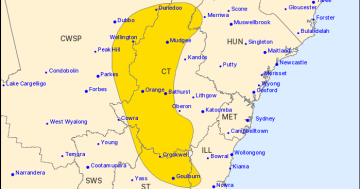
“Through the ACT and east and south of there, the storms could produce damaging wind gusts, locally heavy rainfall – potentially even some large hail,” she told Region.
“They won’t be isolated in nature, but the risk is that they could bring some damaging weather with them.”
According to the BoM, the ACT will see up to 10 millimetres of rainfall on both Wednesday and Thursday (15 January).
But by Thursday, Ms House said the system would have arrived on the NSW South Coast.
It means that Thursday and Friday are set to be the “wettest days of concern”, with up to 60 millimetres of rain forecast for parts of the south-east.
“By the time you get to the end of Thursday, some of our computer models are suggesting [the area] anywhere south of Narooma will see daily rainfall totals of 30 millimetres, maybe 50 millimetres, maybe even a little bit more through parts south of Bega,” Ms House said.
“That follows into Friday, where daily rainfall totals of 30 to 60 millimetres are possible.”
The rain will be welcome on the South Coast, where conditions are currently parched and tinder dry.
The NSW RFS are keeping a close eye on the forecast, racing to finish an ongoing backburning operation north-west of Cobargo before its arrival.
The Brassknocker Fire Trail blaze within the Wadbilliga National Park was first reported to authorities last Wednesday (7 January), and is believed to have been ignited by dry lightning.
Firefighters started a backburning operation after last week’s heatwave broke, hoping to remove some fuel.
Public information officer Inspector Nathan Barnden confirmed firefighters would continue their efforts for as long as conditions allowed, saying they were “confident in where [they] are” in their backburning schedule.
“We are treating it as though we won’t receive any rain on that fire. … Until that rain falls and until we see that impact on the fire ground, we’ll be continuing to plan as though we have none.”
He said the Brassknocker fire was “doing everything we want” amid backburning and the arrival of cooler temperatures.
“The last 24 to 48 hours, crews have done an incredible amount of work on the northside of the fire between the Tuross River and the fire itself to burn out that last pocket of fuel.”
Firefighters have also been backburning along its eastern edge, and have now turned their focus to its northern and southern sides.
Inspector Barnden also said the fire’s growth (currently sitting at more than 3400 hectares) was a combination of the initial blaze and the backburning area.
“That’s where we saw the increase in mapping … [That] is not the wildfire necessarily growing under unfavourable conditions.”
He said the Endeavour Moor fire (south of Eden), which has burnt through more than 700 hectares of Nadgee Nature Reserve, is also in the process of being controlled.
Meanwhile, the interstate Murray River Road fire remains south of the Murray River, with Victorian authorities rating it at the Watch and Act level.
“Both of those fires don’t currently provide a threat to life or property, though we will continue to see smoke affecting the south of the state for quite a while,” he said.
Ms House said conditions are set to remain overcast (and wet) into early next week for much of the south-east.
“Certainly Thursday and Friday look to be key watch point days at this stage, but [we’re expecting] follow-up showers across the weekend.
“More shower activity can be expected across the weekend and early next week.”
The latest forecasts and warnings are available through the BoM’s website or the BOM Weather app.
People can check if their bushfire survival plan is adequate by downloading the NSW RFS guide. Report all unattended fires to Triple Zero (000).
Original Article published by Claire Sams on Region Canberra.