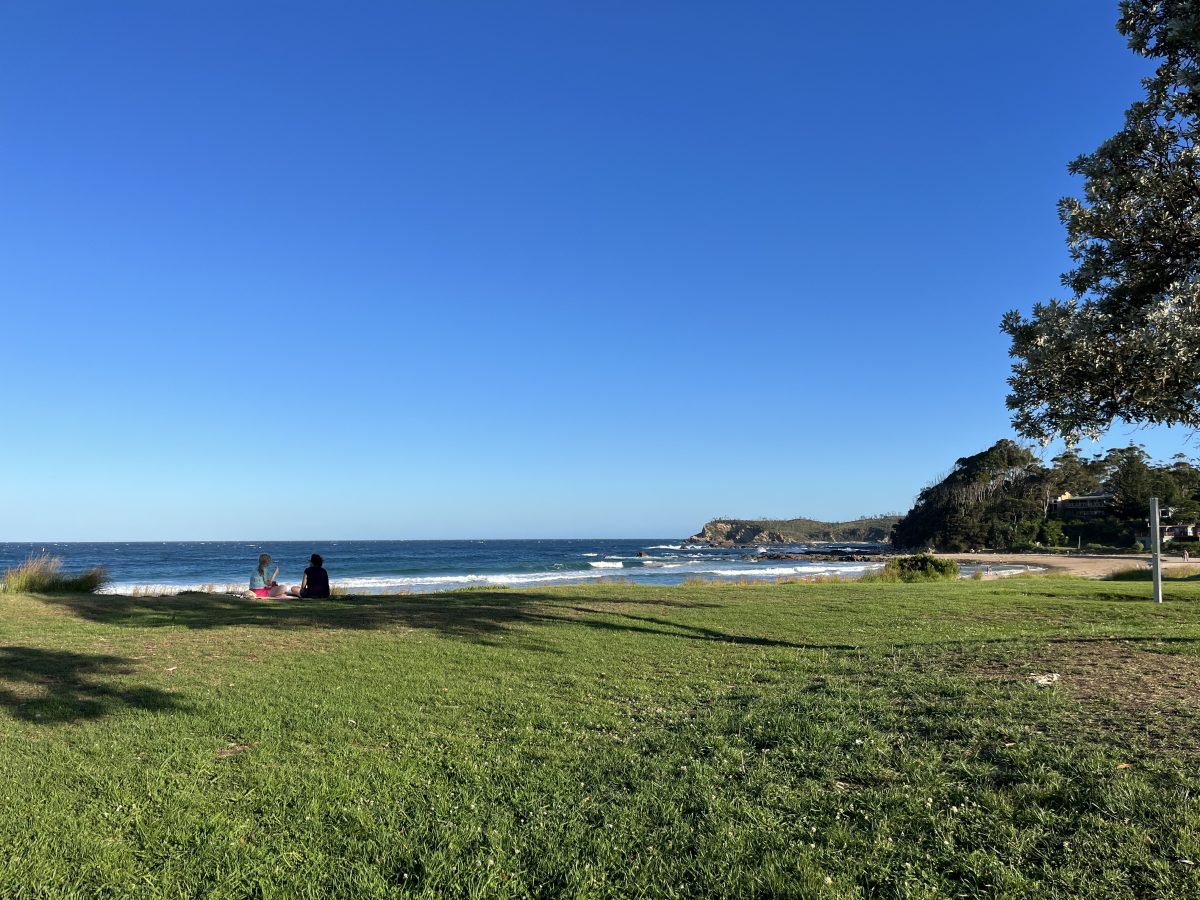
They’re quiet now, but coastal shipping routes in southern NSW were once dominated by one company. Photo: Kim Treasure.
In our modern times, travel to the coast involves jumping into an air-conditioned car with snacks, blankets and mobile phone service.
But in the 19th and early-20th centuries, it was a vastly different story — and it’s one the South Coast History Society has chronicled in its latest booklet.
In the 1850s, the Illawarra Steam Navigation Company was born as three companies amalgamated.
After a restructure in 1904, it would be known as the Illawarra and South Coast Steam Navigation Company (ISCSN Co).
“You were taking your life into your own hands getting on board one of the ships, but you had no choice,” society president Peter Lacey told Region.
For nearly 100 years, it would offer regular services (with the occasional interruption from poor weather) to and from the Illawarra and Far South Coast regions.
“Without it, the South Coast would not have been able to economically develop,” Mr Lacey said.
“Farmers wouldn’t have had any way of getting their produce to market, their cheese or whatever it might be.”
In preparing the group’s booklet, he said, the focus was on creating a general history of the company.
“What we’re not trying to do is be a deep, meaningful history. We tell the story, if you like, to the general public.
“It was set up as a cargo transporting company … Eventually, I think they realised there was money to be made out of passengers.
“They started to get some ships built that had better passenger [facilities], but they were basically a cargo line.”
While some industries had their own ships to transport goods (such as vessels used by timber mills that would ferry their wood to Sydney markets), this was the only regular service in the region.
Mr Lacey said its focus was largely on farmers, which led to it being known as the ‘Pig and Whistle Line’.
“If you went on board most of these ships, you didn’t get a bunk,” he said.
”You could bunk down wherever you could, on the floor of the saloon or on a table in the saloon … But it was the only way of getting anywhere.” (Their research did find a memorable account of a man being told to put his shoes back on after an “immediate outcry” when the smell didn’t please his travelling companions.)

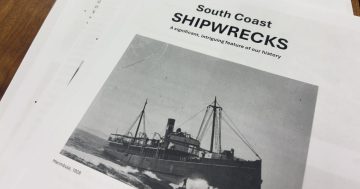
An earlier booklet chronicled the nearly 200 shipwrecks along our section of the coast. Photo: Region.
Mr Lacey said much of the company’s history was fairly well documented, though tracking the individual ships had been a challenge (they often weren’t given specific names).
“There were a couple of books I had a look at that were really textbooks … but a lot of the information is available on the internet, just using things like Trove,” he said.
“They were able to give us some descriptions of people and their experiences with actually being on some of these ships, which were remarkably useful.”
Despite its patronage for almost a century, the ISCSN Co wasn’t to last forever.
The booklet explores how the construction of roads and bridges, and the increased adoption of cars, in the post-World War I era slowed demand.
Mr Lacey believes the new booklet will help spread an understanding of the company’s place in the region.
“Unfortunately, people are not aware of this or have forgotten this,” he said.
“I suppose if you ask most people where tourism started down here, they’d probably immediately think the NRMA.”
He also hinted that further research by the history society into South Coast shipping could be on the horizon.
“That’s the trouble with history — once you start, you go down a rabbit hole,” he said.
“You suddenly find that rabbit hole has all sorts of branches. If you’re not careful, you’ve gone off on some tangent.”
The booklet will officially be launched this weekend at the Bega Show (27 February to 1 March). More information, including the group’s previously released research, can be found on the South Coast History Society Inc website.