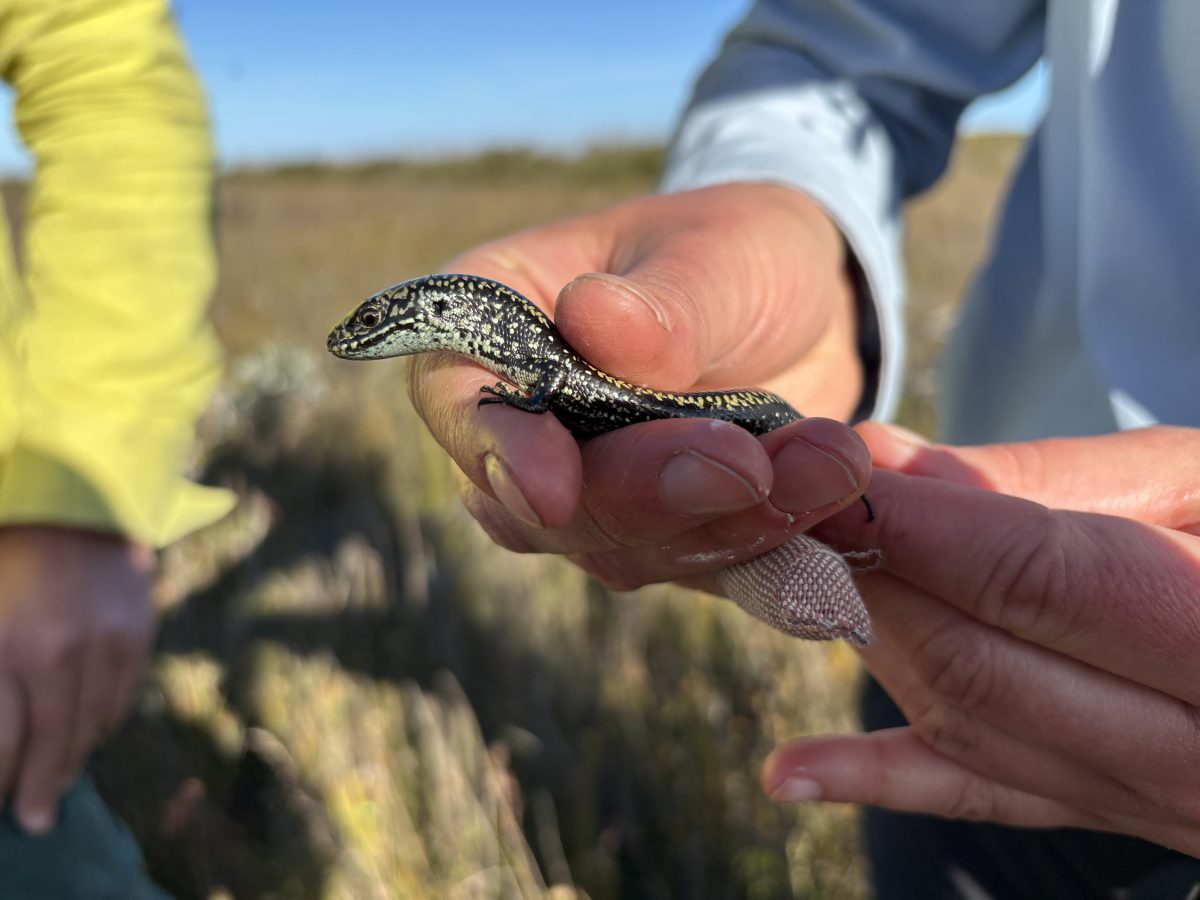
One of the four swamp skinks found south of Bega. Photo: Shannon Kelleher.
A small reptile has been rediscovered in remote southern NSW bushland for the first time since the 1980s.
For Dr Shannon Kelleher, threatened species officer with the NSW Department of Climate Change, Energy, the Environment and Water (DCCEEW), it’s a long-awaited find.
She was part of a four-person survey team exploring Nadgee Nature Reserve, which abuts the NSW-Victorian border.
As part of their search, the ecologists used active searches and deployed baited, white-flash remote camera traps.
While the ecologists had arrived for a three-day search, they found the reptiles on their second day.
“We were walking through some suitable habitat, just looking with our binoculars and our eyes at potential basking spots that were above the thick vegetation,” Dr Kelleher said.
“That’s when my colleague, Andrew Morrison [from NSW National Parks and Wildlife, or NPWS], spotted the first skink basking on a tree stump.”
Finding the reptile in NSW for the first time in decades left a feeling of elation for the team, which also included fellow threatened species officer Dr Bella Contador-Kelsall and NPWS ranger Simon Conaty.
This specific reptile is “notoriously elusive and cryptic”, making finding it a challenge for researchers and conservationists.
But the seeds of their find were planted when the team was looking back through old records and reports of sightings.
“The species has only been previously known in NSW from one historical record, which was in that southern Nadgee area — but that record is quite old,” Dr Kelleher said.
“It had some inaccurate information associated with it … We just had a broad area to focus our search on.”
The swamp skink was classified as endangered in NSW several years ago, and is also known to be present in isolated populations over the Victorian border.
The swamp skink lives in densely vegetated freshwater and saltwater wetlands, swamps and wet heaths, forages within dense, low vegetation and shelters in burrows or beneath fallen timber.
”We initially thought that if we could scout some really good potential habitat for the species and deploy our cameras and try our best to search, that would be a successful trip,” Dr Kelleher said.
“But we honestly couldn’t believe the fact that we actually did manage to find a small group of individuals.”
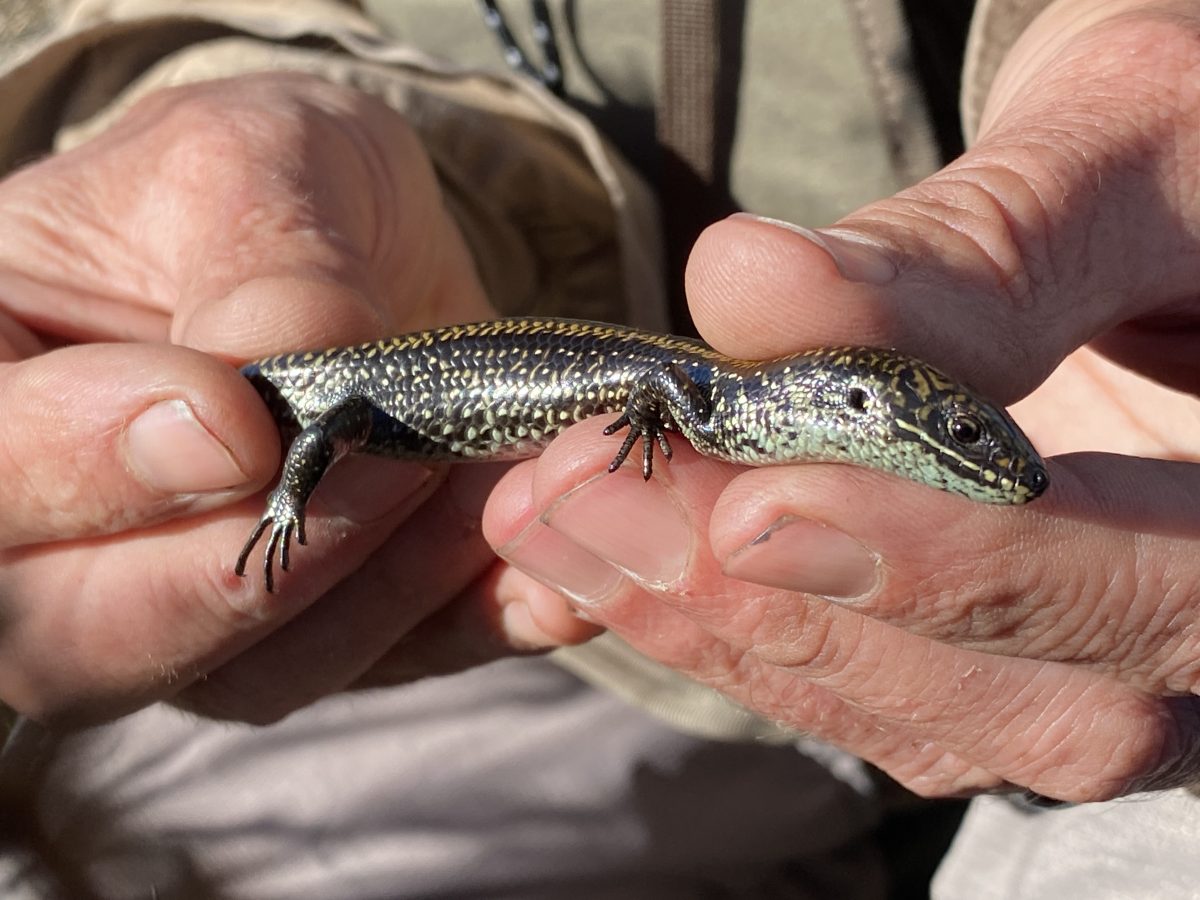
For the team of ecologists, the confirmed swamp skink population gives new hope for the reptile’s future. Photo: Bella Contador-Kelsall.
Dr Kelleher said it wasn’t known whether the four were related (females give birth to between one and four live young), but all seemed to be in the “sub-adult to adult” age range.
The swamp skinks are believed to be aggressive towards each other, making the discovery of a group extra interesting.
“They look really similar in size to kind of a common eastern water skink, which most people probably have seen around their house,” Dr Kelleher said.
“They do vary a lot in their colouration … [and] the way that we can identify them from other species is by a photograph of their head. Often their head scales are quite unique.”
The species varies greatly in colour, ranging from olive green-brown to yellow-brown to dark brown.
It often has copper and black-coloured stripes along its back, pale spots on its legs and a white belly.
Dr Kelleher and the team plan to return to Nadgee Nature Reserve in search of more swamp skinks in the coming months.
They are active between September and May, giving scientists a window of a few months.
“I do suspect there will definitely be more to be seen — potentially they’re more widespread across southern Nadgee than we currently realise,” Dr Kelleher said.
“Hopefully for the species, they’re really thriving in Nadgee. It’s a really remote, undisturbed wilderness area.”
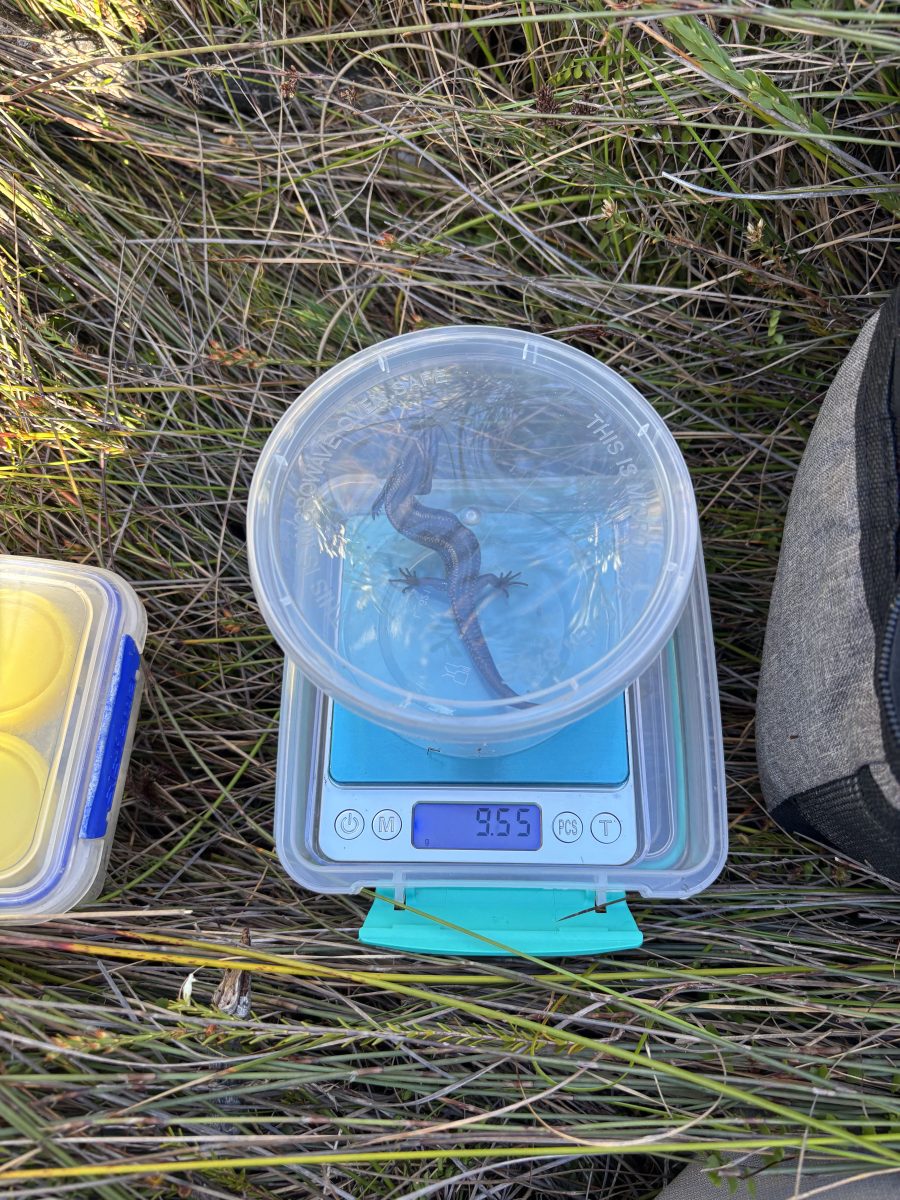
This member of the group came in at only 9.55 grams. Photo: Shannon Kelleher.
During its visit, the team collected morphological measurements (such as the reptiles’ body lengths, tail lengths and weight) and some samples.
But Dr Kelleher said that was just the start, with further surveys to build on a conservation plan as they found more of the population.
“If we find more, we’re going to take some genetic samples,” she said. ”That might give us an indication about how related these individuals are.”