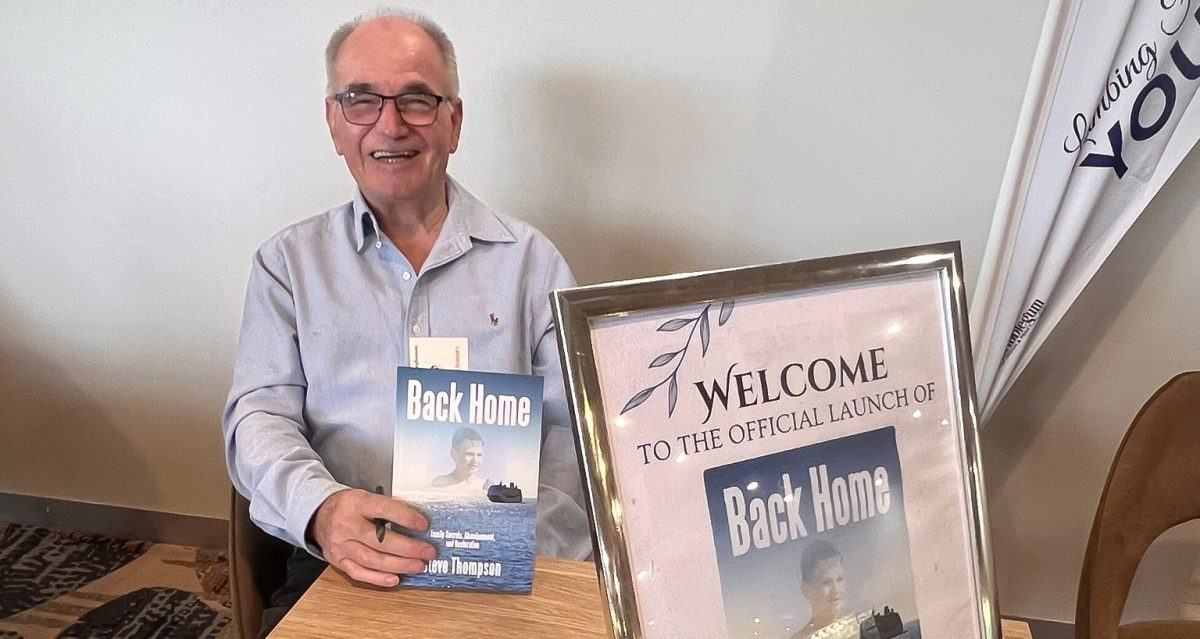
Author Stephen Thompson at Young Services Club for the launch of his memoir Back Home: Secrets, Abandonment and Reconciliation, a story of identity, loss and reconciliation. Photo: Lambing Flat Writers Group Facebook.
When Steve Thompson recently stood before a crowd at Young Services Club to launch his first book, three of his children were in the room – including the two he once feared he had lost forever.
For Steve, a Binalong resident and member of the Lambing Flat Fellowship of Australian Writers’ Group, the publication of Back Home: Secrets, Abandonment and Reconciliation is more than a literary milestone – it’s the culmination of decades of lived experience – painful, confronting and, ultimately, restorative.
“I’ve invested my DNA into that book,” he said. “It’s my creation. I’ll succeed or fail on it.”
The idea of writing began long before retirement, long before Binalong, and even before his years in Canberra. As a young church youth worker in Sydney, unable to find suitable material for stage productions, he began writing his own plays.
What started as necessity became vocation.
“I liked the idea of creating something and then seeing it come to life,” Steve said.
That creative instinct led him to the old studios of Channel Seven, where he introduced himself and asked about work. Two weeks later he was employed, eventually working on the early production of the long-running television series A Country Practice.
“There’s a glamorous side of TV and there’s a not-so-glamorous side,” he said, laughing.
“I was doing construction, production, studio days, location days. But I got really interested in script development.”
It was during those early years that he met respected screenwriter Tony Morphett – a brief introduction that Steve was determined not to waste.
After tracking Morphett down through the phone book he was invited to what he assumed would be a writers’ gathering.
“It turned out to be just me and Tony,” he said. “It was fabulous.”
The conversation became formative. Morphett offered advice that would stay with him for decades.
“Every time you write something, there’ll be people who’ll tell you a better way to write what you’ve already written,” Steve recalled him saying. “They really should be starting with a blank sheet of paper.”
The words would prove their worth years later when he was commissioned to write and stage an Easter production at the Sydney Entertainment Centre.
After submitting his script, he was pressured to dilute elements he believed gave the story its strength.
In a twist of fate, the producer suggested he consult a writer living in the Blue Mountains for guidance – unaware Steve already knew Morphett, who had since moved there.
Their reunion was decisive.
When Steve explained the situation, Morphett’s response was measured but clear: the script was in good hands.
Taking that as quiet affirmation, Steve restored the material he had originally written.
“The stuff I wrote originally was what actually went on stage,” he said. “It was a full house.”
Yet writing remained a strong undercurrent rather than a full-time pursuit, as Steve built a career in transport logistics in Sydney before later running a financial advice practice in Canberra.
He describes his writing habit as “gluttonous” – bursts of intense productivity when inspiration struck, often squeezed into holidays or late nights.
It was personal upheaval, not professional ambition, that ultimately shaped Back Home.
The breakdown of his first marriage marked a devastating chapter of his life. The separation was bitter, and in a decision he still struggles to explain, Steve consented to his children being adopted by their stepfather after his former wife remarried.
“I never came to terms with that,” he said.
Fourteen years later, he reconnected with his children as teenagers in Albury, an emotional reunion that marked the beginning of a slow rebuilding.
Soon after, Steve was shaken by another revelation – the man he had always believed was his father was not his biological parent.
His investigation into his origins uncovered a confronting truth: an affair, attempts to terminate the pregnancy and long-held family secrets.
“When that came in, it was like a wrecking ball,” he said. “You want to know who you are, even if the story’s messy.”
And there’s the incident his life has carried long after his memory of it vanished.
Steve was born in England and brought to Australia as a six-month-old.
At five, he was struck by a speeding van while walking to school, suffering a brain injury that left him unconscious in Wollongong Hospital for two weeks and erased all memory of his early childhood.
“I don’t remember anything from before the day I woke up in hospital,” he said. “All that’s gone.”
Encouraged years ago by a mentor to share his story, he eventually began turning those experiences into a memoir.
Here, Steve found the threads that would hold the book together: identity, abandonment, and reconciliation.
“If I can turn the negative into a positive and use it to help other people, it’s no longer just a painful memory,” he said.
One unexpected confirmation came from a stranger who purchased the book online.
A nurse who later travelled to Ukraine wrote to him repeatedly, saying passages about perseverance had strengthened her during frightening moments abroad.
“That’s the sort of feedback that I need,” he said.
Joining the Lambing Flat Fellowship of Australian Writers’ group provided the final push to publish, with the monthly meetings fostering accountability.
“If I said I was going to do something and turned up the next month having not done it, I’d lose credibility,” he said, “so I put a date on it and just published.”
The launch itself was a full-circle moment, bringing his children from his first marriage face-to-face with the story he had finally shared.
“They said, ‘We didn’t know anything about you until you turned up at our place for the reunion,’” he said. “Now they want to talk about what happens between the lines.”
The title Back Home carries layered meaning.
As a child of British migrants, he grew up hearing relatives speak longingly about “back home”.
Later, the phrase took on more personal resonance – a return to identity, to truth and to connection with his children.
Now retired and working casually at Bunnings in Young, Steve is planning a trilogy.
The next instalments will move into fiction, drawing on experiences that memoir cannot fully contain.
“I feel like I’m going into another career,” he said. “I don’t know how far it will go.”
For a man whose life has been marked by fracture and restoration, writing has become both reckoning and repair.
The circle is still turning – but this time, he’s steering it.
Back Home: Secrets, Abandonment and Reconciliation is available broadly online and also through his publisher Balboa Press.