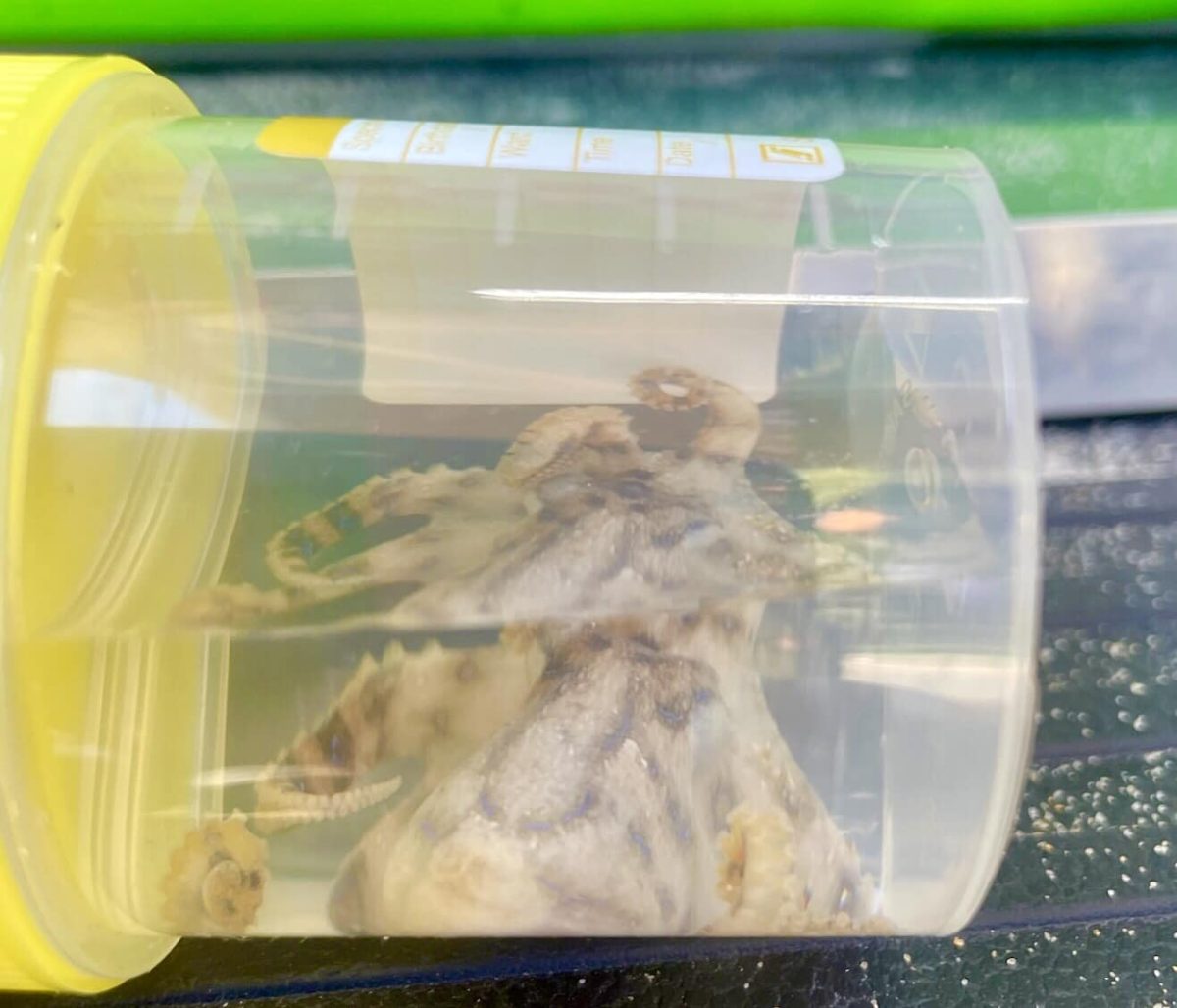
NSW paramedics have dealt with bites from blue-ringed octopus before, such as this culprit from Sydney. Photo: NSW Ambulance/Facebook.
Beachgoers are being urged to remember there are other critters that call our oceans home after a South Coast man was airlifted to hospital following an octopus bite.
The Australian Museum describes blue-ringed octopuses as being “among the most dangerous animals in the sea”, with several species being found in Australian waters.
NSW Ambulance paramedics were called on Sunday (4 January), after reports a man in his 40s had come into contact with one at a South Coast beach.
“We did treat someone for a reported blue-ringed octopus envenomation, and that was at Burrill Lake off Dolphin Point Road,” they told Region.
“We were called there at about midday … We responded with multiple paramedic crews, including intensive care paramedics, as well as a medical team on board the Toll Ambulance Rescue Helicopter.”
The man was airlifted to Wollongong Hospital.
For Associate Professor Zoe Doubleday, the poisoning was a reminder that humans share the water with other creatures.
“They’re often found in intertidal zones … Octopus have dens,” the marine ecologist said.
“They have little nests [in] crooks and crannies. It could be a shell or a seawall where there’s rocks – or a bottle or can where the octopus can go inside.”
She said blue-ringed octopuses didn’t migrate (and babies tended to stay near their parents), meaning there could be fairly localised populations around Australia.
“Bites are rare and hospitalisations are even rarer, but they are very toxic.”
Saskia Ugarte-Carral is the event safety and medical operations coordinator with Surf Life Saving Services at Surf Life Saving NSW.
Ms Ugarte-Carral said people should avoid “putting their hands in little crevices”, as that could make marine life feel threatened – and it was the same for octopus.
“When you swim, you look for the red and yellow flags and swim there, instead of jumping into a rip.
“When you are in a rock pool, for example, don’t pick up shells or put them in your pocket. Don’t poke around in small spaces.”
If people suspect they’d been bitten by a blue-ringed octopus, they should seek medical advice immediately.
Associate Professor Doubleday warns that their bites need to be taken seriously.
In her article for The Conversation, she described the tetrodotoxin in their venom as being more than a thousand times more toxic to humans than cyanide.
People should treat a suspected bite similar to a snakebite – meaning they apply pressure, bandage it and immobilise the affected area.
“They won’t have their characteristic bright blue rings or lines until they’re angry … Everyone’s surprised at how small they are.
“Some people might just get tingling. If you get a serious case, you can get respiratory paralysis, or the inability to breathe.”
The suspected octopus bite wasn’t the only recent incident on South Coast beaches in recent days, with emergency services also called to Murramarang National Park.
The NSW Ambulance spokesperson said paramedics arrived at Pebbly Beach (about 20 minutes from Batemans Bay) shortly after 12:30 pm on Monday afternoon (5 January).
“[There were] reports of a child who was hit by a wave in the surf and pulled from the water. We treated him after a brief submersion.”
The primary school-aged boy was treated at the scene before being flown to Sydney Children’s Hospital in Randwick.