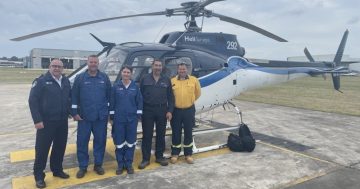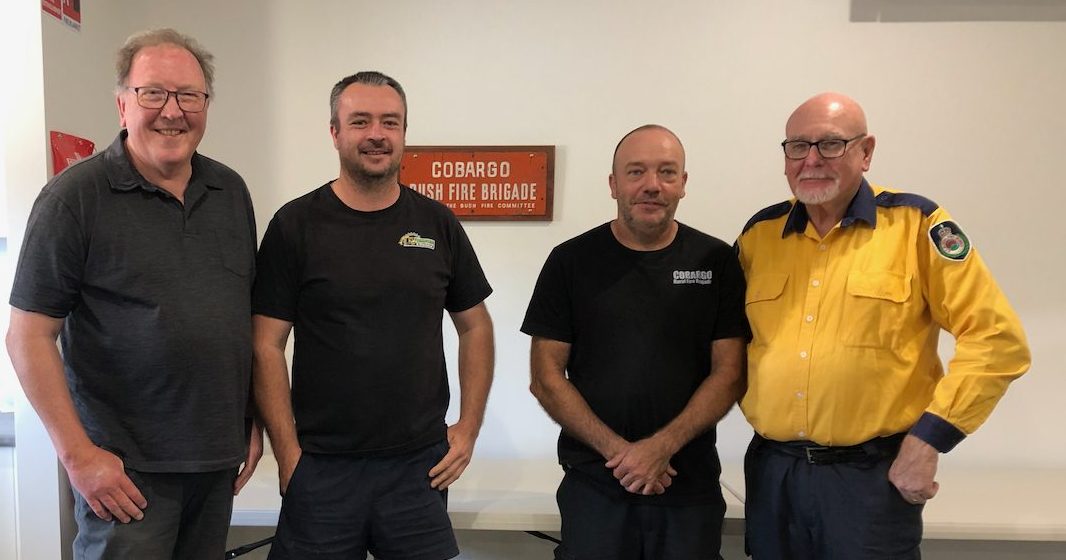
Member for Bega Dr Michael Holland with Cobargo RFS captain Max Niemeier, senior deputy captain Roger Park and president John Walters. Photo: Marion Williams.
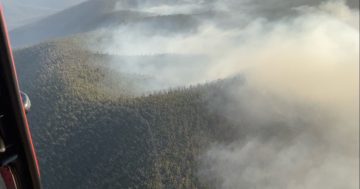
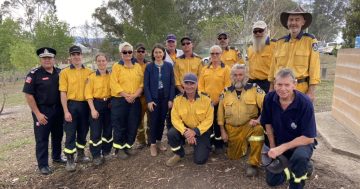
Cobargo RFS has reassured residents that crews are very well resourced to manage the bushfire currently burning in Wadbilliga National Park near Yowrie.
Member for Bega Michael Holland visited the Cobargo RFS station on Friday (9 January) to be briefed on the situation.
He had been told that people were pulling up at petrol stations in Bermagui on Thursday to ask where the evacuation centres were and to fill up their cars with petrol.
Bega Valley Shire Councillor Tony Allen had told him there was a lot of chatter on social media about the bushfire as well.
Dr Holland said the NSW Emergency Services Minister Jihad Dib was in contact with the RFS Commissioner and the Federal Emergency Management Minister Kristy McBain.
Cobargo RFS president John Walters said seven helicopters were currently deployed.
“We know there are a lot of eyeballs on this,” he said. “Six years ago the weather conditions were 10 times worse.”
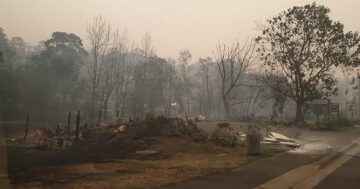
That was during the 2019/20 Black Summer bushfires when much of Australia’s east coast was on fire, stretching RFS resources.
Cobargo RFS Captain Max Niemeier said the bushfire was started by dry lightning on Sunday (4 January) and was detected by Forestry on Wednesday (7 January) afternoon.
Initially National Parks and Wildlife Service (NPWS) was the control authority. The RFS became the control authority on Thursday night, allowing access to more resources.
Mr Niemeier wanted to reassure people about the reliability of the Hazards Near Me app.
“If it hasn’t been regularly updated that doesn’t mean any more than it isn’t giving the authorities concern,” Mr Niemeier said.
“The RFS gets access to a lot of data and other special information, but I personally quite happily trust Hazards Near Me.”
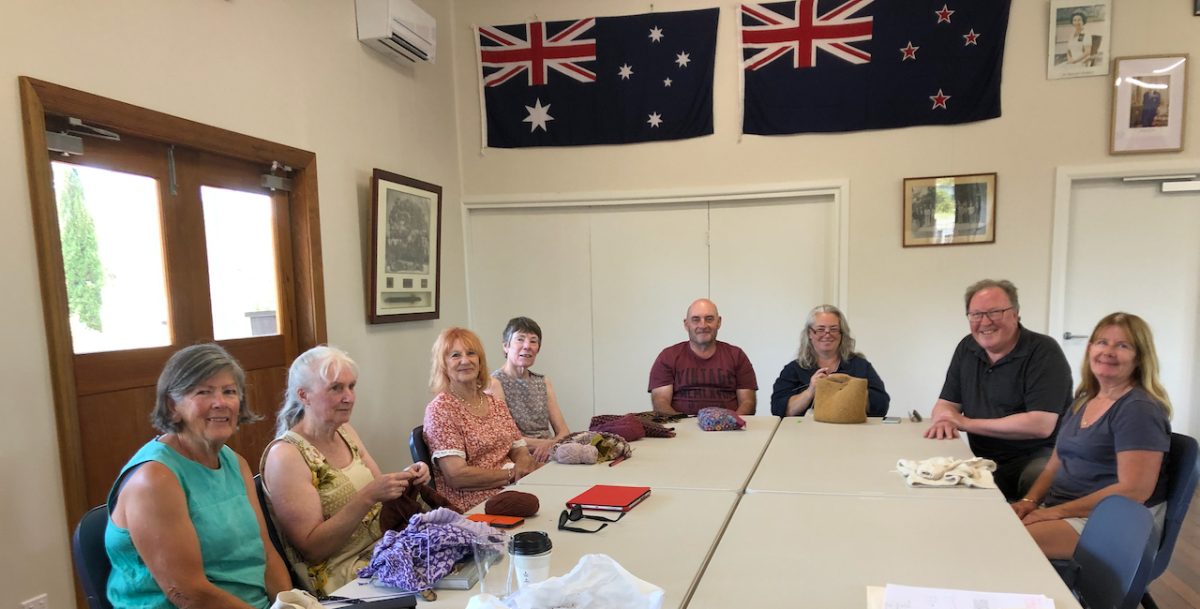
While in Cobargo Dr Holland dropped by the Cobargo Fibre Friends. Photo: Marion Williams.
On Friday afternoon the fire was about 20 km north-west of Cobargo on the border of Bega Valley and Eurobodalla shires.
It is in inaccessible terrain and the RFS is currently applying water by helicopter drops as the location is too remote and hazardous to attack using ground resources, either crewed fire trucks or RAFT (Remote Area Fire Fighters) on foot.
Mr Neimeier said the alert level may move from advice to watch and act on Saturday (10 January) when the temperature is forecast to reach 39 and the north-westerly winds to strengthen to between 25 and 40 km/hour before a southerly change arrives early in the afternoon.
There is a huge screen in the Cobargo RFS station connected to the control centre in Bega and the RFS operations centre in Sydney.
It receives photos taken by the helicopter crew, identifies the path of the fire, the location of houses, the location of helicopters and other fire-fighting equipment, helipads, sources of water and the location of equipment like bulldozers and graders that will be used to build containment lines.
They also have calculators that can estimate how fast the fire will spread when fed information such as the temperature, terrain, wind speed and direction. It can make those calculations for five different types of terrain, including grass, heath, scrub and forest and also predicts the height of the flames.
Mr Niemeier said the RFS would likely start working on the containment lines with ground crews and fire trucks on Sunday.
The RFS has issued a Total Fire Ban for the Far South Coast, Monaro Alpine, Southern Ranges, Central Ranges, Southern Slopes, Illawarra/Shoalhaven, Greater Hunter and Greater Sydney for Saturday due to forecast hot, dry and windy conditions.
Cobargo RFS senior deputy captain Roger Park said the fire area was burnt during the Black Summer bushfires and the trees only have leaves up to 1 to 2 metres high. So, although the fire will run, he said it would not throw out embers because most of the trees have no crowns.
Mr Niemeier said people should revisit their bushfire survival plans and if they plan to leave, they should leave early.
By Friday afternoon the fire had burnt through 136 hectares and was being controlled.