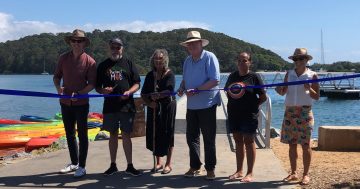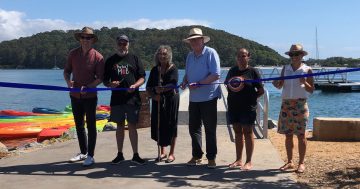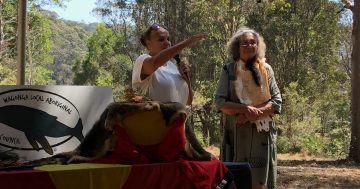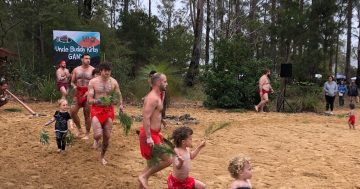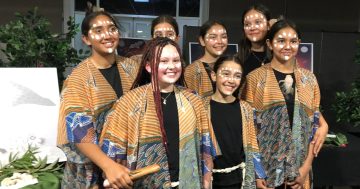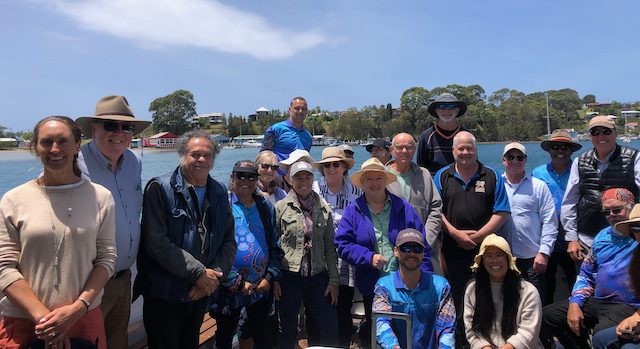
Some of the guests and speakers on a cultural tour on Wagonga Inlet. Photos: Marion Williams.
Truth-telling and breaking down barriers were at the heart of a special cultural tour on Narooma’s Wagonga Inlet.
Traditional owners and elders told a hand-picked group of people about their parents’ struggles for human rights before the 1967 referendum, their own experiences of racism, and how their people still suffered due to the shortcomings and failures of government and institutional policies.
Among the guests on the boat cruise on 15 December were Member for Bega Dr Michael Holland and Eurobodalla Shire Council general manager Mark Ferguson.
The tour was grant funded and was filmed to provide Aboriginal content for the new Powerhouse Museum under construction in Parramatta.
Among the speakers were Uncle BJ Cruse. A political activist since the age of 16, Uncle BJ has chaired Eden Local Aboriginal Land Council for 41 years.
Uncle Stan Jarrett and his wife Aunty Gwenda Jarrett travelled from Gerringong to speak.
Uncle Stan has worked in the justice system for the past 37 years. He helps Aboriginal offenders in the South Coast Correctional Centre get back on track by reconnecting them with their culture. He is someone they can come to after they are released.
Aunty Gwenda worked in the health system for more than 20 years. She spoke about the continued harsh treatment of Aboriginal women in the health system.
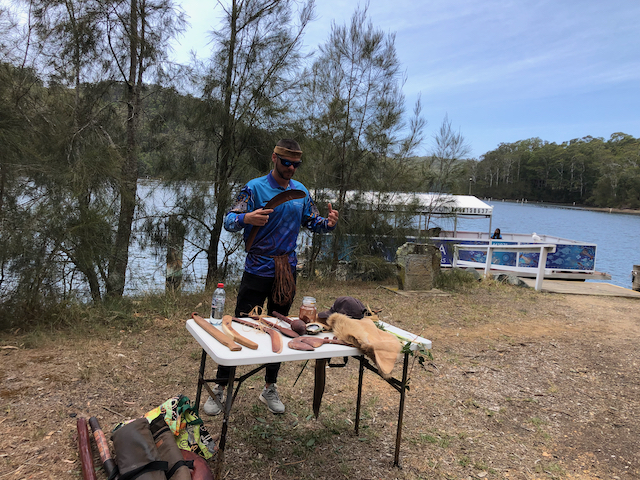
Brock Tutt talks about boomerangs, clubs and woomeras.
Traditional owner and founder of Joonga Land and Water Aboriginal Corporation (Joonga) Wally Stewart led the tour.
He talked about early activists such as Jack Patten who co-founded the Aboriginal Progressive Association in 1937 and led some of the first Aboriginal protests including the Day of Mourning in 1938.
“That marked the loss of connection to family and Country and customs,” Mr Stewart said. “Colonisation really separated us from what we did for thousands and thousands of years. The level of trauma from that disconnection was so high it is passed onto us as intergenerational trauma.”
In 1957 when Aboriginal people were not allowed to live in the town, Mr Stewart’s parents bought a house in Narooma. People started a petition to force them out. His mother had to go to the police station to get an exemption certificate so she could walk around town and shop. These were called ‘dog tags’.
Although Wagonga Inlet remains a very healthy waterway, Mr Stewart said colonisation had changed it. Dredging channels and building rock walls had damaged the ecosystem, and the cockles and the native angasi oysters he had gathered as a kid as part of their healthy diet and lifestyle, had disappeared.
He pointed out midden sites. They are like books, with the layers recording what was happening and what food was around. They were also used as burial grounds because people are buried near the water facing the ocean to ease their spirit’s journey.
He said there were 20 on the inlet, however when there were shortages of lime for building in Sydney the old oyster shells on the midden sites were used.
“So, when they used our middens in their buildings they contained bones,” Mr Stewart said.
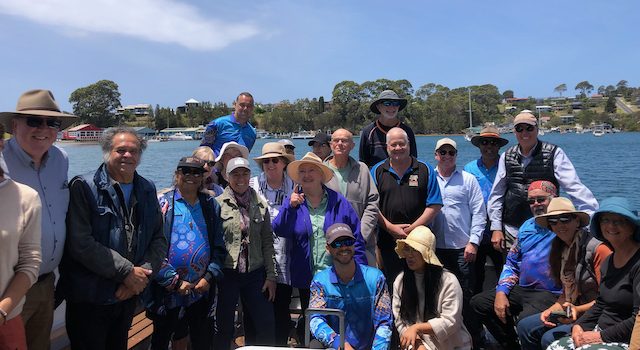
Some of the guests and speakers on a cultural tour on Wagonga Inlet.
People disembarked at Punktebella where Brock Tutt talked about boomerangs and clubs used for hunting, and fishing techniques including crushing soap bush leaves to temporarily stun fish by removing oxygen from rock pools.
He talked about the bush glue they make from the resin of the tea tree xanthorrhoea resinosa. They use it to attach spear heads and to waterproof canoes.
Mr Tutt has travelled around Australia and to Mongolia, Hawaii and New Zealand playing the didgeridoo. He has been playing the instrument since he was about seven and explained how they use circular breathing and flick their tongue to play it.
They were originally called yidaki, but Charles Darwin called them didgeridoos when he heard someone playing it in Arnhem Land.
One person asked what a good future for Country looked like.
Uncle BJ said the environmental problems that existed today were due to the separation of Aboriginal people from the land and the adoption of foreign practices “so give us greater participation in the management of land”.
Traditional owner Rob Chewying, a cultural fishing advocate and a director of Joonga, said science and university research was based on European knowledge. “They haven’t introduced Indigenous knowledge into that space,” he said. “That would dramatically add value.”
Mr Stewart said truth-telling was essential for a good future for Country.
“You have to talk the truth to get people to understand and be on the same page so we can move forward together,” Mr Stewart said.