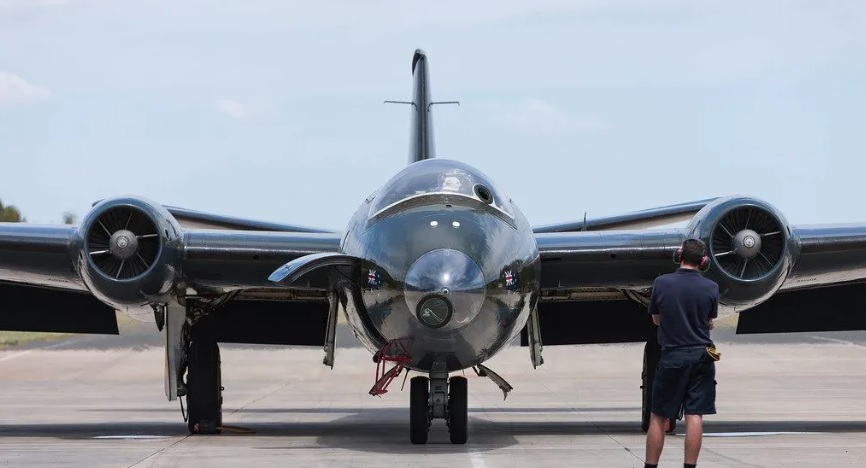
The English Electric Canberra TT.18 was recently restored to flight at Temora after years on the ground. Photo: Temora Aviation Museum.
The Royal Australian Air Force’s recent overhaul of its heritage fleet will see five historic aircraft return to Temora Aviation Museum, marking a major shift for the Riverina institution that has long celebrated Australia’s aviation history through static and flying displays.
Following a comprehensive review of technical and airworthiness factors, the RAAF announced last week it has decided to withdraw eight of its 19 heritage aircraft from flying service to keep No. 100 Squadron safe, sustainable and connected to Air Force history.
No. 100 Squadron – reformed in 2019 as the Air Force Heritage Squadron – is the RAAF’s heritage and ceremonial flying unit, responsible for preserving and operating Australia’s historic aircraft for ceremonial events, airshows and public displays.
The withdrawn aircraft are the DH-115 Vampire T.35, Gloster Meteor F.8, Cessna A-37B Dragonfly, Ryan STM-S2, English Electric Canberra, CA-27 Sabre, CT4A and RE8.
Of those, five – the Vampire, Dragonfly, Meteor, Ryan STM-S2 and Canberra – were originally part of the Temora Aviation Museum’s collection and will be handed back, while the remaining three – Sabre, CT4A and RE8 – are slated for static display at approved institutions.
Some of the planes were based at Temora under this squadron, with museum pilots inducted as RAAF reservists, allowing the public to see them fly while maintaining Air Force safety and airworthiness standards.
RAAF leadership has framed the withdrawal as a balance between heritage and safety.
Air Force Chief Air Marshall Stephen Chappell said withdrawing aircraft was never easy but necessary to preserve aviation history responsibly.
He stated that older airframes were increasingly complex and costly to maintain, especially in flying condition, and that streamlining the fleet allowed the heritage squadron to focus on a core group of aircraft for ceremonial duties and flying displays.
The RAAF will continue to operate 11 heritage aircraft including the Mustang, Harvard, Winjeel, two Tiger Moths, Sopwith Pup, Hudson, Spitfire Mk8, Spitfire Mk16, Boomerang and Wirraway.
Heritage fleet operations will be reviewed again over the next 12 months to ensure sustainability and continued public engagement.
For Temora Aviation Museum CEO Peter Harper, the return of the aircraft represents both the end of a unique partnership and the beginning of an internal reassessment of the museum’s future.
“The museum has always been a flying museum, not just static displays,” Mr Harper said.
He traced the journey back to the early days of the museum – established 25 years ago by Sydney businessman David Lowy – when aircraft were personally purchased and donated to the collection.
In 2019, 11 of the aircraft were formally gifted to the RAAF so they could be flown under the Air Force’s heritage program.
“Our goal was to see these aircraft in the air, in front of as many Australians as possible. Partnering with the Air Force seemed like the way to achieve that,” Mr Harper said.
Over the subsequent six years, museum pilots were inducted into the RAAF Reserve, and the aircraft continued to be based in Temora, maintained by museum staff but operated under the RAAF’s airworthiness system.
For the RAAF though, he said operating historic aircraft, some more than 70 years old, proved inherently challenging.
“Flying historic aircraft is not the RAAF’s core responsibility,” Mr Harper said.
Mr Harper stressed that the immediate priority was receiving the aircraft and integrating them back into the museum’s collection.
“They will initially be accepted as static display items,” he said. “Keeping them on display is vital because they are central to the museum’s value proposition.”
Questions about whether any of the returned aircraft might fly again remain open.
“It’s too early to say. Part of our internal review will look at whether there’s a way for these aircraft to fly in front of Australians again,” he said. “Most things can be achieved with time and money, but right now we don’t have that avenue.”
Space and logistics are not the primary concern – the aircraft have always been visible at Temora, even while part of the RAAF program – but sustainable flying operations are a more complex challenge.
“This is a significant change to what we thought our future would be,” Mr Harper said.
“We have received some enquiry in respect to the possibility of any aircraft returning to flight; it would be premature for me to comment at this time,” he said. “That question forms part of longer-term considerations which are yet to be assessed.
“Once there is greater clarity regarding the future status of the aircraft being returned to the collection, we will communicate updates through the appropriate channels.”
The returning aircraft are among the most evocative in Australian aviation history.
The English Electric Canberra for example, is one of the few Canberra bombers still airworthy and was recently restored to flight at Temora after years on the ground.
“The Canberra bomber is the only flying example of its type in the world,” Mr Harper said.
Vintage jets such as the Gloster Meteor and DH-115 Vampire also resonate deeply with enthusiasts and the public alike, and seeing them fly has long been a highlight of the museum’s program.
Looking ahead, Temora Aviation Museum has a full calendar for 2026, including two showcases in May and September and a Warbirds Down Under Airshow returning to the calendar for the first time since 2024.