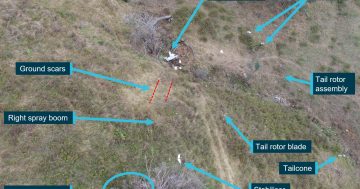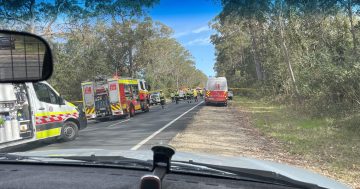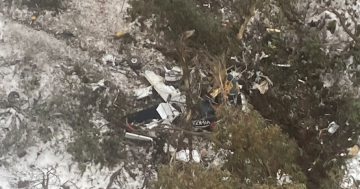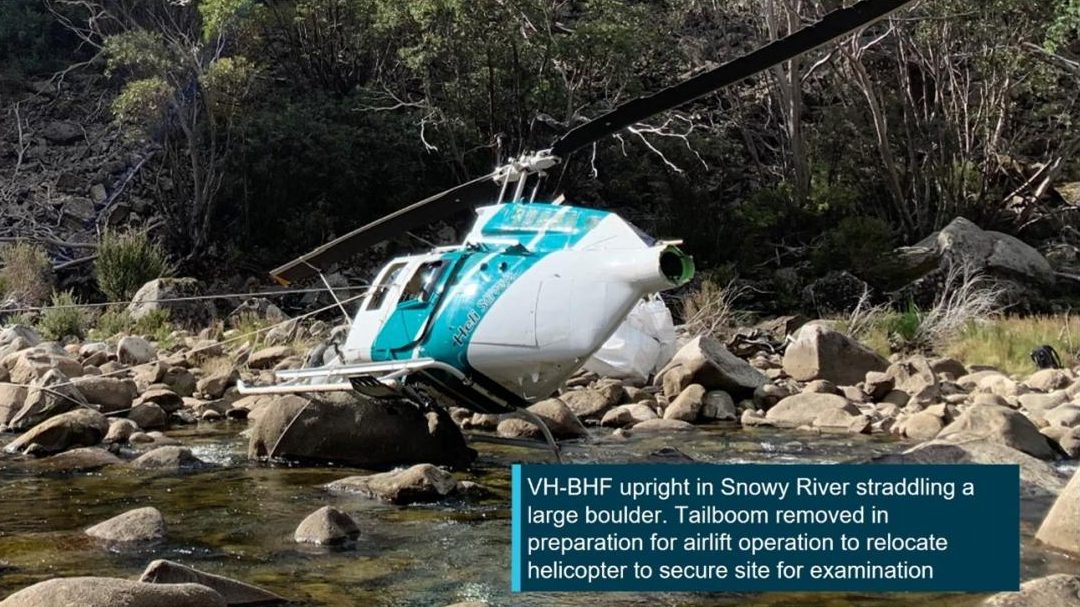
The helicopter crashed in Kosciuszko National Park less than an hour after takeoff. Photo: Australian Transport and Safety Bureau.
A helicopter’s tail rotor contributed to a crash in Kosciuszko National Park, the regulator’s report on the incident has found, which also raised two safety issues.
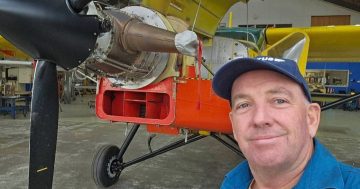
The Bell Helicopter Company B206L-1 helicopter was registered VH-BHF and operated by Heli Surveys Pty Ltd.
It left Jindabyne’s aerodrome at about 10:50 am on 11 March 2022 and crashed while completing a weed survey task on behalf of the NSW National Parks and Wildlife Service (NPWS).
The pilot (who held a valid licence and had experience in flying in mountain areas and at low altitudes) was joined by four NPWS officers for the flight.
During the survey, the helicopter was flying at a low height over the Snowy River’s southern riverbank (about 20 km north of Jindabyne) when it experienced an uncommanded yaw (or tilt) to the right.
The pilot was able to stop the yaw, and made an emergency landing in the river, during which it struck a large, unsighted boulder.
The impact destroyed the helicopter and three of the occupants received serious injuries. Two had minor injuries.
Following the crash, the Australian Transport and Safety Bureau (ATSB) launched an investigation, with its final report flagging several safety risks.
ATSB Director Transport Safety Kerri Hughes said a risk assessment for the flight didn’t consider the hazard and control measures needed to avoid a loss of tail rotor effectiveness.
A loss of tail rotor effectiveness can occur when the airflow through a helicopter’s tail rotor is changed.
“The investigation found that the combination of low-level, slow speed flight while yawed to the right by about 45 degrees, and operating at a high gross weight and density altitude, were conducive to a loss of tail rotor effectiveness,” she said.
“As such, it was likely that a loss of tail rotor effectiveness occurred at an insufficient height to recover and avoid a collision with terrain.”
The report states there was no evidence of a pre-existing mechanical issue.
The investigation also raised concerns with how risks were evaluated and managed.
“The ATSB also identified that the operator’s risk assessment for low-level operations did not contain the hazard and control measures to avoid the likelihood of loss of tail rotor effectiveness,” she said.
“Further, there was no requirement for its pilots to conduct pre-flight risk reviews to ensure that operations could be conducted without unacceptable safety risk.”
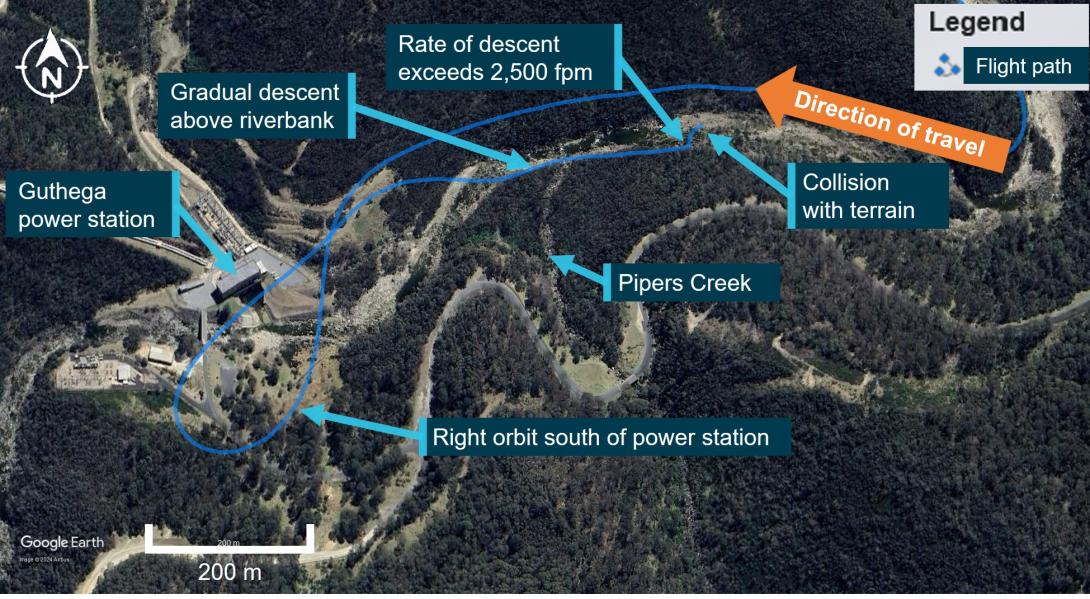
The report found the tail rotor effectiveness likely failed at a height of about 150 feet above ground level, which the pilot couldn’t recover from. Photo: Australian Transport and Safety Bureau.
The investigation also found that one of the NPWS officers on board was “very likely” not required for the survey.
ATSB’s report notes that a definition of ‘essential personnel’ wasn’t given by NPWS, which risked unnecessarily exposing people to potential harm.
“The additional person’s presence appeared to be motivated by opportunity, and while it was acknowledged that they could contribute as a survey team member, their involvement was not essential to a successful task outcome,” the document states.
“Given the nature of the task and the operating conditions under which it was being conducted, the inclusion of personnel who were not essential to fulfilling the task outcomes exposed them to the risks of low-level helicopter flight and, in the event of an accident or incident, potential injury. ”
The ATSB report notes that, in the years since the crash, the parties involved have made improvements to safety procedures in key aspects.
Heli Surveys has reviewed its risk management processes, adding mitigation measures for a tail rotor effectiveness issue into its risk assessment process.
Pilots must also now complete pre- and post-flight risk reviews before carrying out low-level survey operations.
Heli Surveys and the NPWS have changed their policies to clarify who is classed as essential personnel and their eligibility for people joining their flights.
“Once completely implemented, these measures will ensure that only essential personnel, with defined roles and responsibilities, are involved in aerial work activities,” the report states.
“The ATSB is satisfied that these changes will reduce the risk associated with this safety issue.”
Both safety issues were judged to be “adequately addressed” by the aviation safety regulator.
Ms Hughes said the crash emphasised the importance of planning and preparation before a flight.
“Survey flights, particularly when performed in alpine environments, are generally conducted at low level and slow speeds,” she said.
“This creates a high-risk operating environment that requires effective risk management.”
Both safety issues were judged to be “adequately addressed” by the regulator.