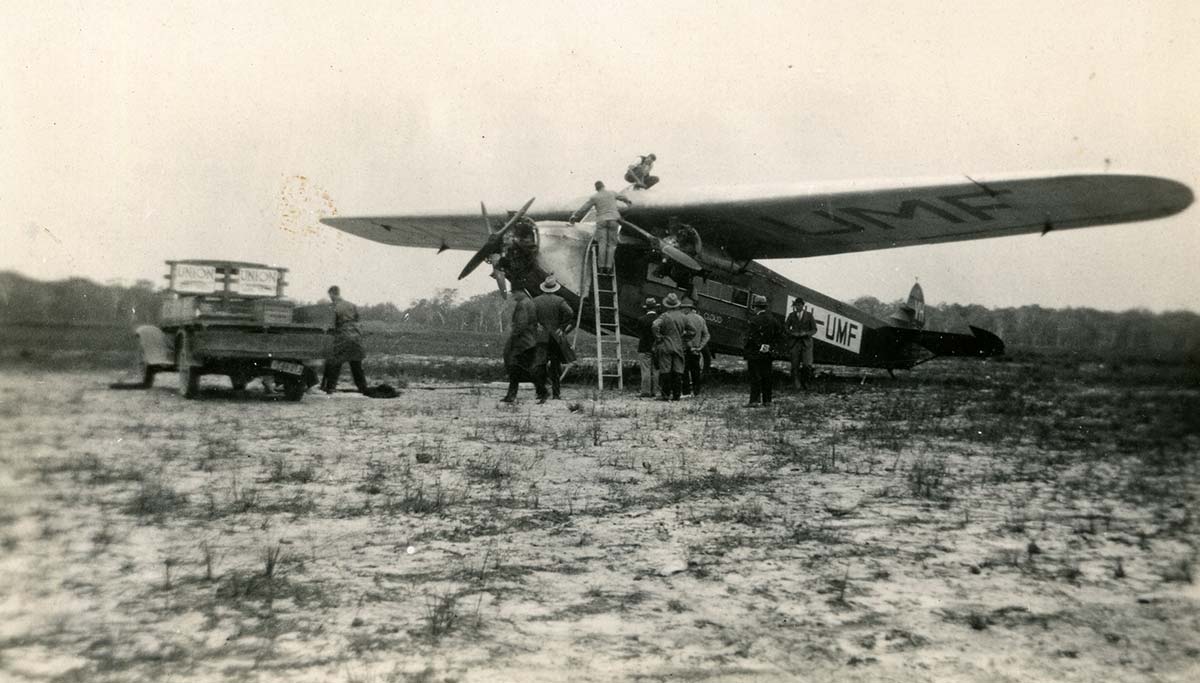
Southern Cloud, Coffs Harbour, 1930. Photo: National Museum Australia.
Tom Sonter wasn’t looking for history when he set out for a bushwalk in the Snowy Mountains in 1958.
A young carpenter working on the Snowy Mountains Hydro-Electric Scheme, he was spending a day off near a place locals called “World’s End” when a glint of metal caught his eye – and with it, the end of a mystery that had gripped Australia for nearly three decades.
This month, as Cooma prepares to mark the 95th anniversary of the Southern Cloud disaster, Sonter will stand at the memorial as the final living link to that discovery – and to the tragedy that reshaped Australian aviation.
The story he uncovered began on 21 March, 1931.
The Southern Cloud, an Avro X trimotor aircraft operated by Australian National Airways, departed Sydney’s Mascot Aerodrome at 8:10 am bound for Melbourne.
On board were eight people: Captain Travis Shortridge, a decorated Great War pilot; flight engineer Charles Dunell; and six passengers travelling for business, family and opportunity.
Among them was William “Bill” O’Reilly, a rising Sydney accountant and son of a prominent Cobargo stock and station agent and Clyde Hood, an American theatre producer for Union Theatres, who was flying to Melbourne to reunite with his wife, singer and actress Bertha Riccardo.
Julian Margules was a successful electrical engineer and partner in the firm Margules and Hickman, while Hubert Farrall was a Melbourne businessman returning from a trip to Sydney. The flight also carried Elsie “May” Glasgow, a domestic worker returning home after a holiday with her sister, and Clara “Claire” Stokes, a 25-year-old artist from Rose Bay.
For its era, the Avro X symbolised the promise of commercial aviation. Yet by modern standards it was primitive. Passengers sat in wicker chairs. The aircraft carried no radio. Pilots relied on visual navigation and basic instruments, with no ability to receive updated weather information or send a distress signal.
For a weather forecast that day, Shortridge had relied on that day’s Sydney Morning Herald, which had compiled its weather report the night prior.
After departure, the Southern Cloud encountered weather conditions that were much worse than predicted.
When the aircraft failed to arrive at Melbourne’s Essendon Airport for its scheduled 12:30 pm landing, the alarm was raised.
What followed was one of the largest search operations the country had seen with more than 20 aircraft and around 1000 ground volunteers scouring 100,000 square miles, stretching from the Blue Mountains to Bass Strait.
Despite the scale of the effort, no trace of the aircraft was found.
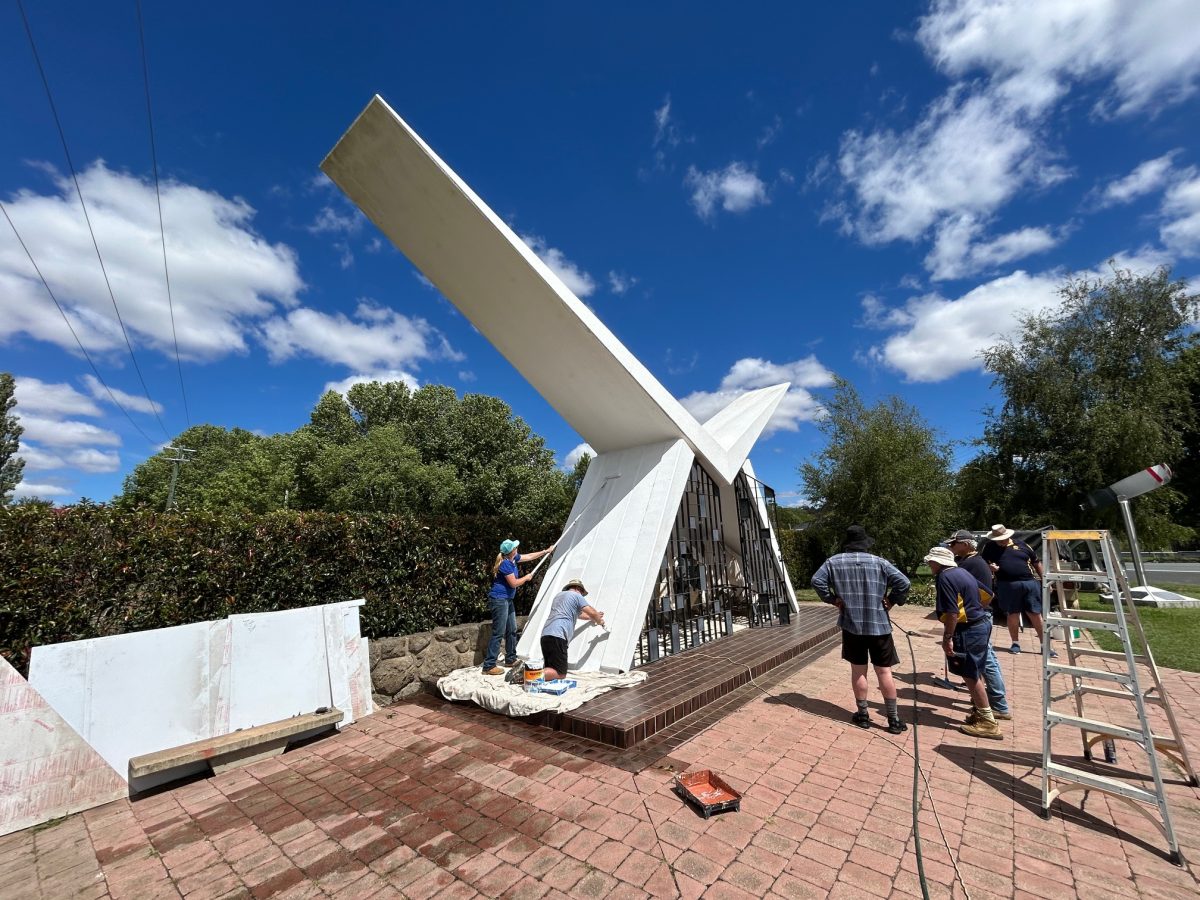
Members of the Cooma Lions Club have been working to ensure the Southern Cloud Memorial in Cooma is in tip-top shape for the 95th anniversary. Photo: Cooma Lions Club Facebook.
In the Monaro and Snowy regions, the disappearance became part of local folklore.
Around Tintaldra, residents reported hearing an explosion and seeing flashes of light in the mountains that night, but their accounts were dismissed as being too far off the assumed flight path.
Newspapers speculated for years about the plane’s fate – the “Missing Cloud” became one of Australia’s most enduring aviation mysteries.
The silence lasted 27 years.
In 1958, bushwalking near the Tooma River Gorge, Sonter noticed a small piece of metal protruding through saplings in the dense forest.
As he pushed further into the rugged terrain, he uncovered the skeletal remains of the aircraft.
Among the debris were personal artifacts, including a gold key ring and a pocket watch that had stopped at 1:15 pm – believed to mark the moment of impact.
The wreckage lay about 25 kilometres off the intended flight path.
Investigators later concluded that strong winds and poor visibility had forced it into the mountainside.
Authorities documented the site, though in the early days hundreds of visitors made the difficult journey in, some removing souvenirs.
Over time, key artifacts – including the aircraft clock – were preserved at the National Museum of Australia.
Memorials have been established to ensure the story of the Southern Cloud is remembered with dignity.
The simplest and most significant stands at the crash site itself, accessible only by foot.
For a broader perspective, the Southern Cloud Memorial Scenic Lookout south of Tumbarumba offers sweeping views of the Tooma Valley and the rugged terrain where the aircraft came down.
In Cooma, a monument at the local cemetery marks the final resting place of the remains recovered in 1958, while salvaged parts of the aircraft, including the engine casing, have been assembled into a striking memorial designed to resemble an aircraft wing at the corner of Sharp and Boundary streets.
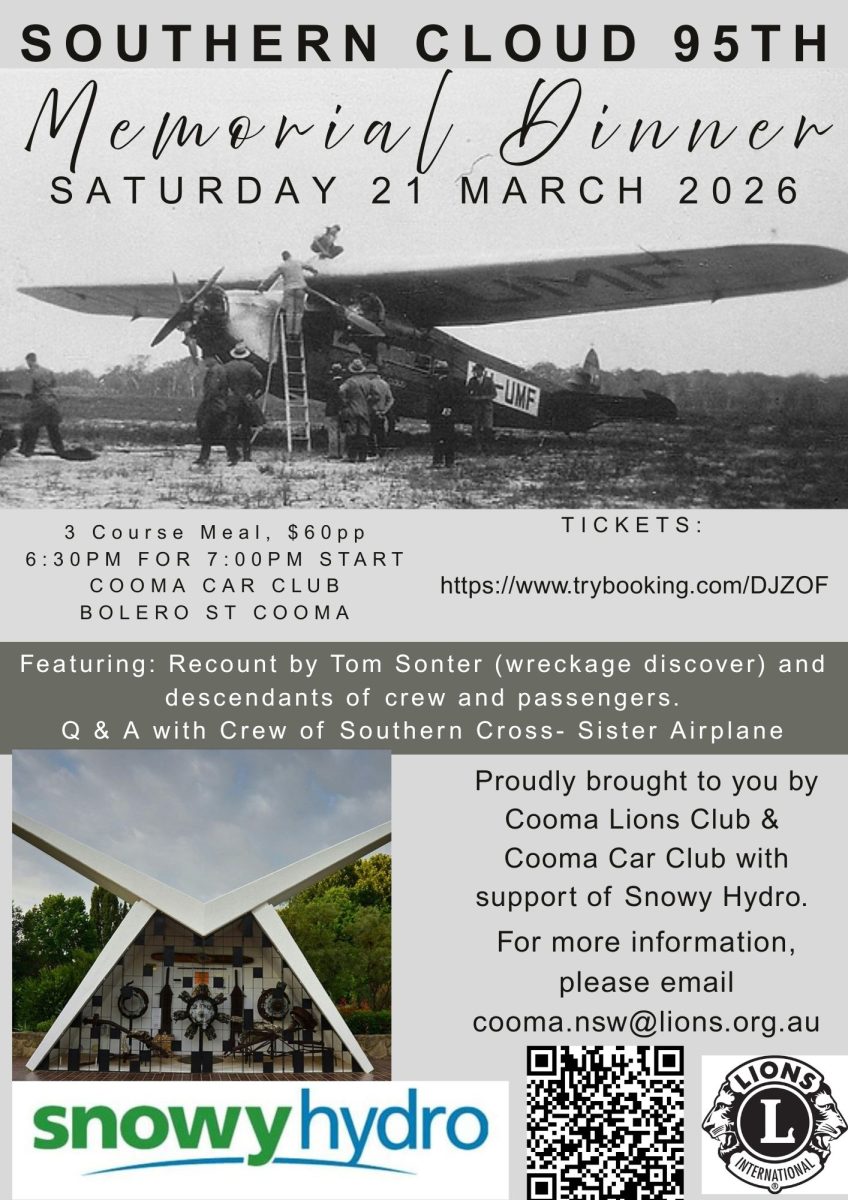
Tickets are available via trybooking. Photo: Cooma Lions Club/Facebook.
The disaster also changed aviation.
In its aftermath, the disaster became a turning point in Australian aviation, prompting mandatory two-way radios in commercial aircraft, stronger weather forecasting and reporting systems and improved pilot training with greater emphasis on instrument flying and decision-making in adverse conditions.
On 21 and 22 March, Cooma will mark 95 years since the aircraft disappeared.
The anniversary weekend, organised by the Cooma Lions Club with support from Snowy Hydro, will include a memorial service at Aviation Pioneers Park on Sharp Street, a wreath-laying at Cooma Cemetery and a commemorative dinner at the Cooma Car Club, where Tom Sonter will be guest of honour.
A highlight of the weekend will be the arrival of a replica Southern Cross – the sister ship of the Southern Cloud – flying from Albion Park to Cooma before departing again on Sunday morning.
Families of the crew and passengers, aviation enthusiasts, local residents and historians are expected to attend.
The Southern Cloud Memorial Dinner will be held on 21 March at the Cooma Car Club. Tickets are available via trybooking. For more details of the weekend and the planned schedule, visit the Cooma Lions Club Facebook page or email [email protected].