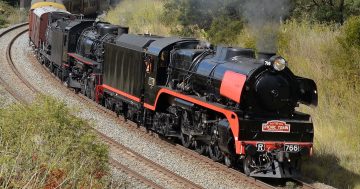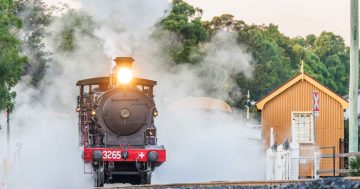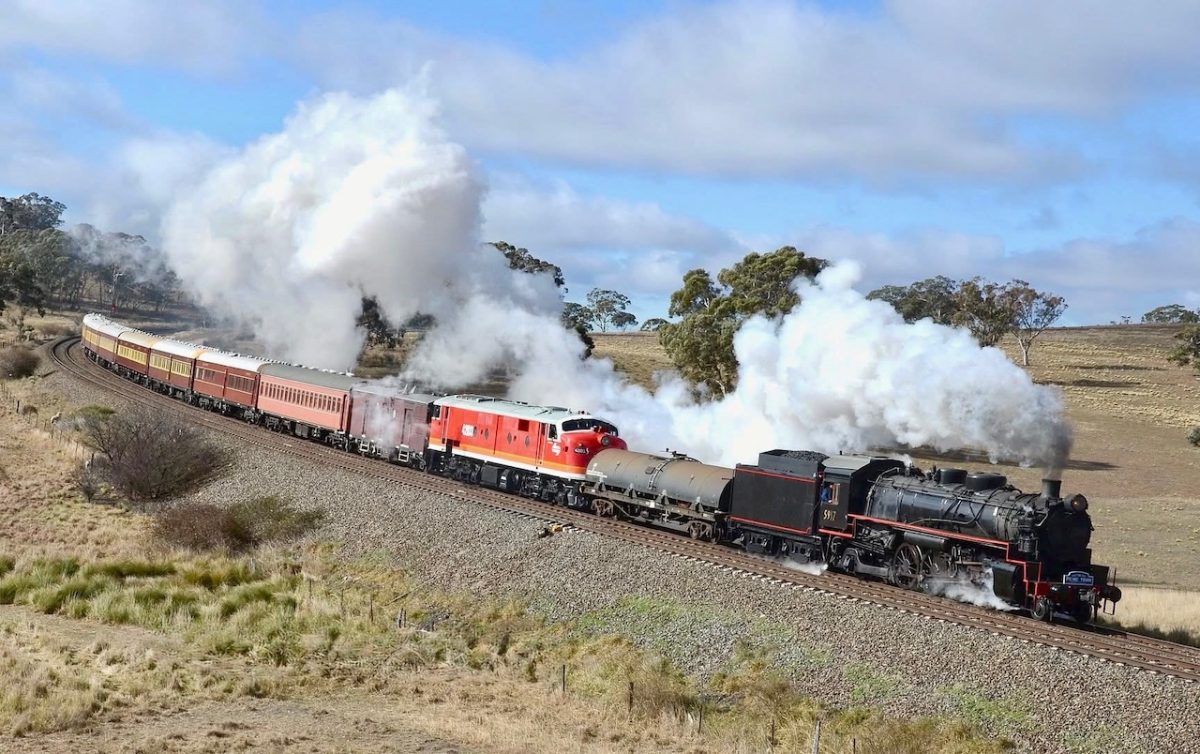
Approaching Yarra near Goulburn, The Picnic Train has a little help from a diesel locomotive, but dominates the landscape with its trail of steam. Photo: Leon Oberg.
In awe of heritage steam trains since he was a boy, Paul Mitchell has bonded with one in particular, Locomotive 5917, better known in NSW as The Picnic Train.
The 29-year-old fitter and turner has spent almost half a lifetime maintaining this train. Not so long ago he was NSW’s youngest qualified steam driver, and still might be. His ears are always alert to how efficiently the trusty engine is blowing steam.
Mostly, it performs beyond expectations.
“Steam engines are pretty cool, they’ll sort of tell you what’s going on before it becomes a problem, so you’ll start hearing certain noises or seeing a lack of performance in certain aspects that tells you something is wrong before it completely gives up,” he said.
“You are checking pins and split pins in all the suspension gear and general running gear. You go around with a hammer and tap all the nuts on things, making sure nothing has come loose because there are a lot of pretty savage forces at work,” he said.
The train was imported from the United States in 1952 as an oil burner, on account of a long-running coal strike in NSW and converted back to coal in the 1960s.
“I have a lot of affection for the 59 class, it has been a huge, huge part of my life,” he said. Working back late at night sometimes, trying to figure out why 5917 isn’t performing at its best can test that affection.
“There’s been times when it has thrown a bit of a temper tantrum and something has failed on it and it’s been a nightmare to fix it,” he said.
“For the most part the 59 normally does what I want it to do – behaves itself.”
The train has shared amazing scenery with Paul. “One time I brought the 59 to Goulburn,” he said. “Coming through Wingello and all the way to Goulburn just as the sun was coming up there was low-lying fog everywhere. Very, very picturesque.”
One of six children, Paul’s destiny was bolted onto trains before he was even born. His father Dennis, who trained train drivers, was among the founding members of heritage railway groups including Dorrigo Steam Railway and Museum and Zig Zag Railway. That meant many old-school volunteers awaiting the arrival of Dennis’ son to stoke his curiosity in these hissing, heaving, throbbing monsters.
“When other kids my age were growing up watching Thomas the Tank Engine I was watching Australian train documentaries with Dad,” he said.
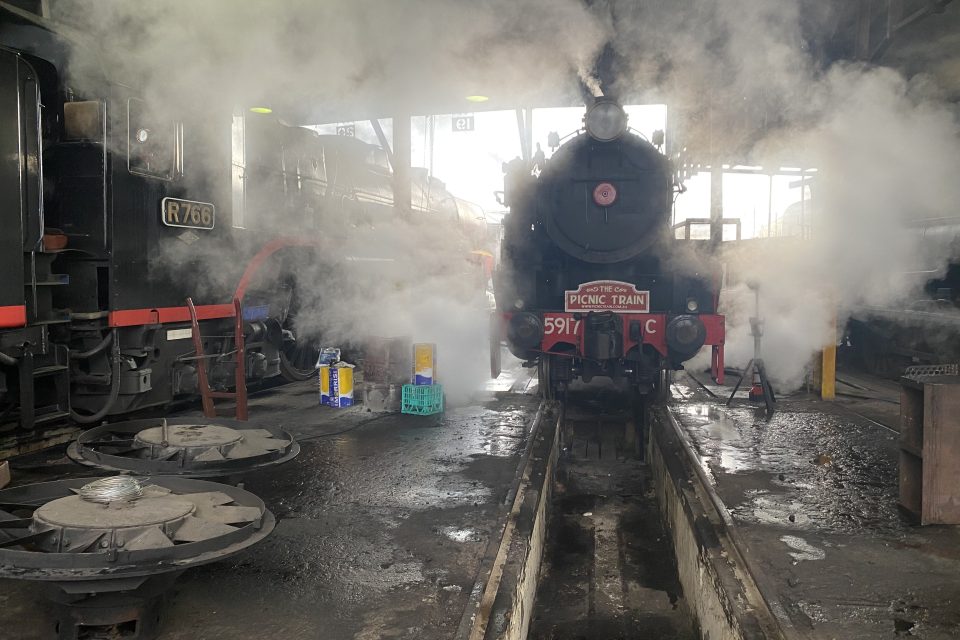
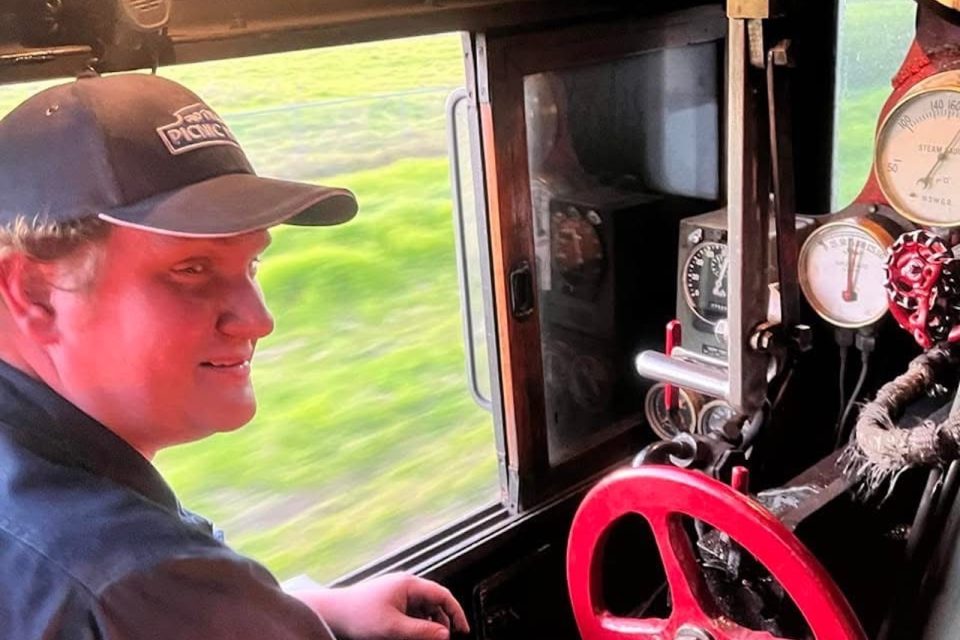
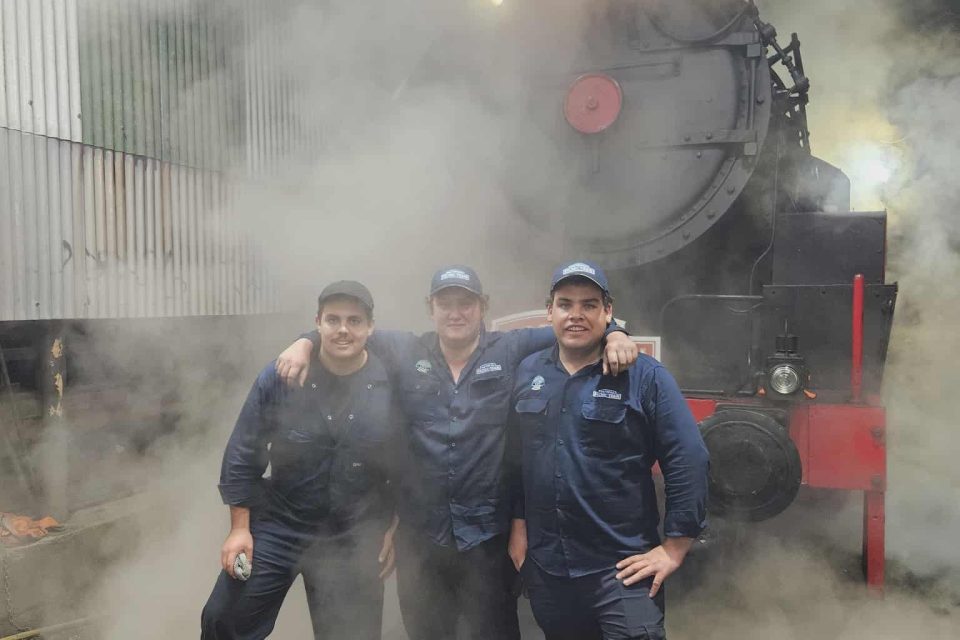
By the time he was 14, he was learning the inner workings of steam at the Western Districts Live Steam at Fairfield, and later the Valley Heights Rail Museum working alongside volunteers who remembered him as a wide-eyed youngster around the trains. While completing his fitter and machinist apprenticeship he began volunteering for the Lachlan Valley Railway, at Eveleigh Railway Workshops, near Redfern.
He got to know Paul Stapleton who belonged to a syndicate of enthusiasts who had bought the 59 class after it was retired from railway service in 1972 and he helped with the train’s major overhaul.
Later Paul, the owner of Sydney Rail Services, offered him the opportunity to get his train driver qualifications and by the time he was 23 he was firing steam trains. He’s been driving them since he was 27. Qualifications are route based and he is qualified from Canberra through to Sydney and north to Werris Creek.
Most of his work centres on maintaining the black and red 5917 class, one of three steam locos operating as picnic trains. For the past two years he has worked in Goulburn, at the Rail First depot and Goulburn Roundhouse Museum next door.
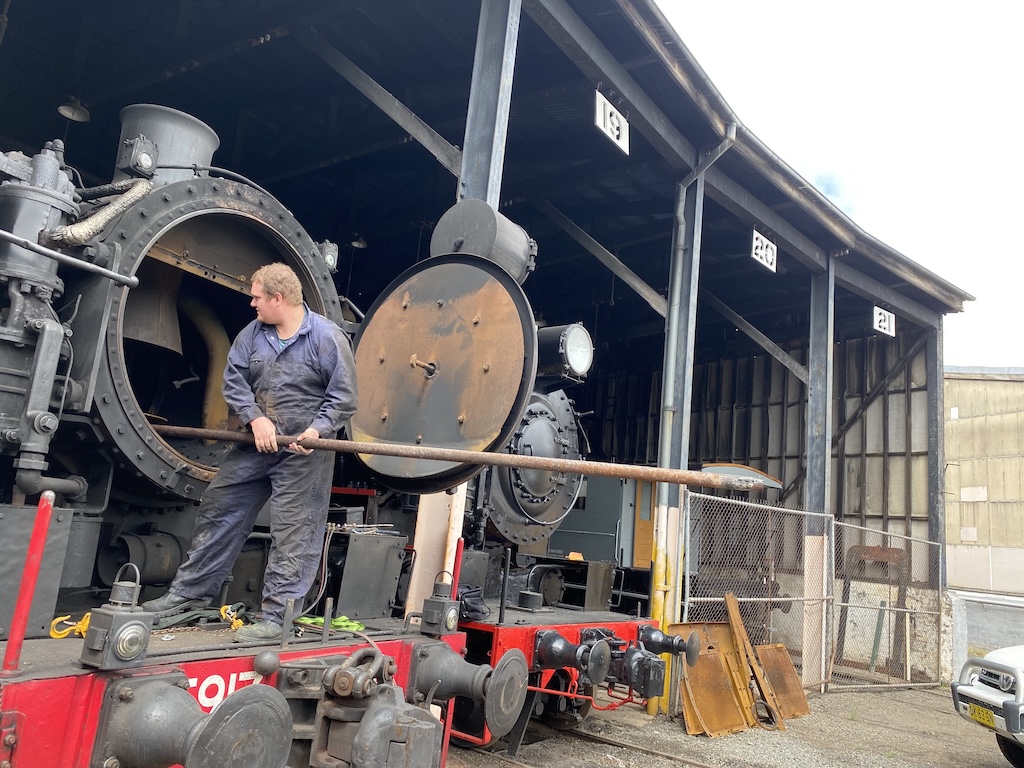
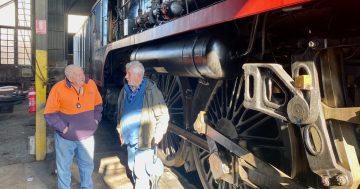
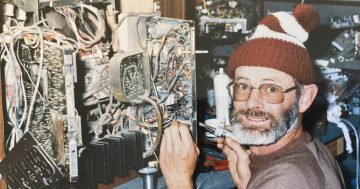
Paul Mitchell on his latest maintenance project, replacing nine of the 139 smaller fire tubes in Locomotive 5917’s boiler. Photo: John Thistleton.
He and his colleagues thought they would be running the picnic trains for a couple of years before interest waned. But they are far from being shunted. So full of people are the picnic trains, diesel engines are needed to push the rising number of carriages that have become too much for steam locos operating alone.
The best bit for Paul is seeing a new generation of volunteers coming along to help, including some he has known since they were little kids, in awe of the noise and power of these big old locos, as he was at their age.