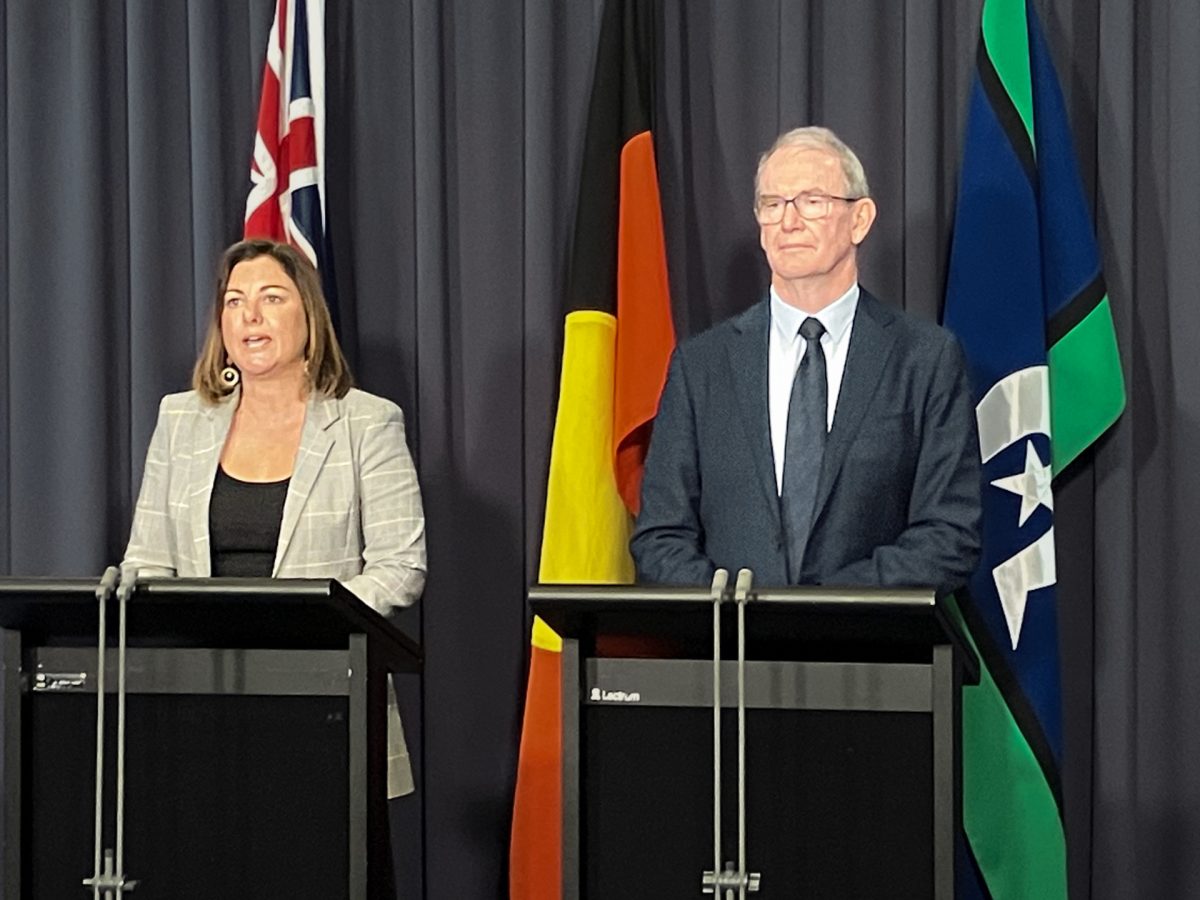
Emergency Management Minister Kristy McBain and National Emergency Management Agency boss Brendan Moon explain the incoming AusAlert system. Photo: Region.
A new ultra-high-tech national emergency alert system will be rolled out to replace the current outdated and problematic one.
Its name is AusAlert, and it is expected to be fully operational by October this year, but not before numerous trials across the country to detect and iron out any teething problems.
Trials in the ACT will test how the alerts work inside large buildings, while Canberra-Queanbeyan tests will measure their effectiveness for people moving across state and territory borders.
Unlike the current text message-based ‘Emergency Alert’ system, AusAlert will use the latest technology to enable authorities across jurisdictions to send geographically targeted emergency messages to all compatible mobile devices within a 160-metre accuracy.
The alerts will be broadcast via cell broadcast technology. They will not rely on any specific mobile network or carrier, or on standard messaging apps, and they won’t be linked to the Triple Zero service.
Instead, they will be broadcast to compatible mobile devices over mobile network towers through the Cell Broadcast Entity system and centres.
The alerts will override locked screens and silent modes to send emergency sirens, vibrations, and screen alerts directly to mobile phones to warn of emergencies and dangers.
Emergency alerts will appear on phones whether or not they are connected to Bluetooth or headphones.
While it will be up and running in time for the 2026-27 higher-risk weather season, the system will not be used solely for natural disaster emergencies and warnings.
Police and health emergency warnings, as well as biosecurity threats, will also be able to be broadcast through the new system, with states and territories responsible for sending police-related alerts.
The system will not be impacted by telecommunication network congestion, which has often been the current system’s failing and has sometimes resulted in phone users not receiving messages until days after they were sent.
Emergency Management Minister Kristy McBain said the Federal Government has spent a lot of time looking at how the system has worked around the world and is convinced this is the appropriate application for Australia.
“Cell broadcast works when mobile networks are overwhelmed with traffic,” the minister said.
“It is considered international best practice and has been adopted by more than 35 countries across the world.
“AusAlert will be more reliable, more accurate and efficient than the current systems in place.”
There will be two types of alerts – critical and priority – with users not able to opt out of receiving the ‘critical’ alerts.
Community-based trials will take place across urban, regional, and remote areas in all states and territories in June.
Those locations will be microtests at the Emergency Services Agency headquarters in Majura, ACT; Launceston, TAS; Port Douglas, QLD; Liverpool, NSW; Geelong, VIC; Tennant Creek, NT; Goomalling, WA; Port Lincoln, SA; and the Queanbeyan/Canberra cross-border test.
A national test of AusAlert will take place at 2 pm AEST on Monday, 27 July 2026, following the community testing to validate the system’s full capability and support awareness of the new system.
During the national test, everyone with a compatible mobile device will receive an alert.
Ms McBain said the government was undertaking the tests to ensure the technology performs as expected, and to build community awareness before AusAlert is needed in an actual emergency.
“This is an important project that will help us and emergency services organisations warn people when they are in harm’s way, saving lives and protecting property during a disaster, delivering on a key finding from the Royal Commission into National Natural Disaster Arrangements,” the minister said.
“Every state and territory will participate in a community-based trial in June, before a national test takes place on 27 July 2026.
“This is a major development in Australia’s emergency communication landscape, and I thank Australians in advance for their cooperation as we move into the launch phase for AusAlert ahead of the next high-risk weather season.”
National Emergency Management Agency coordinator-general Brendan Moon says the new messaging system will alert people to the types and locations of hazards they may face, as well as the actions they should take.
“This is using the latest technology to provide immediate alerts to our community,” he said.
The current text-based emergency alert system will be phased out and cease operation completely by July 2027.
Original Article published by Chris Johnson on Region Canberra.