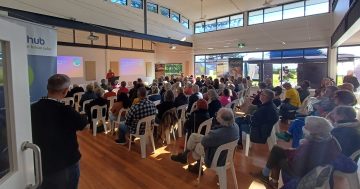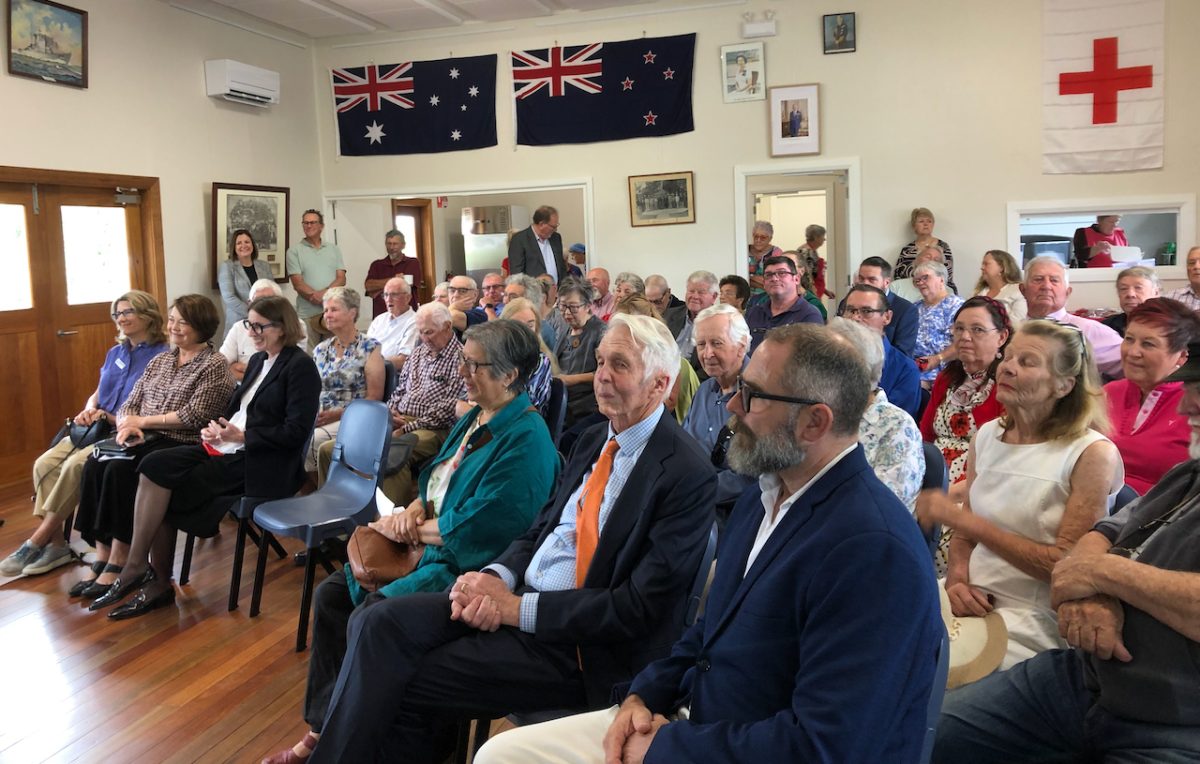
Cobargo RSL Memorial Hall was officially reopened on 29 November. Photos: Marion Williams.
For the first time in many years, the Cobargo community crowded into Cobargo RSL Memorial Hall on Saturday (29 November).
They were joined by local dignitaries for the official reopening of the hall after a three-year refurbishment, as well as people from Melbourne and Sydney who were instrumental in the project’s success.
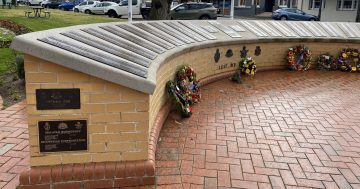
Bev Holland, a member of Cobargo Sub-Branch RSL and Cobargo District Museum, outlined the history of the Cobargo and District Soldiers Memorial and the RSL Memorial Hall, while photos of Cobargo people who had served in the two world wars were shown through a projector. Old family names including Salway, Tarlinton, Benny, Allen and Motbey featured prominently.
The opening of both the Soldiers Memorial and RSL Memorial Hall took years.
The Soldiers Memorial was intended to honour those who served in World War I. The idea was first proposed in 1919 and a committee of local men was formed. Over the next 14 years, interest came and went.
In 1933, some women formed a new memorial committee. Land was procured and construction began using granite from Tilba.
It was officially opened on 16 November, 1935.
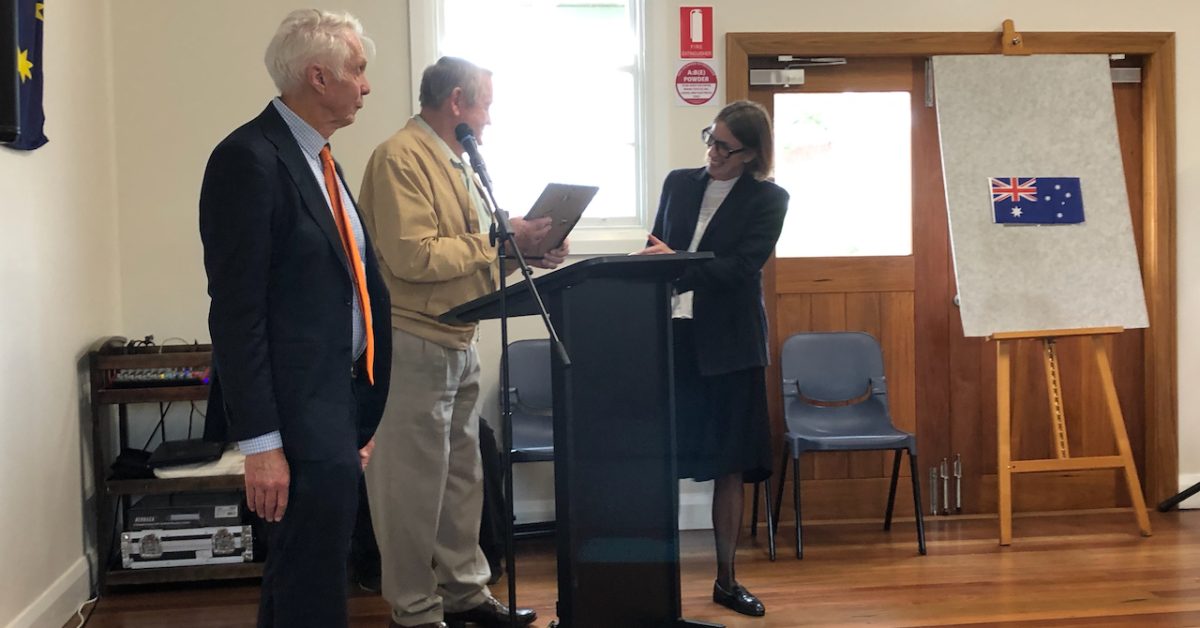
Architect Nigel Dickson (left) and Rachel Lacy received certificates of appreciation from Cobargo RSL Sub-Branch president Glen Morrison.
The RSL Memorial Hall was first proposed in 1945 to honour those who served and died in World War II.
The community approached the council in 1947 about building a community centre at Cobargo with rooms attached for the use of returned servicemen. The council rejected the proposal, so Cobargo RSL Sub-Branch took it on.
The community and district families were asked to pledge services and materials. By 1948, they had enough resources to start.
Due to postwar shortages, it took nearly three years to construct the hall amid an extreme shortage of building materials and high costs. The hall officially opened on 28 November, 1952.
“For nearly 50 years, the RSL Memorial Hall was at the heart of the community,” Ms Holland said. “Like so many small halls, it was a much-loved venue for family and community social events, weddings, funerals and debutante balls.”
It was also used by visiting doctors and dentists, served as a library for a time, and at another point was an op shop.
Over the years, though, the building slowly deteriorated.
Minister for Regional Development, Local Government and Territories, Minister for Emergency Management and Member for Eden-Monaro Kristy McBain said the hall had closed in 2012.
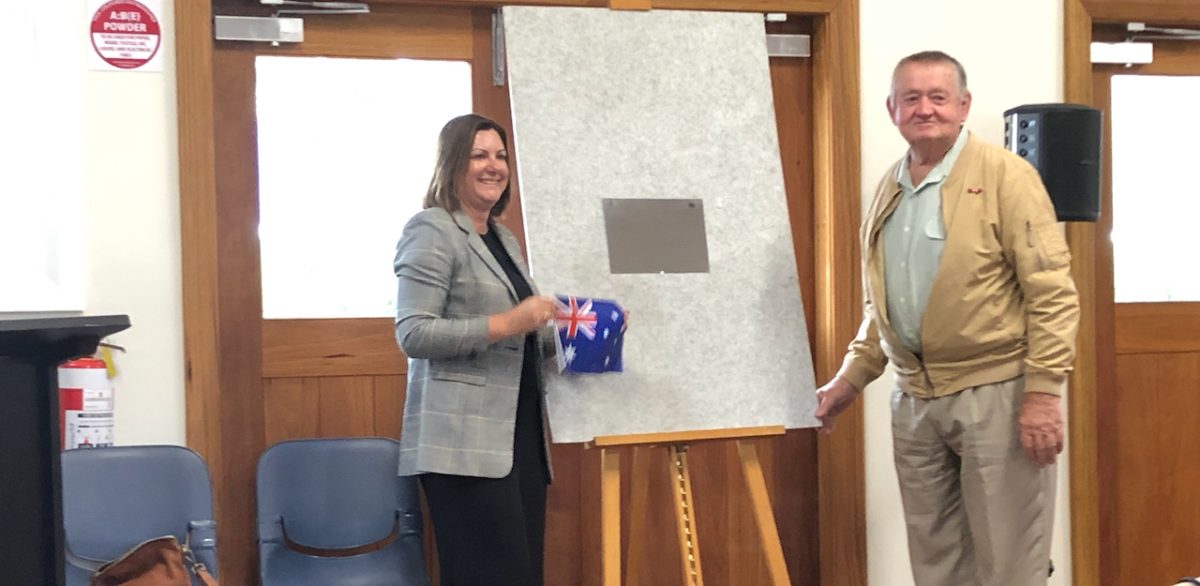
Member for Eden-Monaro and Minister for Emergency Management Kristy McBain and Cobargo RSL Sub-Branch president Glen Morrison unveil the plaque.
Ms McBain said there were 150 applications for the Australian Government’s Black Summer Bushfire Recovery (BSBR) Grants Program.
“This project is one I wrote a letter of support for,” she said.
Several speakers thanked Melbourne-based Rachel Lacy for her help writing the successful grant application. At the time, she was associated with Taubmans and national disaster and recovery organisation GIVIT. Taubmans donated the paint for the hall’s interior and exterior.
Architect Nigel Dickson of Sydney’s Dickson Rothschild Design was thanked for his pro bono services for the hall’s restoration.
Cobargo RSL Sub-Branch vice-president Graham Churchill said many others had made donations to supplement the $1 million BSBR grant. He thanked Bega Valley Shire Council and the NSW Government for their support, as well as the Cobargo community, notably John Walters, plus Alex McHugh of Rapid Construction.
Thanks to a grant from the Cobargo Community Bushfire Recovery Fund, and the work of community group Cobargo and District Energy Transition (CaDET), the hall has solar panels, battery and air conditioning, and can serve as a safe haven for those in need during heatwaves and heavy smoke.
CaDET president Zena Armstrong said the hall’s successful restoration “shows the grit and determination of the Cobargo community, despite everything we have been through”.
“Our village became synonymous with the tragedy of the bushfires and we had no power for 10 days,” she said.
That meant the community could not pump fuel, sewage became a problem and there was no functioning EFTPOS.
The Cobargo Co-operative operated for two weeks with pen and paper for IOUs, allowing people to buy feed, tools and supplies without access to bank and credit card facilities.
“This building will become a heart of the community,” Ms Armstrong said. “It has cheaper, cleaner and more resilient energy.”
She said people such as Mr Churchill and Cobargo RSL Sub-Branch president Glen Morrison turned trauma into action.
“What we have is a model for rural resilience, our refusal to be victims, embodying the spirit of service, and protecting the community,” she said.
“It is a symbol of hope and proof that a small rural village can come together and identify what we need and do it. We will face the future with our eyes open and the lights on.”