

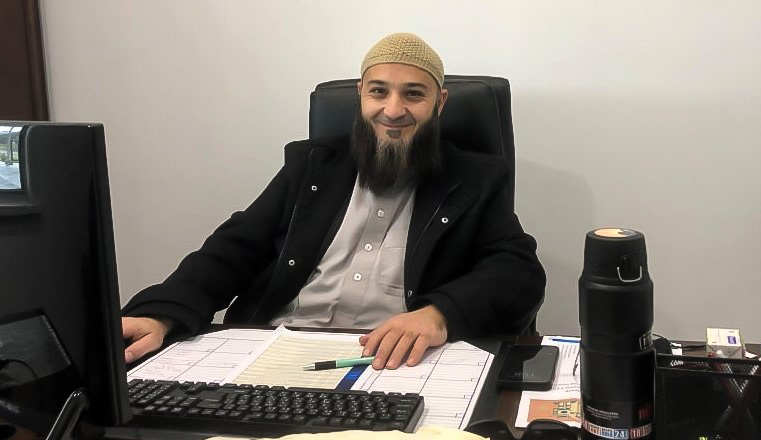
Sheikh Abdulghani Albaf is challenging a NSW Education Standards Authority finding that he is not a fit and proper person to hold a responsible position at Young’s New Madinah College. Photo: New Madinah College.
The NSW Supreme Court has spent a full day hearing a challenge by the principal of Young’s New Madinah College to a finding by the state’s education regulator that he is not a fit and proper person to continue leading the school.
Sheikh Abdulghani Albaf, who stepped aside from his role at the Islamic school earlier this year, is challenging the NSW Education Standards Authority (NESA) determination.
The matter was heard before Acting Justice Monika Schmidt on Thursday (11 June), with Tom Brennan SC and Paul Farrell appearing for Sheikh Albaf and barrister Greg Johnson appearing for NESA.
New Madinah College is a K-10 Islamic school in Young operated by the Young Muslim Association, to which Sheikh Albaf was appointed principal in July 2024.
The case centres on a series of Facebook and Instagram posts Sheikh Albaf made about the Israel-Gaza conflict, primarily in late 2023 and early 2024 before he took up the principal’s role.
They were first brought to public attention in early 2025, attracting widespread accusations of antisemitism.
Sheikh Albaf has consistently maintained the posts were political commentary directed at the actions of the Israeli Government and its leaders, rather than Jewish people.
NESA had been monitoring the school since early 2025 and conducted an inspection of the campus in mid-2025, reviewing its policies and governance.
Public scrutiny intensified again following the 14 December, 2025 Bondi Beach shooting, an antisemitic attack at a Hanukkah event that killed 15 people and reignited national debate about antisemitism in Australia, with media inquiries to NESA about Sheikh Albaf’s posts following shortly afterwards.
On 24 December, 2025, NESA issued a formal show cause notice warning the college’s registration could be cancelled if the principal did not meet fit and proper person requirements.
The college sought an extension of time to respond over the summer holiday period, but the request was refused.
Sheikh Albaf stepped aside from his position in January 2026.
On 17 February, 2026, NESA’s Registration and Accreditation Committee determined Sheikh Albaf did not satisfy the fit and proper person requirements. The finding was subsequently communicated to the school’s parent community.
The court heard the college’s governing board had conducted its own review of the same material and reached a different conclusion.
Sheikh Albaf filed proceedings in the NSW Supreme Court in March 2026.
A judge later issued consent orders, agreed to by NESA, temporarily freezing the determination and protecting the school’s registration while the case proceeded.
Thursday’s hearing focused heavily on the circumstances surrounding NESA’s investigation and decision-making process.
The court heard from Young Muslim Association chairman Mohammed Barghachoun, who described a phone call with NESA chief executive Paul Martin in January 2026.
Mr Barghachoun said he had asked for the school’s lawyer to be present but was told the discussion would be informal and that legal representation was not required.
He said Mr Martin acknowledged the school valued Sheikh Albaf’s work but said that, under the current political climate, the situation was difficult.
NESA senior inspector Brooke Prideaux, who prepared the investigation report relied upon by the committee, was questioned about two pieces of correspondence that had not been included in her original report.
Ms Prideaux told the court she located the documents while reviewing material the night before the hearing and accepted they had not been provided to the committee at the time, saying she had simply missed them in the volume of material under review.
Mr Brennan challenged whether she had in fact received the emails when they were sent, noting she was not an addressee.
Ms Prideaux said she believed she had been forwarded them or blind-copied but could not confirm this.
Acting Justice Schmidt noted the call for production of any document showing she had received them would need to be responded to.
Ms Prideaux also confirmed that before she prepared her investigation report, she was aware the minister’s office had indicated it did not want Sheikh Albaf at the school when students returned for the 2026 school year.
She said she did not include this information in her report.
Much of the day was devoted to submissions from Mr Brennan, who argued the February determination should be set aside on several grounds.
He said NESA did not have power under the Education Act to make a standalone determination that Sheikh Albaf was not fit and proper, separate from any recommendation to the minister about the school’s registration.
He also said NESA’s role was to assess matters and make recommendations to the minister, not to issue findings carrying direct legal consequences for individuals, and that requiring the school to publish the finding to its parent community went beyond anything authorised by the act.
Mr Brennan also pointed to evidence he said showed the process had been influenced by the minister’s office, including the refusal of extension requests and communications surrounding the conduct of the investigation.
A significant part of the hearing focused on whether NESA had properly distinguished between criticism of Israel and antisemitism when assessing the posts.
Mr Brennan argued the committee’s notes showed that distinction had been dismissed without proper analysis, pointing to handwritten notes recording the view that there was “no distinction between Zionists and Jewish people”.
He said the committee had rejected Sheikh Albaf’s central defence without properly engaging with it and that the statement of reasons contained no finding on what he described as a central factual question in the case.
Mr Brennan also referred to a Federal Court decision he said involved similar language and found a reasonable reader would understand the comments as criticism of a state and its government rather than Jewish people as a group.
He also raised procedural fairness, arguing Sheikh Albaf had not been given a direct opportunity to respond to adverse findings and conclusions before they were acted upon.
The court was also told the college’s governing board found no authority had determined Sheikh Albaf’s conduct amounted to hate speech, extremism or incitement to violence, and that there was no evidence of harm to students, staff or the school community.
They concluded there was insufficient evidence to justify terminating his employment and instead placed him on probation, introduced monitoring arrangements, counselling and policy reforms.
Acting Justice Schmidt raised questions throughout the day about the legal basis for several aspects of the process, but one issue appeared to catch both sides by surprise.
It concerned the committee’s statement of reasons – the document explaining its decision.
The court heard it was prepared not by the committee itself, but by NESA chief executive Paul Martin, who attended the February meeting as a staff member but was not a committee member.
The judge noted the statement had never been shown to the committee or formally adopted by it, observing she had “never encountered a situation quite like this one” in her years on the bench.
Mr Johnson began his submissions late in the day and told the court the issue required further consideration before he could address it fully.
He argued NESA had not directed the school to notify parents of the determination, but had requested a copy of the relevant correspondence be provided to the parent community. He also submitted the determination formed part of a broader regulatory process that had not yet reached its final stage.
The hearing will resume on 19 June.











Congratulations again Councillor Winslade. You seem to be the only one concerned with the costings… View