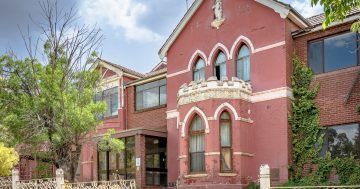
Sacred Heart Hospital in Young, established in 1911, where century-old remains uncovered nearby are believed to be linked to its history. Photo: Trove/NLA.
When a construction crew unearthed something unexpected in the rear yard of a Bruce Street property in the Hilltops town of Young in December 2024, the discovery was unsettling enough to stop work entirely and bring police to the scene.
What they found – a small collection of bones thought to be human – set in motion more than 15 months of forensic examination involving a pathologist, a forensic anthropologist, DNA testing and radiocarbon dating.
The answer, when it came, pointed not to a crime but to history.
A post-mortem examination report prepared for the NSW Coroner and obtained by About Regional reveals that the bones were not all found at once.
A first group came to light on 9 December during landscaping works at a site where six new dwellings were nearing completion, with further remains recovered three days later during additional excavation.
In total, only three bones were found: part of a right femur, a foot bone known as a cuneiform, and a single small finger bone.
On 17 January 2025, forensic pathologist Dr Leah Murray conducted a post-mortem examination at Forensic Medicine Newcastle, noting the bones were well preserved and coated in dust, with no signs of injury and no clothing or jewellery present.
DNA testing was carried out but Dr Murray’s report records no identifying result.
With no cause of death able to be determined, Dr Murray formally recorded the case as “unascertained, human remains” – a finding that left the question of origin unresolved.
The case remained open for more than a year while specialist analysis continued.
One detail in particular had caught the attention of forensic anthropologist Penny McCardle, of McCardle Cultural Heritage, who was brought in to examine the femur more closely.
In her forensic anthropology report, McCardle found the bone had a cleanly sawn end – not broken or fragmented, but deliberately cut.
She established the cut was peri-mortem, meaning it was made while the bone still retained living-tissue properties, around the time of death.
This ruled out someone sawing a dry old bone after the fact, pointing instead to a surgical or anatomical procedure – an amputation, or a post-mortem dissection – carried out at or near the time of death.
McCardle’s further analysis of the cut marks pointed to a hand-powered saw with raker-set teeth and a low tooth count, consistent with a larger-bladed instrument.
The exact type, she noted, could not be determined, but the technique was deliberate and methodical.
It’s a detail that, in another context, might have raised serious questions.
Here, it helps answer one.
The block on which the bones were found sits within the wider grounds of the former Sacred Heart Hospital and Convent – the first Roman Catholic hospital in rural NSW, established in 1911 by Reverend Monsignor Jerome Hennessy, who had come to Young in 1889.
The Sisters of Mercy took over management of the hospital in 1914 and ran it for the better part of a century.
Under their care it grew substantially, adding a maternity unit and nurses’ quarters in 1935, a new nurses’ home in 1960, and further wings through the 1960s. It didn’t close until 2004.
Hospitals of that era routinely retained amputated limbs and surgical specimens – a practice once considered standard.
Taking into account the location, the age of the remains and the nature of the cut marks, Dr Murray concluded in her post-mortem report that the bones are most likely a historic surgical specimen, discarded or buried on the grounds at some point during the hospital’s long life.
Radiocarbon testing, while not detailed in Dr Murray’s report, is understood to have placed the remains at more than 100 years old – a result that places the matter outside the NSW Coroner’s jurisdiction.
Police had indicated from the outset they were not treating the discovery as suspicious, a position now supported by the forensic findings documented in the post-mortem report.
With no evidence of foul play, the discovery has shifted from a police investigation to a piece of local history and a very human reminder of the site’s past life as a hospital.