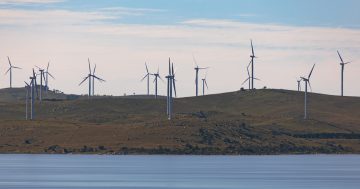
There are ways to prevent Wedge-tailed Eagles and other birds from flying into wind turbines. Photo: Jacqui Barker.
Australia needs to keep the lights on without producing greenhouse gas emissions and exacerbating global warming. Windfarms are a crucial part of the renewable energy mix required to achieve that.
But that does not mean they can be developed and operated with impunity, and without a social licence.
The deaths of birds such as the iconic Wedge-tailed Eagle, as reported near Yass, cannot be seen merely as collateral damage in the necessary process to produce electricity.
The deaths that occurred over 18 months at the Rye Park Wind Farm are a tragedy. As good an emblem for the Australian bush as any, the Wedge-tailed Eagle has endured a persecuted existence long enough and is often targeted by farmers ignorant of their important role as apex predators controlling pest animals such as cats, foxes, rabbits and the mice that can grow to plague proportions.
Anyone who has observed these awesome avians soaring over the countryside cannot but be impressed.
Of course, large birds are not the only ones contending with wind turbines. Cockatoos are one of the high-risk species, as are parrots and migratory birds, not to mention bats.
They should not fall foul of a wind turbines’ rotating blades.
There are ways to mitigate bird strikes. Turbines can be sited in low-risk areas, operators can ensure surrounding areas are cleared of sheep or rabbit carcasses, or their operation is paused during migratory flights.

The Rye Park Wind Farm, whose operator has developed a mitigation plan. Photo: Tilt Renewables.
There are also automated curtailment systems that have been developed for onshore wind farms and proved effective in reducing eagle deaths.
A camera system, integrated with an artificial intelligence feature that detects objects, estimates the line-of-sight distance to the object and takes 10 photographs per second to track movement. The probability that the object, such as an eagle, will enter the rotor-swept zone is then used to trigger cessation of the turning blades.
Devices that deter birds and bats by emitting audible or visual stimuli constantly, intermittently or when triggered by a bird-detection system can also be effective.
Simply painting turbine towers and blades can make them more visible. There is evidence of 70 per cent reductions in death rates with one blade painted black, compared with unpainted turbines.
For people who find this unsightly, the use of ultraviolet light also has potential. One study showed that it reduced collisions with power lines at an important migratory bird stopover location in Nebraska, in the US, by 88 per cent. This suggested that illuminating power lines, guy wires, towers, wind turbines, and other sites with UV will likely lower collision risks for birds while increasing human acceptance of mitigation measures.
What is missing, though, is a national or state framework for windfarm operators, who will, of course, say, like Rye Park operator Tilt Renewables, that they take the issue seriously.
It has even developed a Wedge-tailed Eagle Mitigation Plan in consultation with government agencies, ecologists and a specialist on that species.
That’s great, but the problem should not have reached this point and it isn’t enough for individual operators to respond in an ad hoc way to what are predictable and preventable situations.
There needs to be standard mitigation practices for every wind farm as part of the development approval process.
The backlash against renewable energy projects in some quarters of the bush means that companies need not just to establish the public benefit of the green power they produce, but also negotiate a social contract.
It’s a tough enough battle to do that without dealing out death to iconic native wildlife.
The strategies and tech are there to prevent these environmental tragedies. Government, the industry and experts need to come together to ensure they stop.
Original Article published by Ian Bushnell on Region Canberra.