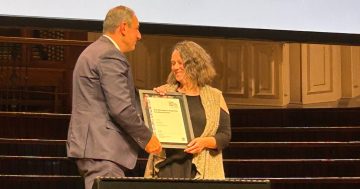
Families hear from childhood education experts at last year’s transition to school event. Photo: Eurobodalla Shire Council.
More children living in Eurobodalla Shire are likely to start school inadequately prepared than the national average.
In the shire, 25 per cent of children start Kindergarten with one or more vulnerabilities in language or communication, or do not have the social, emotional and physical maturity needed to navigate the school environment. That is 9.7 per cent higher than the national average.
It is a problem affecting regional areas across Australia because they do not have the same access to childhood healthcare and preschool and out-of-school-hours daycare as cities.
Eurobodalla Shire Council offers some support services. In late March it is holding free school-readiness seminars for parents of children aged three to five.
Louise Hatton is council’s coordinator of children’s services. She has a degree in teaching early childhood and other related qualifications. She and her family moved to the area in 2004, and she has worked for council for 18 years.
“The further you live away from the city, the more disadvantaged children are in terms of community health, generalised health and support, early childhood education and care, and specialist services,” Ms Hatton said.
There is a very long waiting list for the paediatrician who visits every month and children must travel to Canberra, Sydney or Wollongong for surgery.
Ear, nose and throat problems are common in children and if not addressed early, issues such as hearing difficulties can impact many aspects of childhood development.
“People who need that support have to leave town and rely on their own transport because there is no public transport here, unlike cities,” Ms Hatton said.
She said access disadvantage was compounded by Eurobodalla’s relatively low socio-economic status.
Ms Hatton said many preschools and out-of-school-hours daycare services were run by for-profit organisations and tended to be in the cities and highest income areas.
It means children in rural areas miss out on valuable socialisation skills and do not learn about things such as negotiation and fairness that preschool and quality daycare teach.
Ms Hatton said council ran three out-of-school-hours care centres and a Family Day Care service with 10 educators across the shire. Family Day Care is a home-based education and care service provided by qualified educators and supported by council’s Children’s Services team.
Council also runs seven fortnightly playgroups across the shire through a federally-funded program. Council staff provide engaging and structured programs that incorporate story time, art and craft, music, physical movement and a healthy morning tea. “It is based on the premise that parents are their children’s best teachers,” Ms Hatton said.
She said it could be difficult for parents to identify if their child was falling behind because children developed at different rates, and sometimes local GPs tended to look for significant developmental problems rather than mild or moderate ones.
That is compounded by access to quality services or not knowing about them. There is an NDIS agency for children but many families do not know it exists.
The latest data indicated that Eurobodalla’s children were most affected by language shortcomings and physical issues such as motor control or being unable to do things such as open lunch boxes or tie up their shoelaces.
The good news is that there is plenty that parents can do to help their children’s development including reading to them often and turning off screens while on short car journeys and instead playing games such as “I spy” or describing the colours of cars or other things they can see outside.
“The more books you can read to them, the better their language will be,” Ms Hatton said.
Taking children for walks in the bush or on the beach supports language development and thinking, while watching a movie together and discussing the storyline or going to library story times where their attention is required is far more beneficial than doing something on a device that happens very quickly.
Council is holding free one-hour school-readiness seminars at 5:30 pm at Moruya Showgrounds on 23 March, Batemans Bay Children and Family Centre on 24 March and Narooma Golf Club on 25 March.
Guest speakers include Naomi Blunden, who helps with school readiness at Batemans Bay Public School. She will give tips for families when starting school. Another speaker is occupational therapist and former teacher Carly Tunnecliffe from Noah’s Inclusion at Batemans Bay. She will talk about skills and activities that support school readiness and a smooth start to school. They will be joined by Claire Price, a speech pathologist at South Coast Speech in Moruya.
Bookings are essential through council’s website.