Costa with a mandala made with produce from Bermagui’s Moodji Farm. Photo: Alison Kuiter.
The more he travels and the more conferences he attends, the more Costa Georgiadis is convinced that the real answers for a sustainable and meaningful life are found locally.
Costa, the hugely popular host of ABC TV’s Gardening Australia program, recently returned for his 10th trip to the Far South Coast.
He spoke to Region while he was at Moodji Farm in Bermagui. It is an urban and Indigenous agriculture project next to Bermagui Preschool. Volunteers help the children tend the garden under the guidance of Dan Bakker of Eat Dirt Permaculture.
The preschoolers, volunteers and Costa made a mandala from Moodji Farm produce, and the children painted paper tablecloths for the annual fundraising Moodji Futures Dinner.
Over the years Costa has seen and revisited a broad spectrum of community enterprises and projects like Moodji Farm, Grow the Future, FLING Physical Theatre and seed saver networks.
“The essence of all these is we are nature,” Costa said. “How we engage and interact and support that reality plays out through these projects in different but similar ways. Nature speaks to everyone.
“Everything about the tour is a chance to illustrate or provide a space where nature’s voice can come through,” he said. “The more I look, the more I see the common threads. The connectivity is real.”

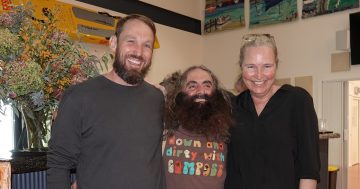
Dan Bakker of Eat Dirt Permaculture and TV presenter Paul West at the fundraising auction for Moodji Farm on 15 May. Photo: Alison Kuiter.
Costa loves the intergenerational aspect of Moodji Farm where preschoolers interact with volunteers, many of whom are retirees in their 60s and 70s. He also spoke about a mentorship that FLING Physical Theatre ran enabling young people to move from one mentor to another to ask questions.
“That is what the extended family used to do, but young people don’t have that outlet of other trusted family members anymore,” Costa said. “The best thing we can give our next generation is our presence, allowing them to ask the questions or vent or defog, clean the windscreen and see things in a different light.”
He talked about a conversation he had with his nephew who was grumbling about why he had to listen to his grandfather. Costa told his nephew that his grandfather had been around the world for much longer and therefore could set young people straight with their own priorities. “Parents are the CEOs running everything but the grandparents are on the board and saying this is the direction we should go.”

The gnome on the roam with a megaphone: Costa at Moodji Farm on 14 May. Photo: Marion Williams.
Costa had recently attended a regenerative agriculture conference, a national waste conference, and environmental and garden expos, some of which were run by councils. In a world where once-trusted news sources are no longer around and information on websites can no longer be relied on, people are turning to local sources for information.
“Council-run expos showcasing local groups and enterprises, workshops and talks by people living and breathing this space and telling those hyper-local stories are where people are looking for truth,” Costa said. “They are going to libraries where there is a human to help you rather than an algorithm trying to monetise you and take your attention.”
He talked about the nexus between attention and intention. While there is an online juggernaut clamouring for our attention, the volunteers at Moodji Farm, for example, have a very clear intention. They want to contribute locally and can see that the story of Moodji Farm is true as a place for children to come and understand their food and where they are encouraged to express themselves.
“When the children were painting I was telling them you are all artists, you are all creatives and you are all going to do things differently which is beautiful,” Costa said. “We can look at the same thing but when it comes through your heart and onto the page it is different. You are heartists. An algorithm doesn’t have a heart and never will, but your hearts are constantly evolving and developing because of your experience.”
He said projects like Moodji Farm were a gift to the children and the community, but sometimes we did not realise what we had because it was there and we took it for granted. Moodji Farm is a truly significant community asset and a piece of infrastructure that is operated by locals. That is Costa’s message.
“We need to be hyper-local,” he said. “That is where we get information from people we know, otherwise our information comes from so many different places it is difficult to trust anything that comes down the wire.”
Costa’s tour was organised by Eat Dirt Permaculture’s Dan Bakker.