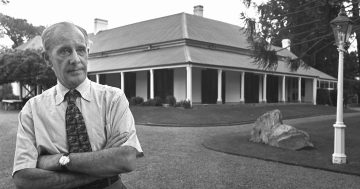
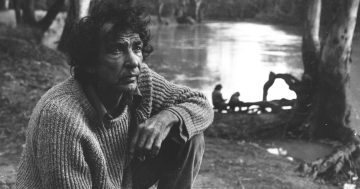
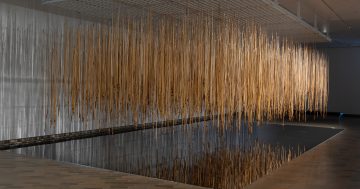
Brenda Croft’s current exhibition explores sites in the Goulburn Mulwaree region that relate to her heritage. Photo: Goulburn Regional Art Gallery.
Brenda Croft is a prominent and highly acclaimed First Nations artist, curator, writer and academic who has had a lengthy association with the Canberra region.
Born in Perth, Brenda is the daughter of an indigenous man from the Gurindji, Malngin and Mudburra peoples of the Northern Territory and Western Australia. He is a member of the stolen generation who was removed as a two-year-old from his parents.
Her mother was a non-indigenous women of Anglo-Australian, British, German, Irish, Scottish and Chinese heritage.
Much of Croft’s art practice over the past four decades has involved the layering of photographs and text to create a visually engaging palimpsest involving autobiography, genealogy and history.
Her current exhibition at the Goulburn Regional Art Gallery explores the sites in the Goulburn Mulwaree region that relate directly with her matrilineal heritage.
In particular, it explores her great-great-grandmother Caroline Stephenson (and her family) with whom she shares a birthday, who lived and worked in the broader Goulburn region during the mid to late 19th century.

St Saviour’s Cemetery Headstones in Croft’s exhibition. Photo: Goulburn Regional Gallery.
The theme of echoes of our forgotten ancestors has challenged many an artist. In Croft’s case, she employs a beautiful but antiquated technology – the Collodion tintype photographic process (with which she was assisted by the artist Prue Hazelgrove) – together with a large-scale audio-visual installation.
Croft, in a strategy that she has employed in some of her other art works, intermeshes public history with personal memory to create something that has the quality of a waking dream.
She creates a new reality where the boundaries are porous between historical records and personal recollections.
She brings to life specific historic sites that have particular relevance to her mother’s family, including the Coach and Horses Inn, St Saviour’s Cemetery and the northeast corner of Weereewa/Lake George.
This is a great endorheic lake that is caught within a closed drainage basin that has no outlet to the ocean or sea. It has been a historic site of atrocities, myth making and mysteries over thousands of years.

Croft’s Weereewa tree. Photo: Goulburn Regional Gallery.
Croft takes family records such as slides from family vacations and, by altering their scale and employing digital technologies to present them as large-scale colour images that can be shown on a wall like a series of posters, has changed something that was intimate, personal and technically ephemeral, into quite public and permanent images.
She has created a new history and a new reality where the personal has subsumed the historic record and challenges us with a new narrative.
However, what is most effective about Croft’s exhibition, particularly the monumental three-channel video installation, is that a degree of ambiguity is created.
The soundtrack consists of snippets of conversations involving the artist as a young child. The three screens bring together photographs of architecture with family photographs that have been eroded by time and are presented as enigmatic presences.
We have been given privileged access into this newly created world where it is up to the viewer to make sense of this new reality.

A photo simply titled US Christmas – 1961 engagement. Photo: Goulburn Regional Gallery.
A few years ago, Croft wrote of her art practice: “By placing myself behind the camera I am taking control of my self image and images of ourselves. I cannot, do not, take sole responsibility but challenge and attempt to reverse the expected.”
It is an intriguing and challenging exhibition that gives us access to an unexpected reality that we are invited to interpret and through which to discover our own reality.
Brenda L Croft’s exhibition, after/image, is on display at Goulburn Regional Art Gallery until 4 April, alongside Prue Hazelgrove’s Re:Generation. The gallery, in Goulburn’s Civic Centre at 184 Bourke Street, is open from 9 am to 5 pm Monday to Friday and noon to 4 pm on Saturday.
Original Article published by Sasha Grishin on Region Canberra.