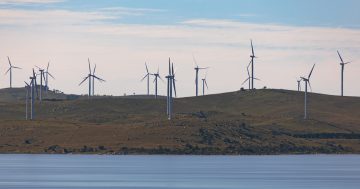
Yass Valley Councillor Alvaro Charry said the deaths of the wedge-tailed eagles were “deeply saddening and concerning”. Photo: Jacqui Barker.
The reported deaths of 20 wedge-tailed eagles at the Rye Park Wind Farm over the past 18 months have sparked calls for stronger wildlife protections, with community leaders, farmers and conservation advocates urging governments to make bird-strike mitigation technology mandatory at wind farms.
Rye Park is a 396-megawatt (MW) wind farm located 11 km north of Yass. The project area spans the Hilltops, Upper Lachlan and Yass Valley local government areas.
The figures, revealed by Tilt Renewables during a meeting of the Rye Park Community Consultative Committee (CCC), have also prompted questions over whether more could have been done to protect one of Australia’s largest birds of prey.
Yass Valley Councillor Alvaro Charry, who represents the council on the committee, said learning of the deaths was “deeply saddening and concerning”.
“The wedge-tailed eagle is one of our nation’s most iconic native birds. It also holds profound cultural significance as the sacred totem of the Ngunnawal People,” he told Region.
“To hear that so many of these majestic birds have been lost is distressing and raises important questions about how these impacts are being managed and mitigated.”
Following the meeting, the committee formally requested that Tilt Renewables provide a detailed report in October outlining all recorded bird and bat strike incidents across the wind farm, the measures already in place to reduce wildlife deaths, additional mitigation strategies under consideration, and how incidents are reported to the NSW Government.
While describing renewable energy as essential to Australia’s future, Cr Charry said protecting wildlife could not become an afterthought.
“Renewable energy projects are an important part of Australia’s diversified energy future, but that goal must be pursued responsibly,” he said, stressing that he remains a strong advocate for renewable energy.
“Protecting biodiversity and respecting our cultural and environmental heritage must remain central to how these projects are planned, operated and continually improved.”
The figures have also reignited calls from Farmers for Climate Action to make proven bird-protection technology a standard requirement for new wind farms.
“The shift to clean energy can be kind to nature,” the organisation said.
It pointed to several technologies already being used successfully overseas and in Australia, including cameras that automatically stop turbine blades when wedge-tailed eagles approach, radar systems that detect birds in flight and painting one turbine blade black to improve its visibility.
The group said camera technology had already proven effective at two Tasmanian wind farms without affecting profitability.
“The time for consideration is over. The time for action is now,” it said.
“We ask the government to make these bird-kill mitigation measures standard conditions for wind farm approval.”
Tilt Renewables said it took any impact on native wildlife seriously and had been actively monitoring bird strikes since the wind farm began operating.
“We take seriously any impacts our wind farms have on the local environment—especially in relation to bird strikes,” a spokesperson told Region.
The company said trained detection dogs regularly searched around turbines for bird deaths, with every wedge-tailed eagle fatality immediately reported to the NSW Department of Planning, Housing and Infrastructure.
Importantly, the company acknowledged the problem was greater at Rye Park than elsewhere in its portfolio.
“This process has alerted us that wedge-tailed eagle impacts are higher than expected at Rye Park compared to our other wind farms, and we are doing something about this,” the spokesperson said.
Tilt said it had developed a dedicated Wedge-tailed Eagle Mitigation Plan in consultation with government agencies, ecologists and a wedge-tailed eagle specialist.
Among the first measures already underway is the removal of sheep and cattle carcasses and rabbit warrens to reduce food sources that attract eagles to the wind farm.
The company said additional mitigation measures would be introduced once agreed with the NSW Government.
The effectiveness of those measures is likely to come under scrutiny when Tilt Renewables returns to the Community Consultative Committee in October with the detailed report requested by local representatives.