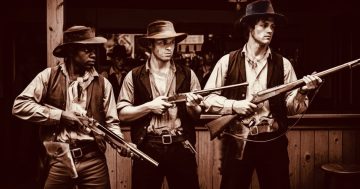
Proof that a catchy name can secure your place in history. Image: T-shirt design of William Westwood available on Redbubble.
Every Australian town likes to claim its own bushranger, and for Bungendore, it wasn’t Mick Jagger – his rendition of Ned Kelly that was filmed in the town in the 60s really had nothing to do with the town itself. For Bungendore, it was actually a chap called William Westwood who became widely known as Jackey Jackey.
When it comes to bushrangers, myth and legend often converge, and the lines between truth and reality are no longer distinguishable. The myth surrounding Jackey Jackey is that he was the gentleman bushranger. While some may feel that stealing for a living automatically rules you out of the status of gentleman, others see it differently, and seeing as Jackey Jackey was executed in 1846, he can’t really tell us either way.
William Westwood came to Australia in a predictable fashion, aboard a convict ship. He was 16 years old. It was 1837 and one might imagine his crime was being cold, as he’d stolen a coat. It was a crime which came with the typical overblown sentence of the day, 14 years’ imprisonment and a one-way trip to the other side of the world.
His first introduction to convict life was on the property Gidleigh, just a stone’s throw from Bungendore, a property that remains inhabited to this day. All accounts of William’s time at Gidleigh indicated that convict life was not really for him and even less so after receiving 50 lashes after a brief period of time spent on the run.

Port Arthur in 1870. Image: portarthur.org.
In the year 1840, he escaped Gidleigh for the final time, heading for the Jingera Mountains and raiding nearby properties for supplies. This was the start of a six-year fiasco of robberies, mutinies, captures, escapes and recaptures that took him to some of Australia’s most notorious prisons, including Cockatoo Island, Port Arthur and Norfolk Island.
Despite their reputations, there wasn’t a facility in the country that Jackey Jacky didn’t see fit to escape from. He embarked on a daring swim to the mainland with a number of inmates from Cockatoo Island, an act which landed him transportation to Port Arthur. He made two attempts to escape Port Arthur, the final one being successful, something that can’t be said for his companions who were reportedly eaten by sharks. It’s worth noting that William was the only person alive left to tell that tale.
He was later sentenced to life in prison on Norfolk Island, but life turned out to be not that long when William took umbrage at the brutality of the conditions in the prison and led 1600 men in a riot known as the Cooking Pot Uprising. Four of the prison’s guards were killed during the riot, and William later pleaded guilty to personally taking the life of a guard called Morris and was hanged for his crimes in October 1846.

A watercolour of the Cooking Pot Riot. Artist unknown. Image: Wikipedia.
In a final note written by Westwood shortly before his death, William compares the treatment he received as a convict to be more like that of a beast and not a man and that the prison guard that he killed tortured men’s minds and bodies, sending men to early graves.
That last plea for understanding may account for his crimes against his gaolers over the years but the evidence for his gentlemanly reputation isn’t looking good. During the periods of time that he was not being accommodated in our finest establishments of confinement, Jackey Jackey was busy. He stole horses, robbed people at gunpoint, bailed up servants, mailmen, innkeepers and postmasters. But the unusual fact of it all was that he did it all in a suit.
The famous saying is that the suit maketh the man, and in this case, it made the gentleman, and with his dapper attire, the legend of the gentleman bushranger was formed. History has been kind to Westwood, and in addition to his choice of attire, a few key occurrences loom large in the minds of those who support the notion of him being a gentleman. One was his stance on sexual violence against women, having parted with a ‘business associate’ he caught raping a servant during a raid. Another was his ability to so eloquently sum up the circumstances that led to his execution; of course, only a gentleman could put that so poetically.
In a time when brutality, on both sides of the law, was commonplace, was a suit, a moral stance and perfect diction enough to warrant the reputation that has followed William Westwood in life and death? I guess that’s for you to decide.