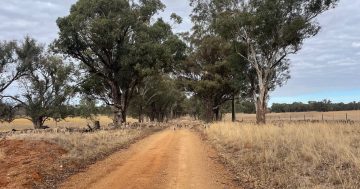
Queanbeyan Council has put aside $20,000 for the trial. Photo: Eurobodalla Shire Council.
It’s hoped a $20,000 trial will prevent motorists from striking wildlife near Bungendore, but there are calls to hit the brakes on its rollout.
Virtual fencing technology is being installed on a stretch of Macs Reef Road between Bungendore Road and Denley Drive.
Devices are installed along the sides of a road in alternating fashion and are triggered by a vehicle’s headlights.
Once illuminated, they emit a noise and light, in hopes of deterring animals from stepping onto the road.
Queanbeyan-Palerang Regional Council (QPRC) has chosen the trial location after a rescue group found it had the highest frequency of wildlife strikes.
A council spokesperson said Macs Reef Road saw 25 reported collisions that injured wildlife.
Eight were recorded in the trial area.
“As noted, these reports are injured wildlife only,” the spokesperson said.
“Council staff also inspected along the roadside to confirm that this section of Macs Reef Road had high numbers of roadkill.”
QPRC has also asked insurance providers for their related data.
Doctor Colin Salter from WIRES isn’t convinced the technology, at least in its current form, will stop wildlife collisions.
“It’s reflecting positive concerns and a want to make a difference,” he said when asked about the use of the technology.
“I welcome any initiative that is looking to minimise the impact of roads on wildlife. Unfortunately, all the evidence we have is that [virtual fencing] doesn’t work.”
He warned that, when it was first installed, animals might be deterred by the light and noise, but this wouldn’t last forever, with animals becoming habituated to the noise, or not recognising it as a warning.
“It’s brought in as a one-size-fits-all [approach] … We need to tailor that.
“If this kind of tech could work – and that’s an ‘if’, because we don’t know – it would need light or sounds that would have an impact on Australian wildlife.”
Council meeting papers state QPRC has been investigating virtual fencing since 2024 as a measure to reduce wildlife collisions on rural roads, such as Macs Reef Road at Bywong.
At the time, the council said there wasn’t time to add the program to the 2024/25 budget.
The technology has also been used along roads in Eurobodalla Shire and the Riverina region.
Most recently, the ACT Government knocked back a push for the technology to be trialled in the Territory earlier this year.
More than 1300 people had signed a petition for virtual fencing to be installed along Erindale Drive to reduce road accidents involving kangaroos.
In her response, City and Government Services Minister Tara Cheyne said that research indicated it wasn’t effective.
“[One NSW report showed such trials] have shown mixed success and the experimental design of some studies has been criticised,” she said at the time.
A push to consider other strategies was raised by Doctor Salter, who said there were other (albeit more expensive and invasive) options on the table.
He said a renewed focus on ensuring habitat remained connected, including during the infrastructure design process, would make a larger difference.
“We’re not going to stop roads – we’re going to continue to build roads – but we need to factor in wildlife and [habitat] connectivity,” he said.
Other steps could include reducing speed limits to increase drivers’ reaction times or increasing light on country roads, he said.
Queanbeyan Council will review wildlife collision data for Macs Reef Road after a year, with a report to be presented to the councillors.
The spokesperson said the trial’s findings would be compared with information from “previous, current and future years”.
“We will also be considering the operational aspects of the trial, such as the reliability of the devices, how the solar panels that charge the batteries are affected by different conditions such as shade, ease of installation, and any maintenance required.”