Self-taught folk musician Pearlie Watling, a notable character in the Murrays Flat district. Pearlie formed her Old Time Band with family members and played for many years at the Goulburn Railway Bowling Club. Photo: John Meredith, National Library of Australia.
A small rubblestone church and bluestone home in the distance flash by in a fleeting moment for passengers aboard trains approaching or leaving the outskirts of Goulburn.
Yet this glimpse suggests the tiny settlement of Murrays Flat must have been significant in Goulburn’s early European history.
Over the past 150 years it has rarely made the news, except for when a stray bullet struck a fireman while he was stoking a steam train travelling through Murrays Flat in 1953.
The driver opened the train’s throttle to make a mercy dash to Goulburn to save the stricken young man’s life. Police never found the shooter.
At the time Murrays Flat was almost a century past its halcyon days when 300 people gathered for the laying of a foundation stone for the Wesleyan Chapel in December, 1857.
About nine kilometres from Goulburn, the bluestone schoolhouse was added in 1868 with accommodation for a teacher.
Jan and Nancy Cheetham, who had immigrated from the United Kingdom to Australia in 1968, bought the schoolhouse in 1976 and restored it, reinstating cedar doors and window frames. The classroom became their lounge room.
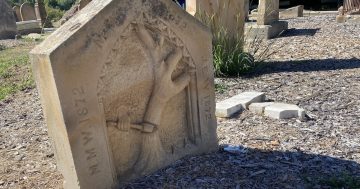
They later bought the old church and began urgent repairs. “It was an absolute tip, we cleared up that much rubbish,” Jan said. A previous neighbour had bulldozed headstones above graves near the church.
Nancy is now in care and living in Goulburn. Jan continues maintaining their small cattle enterprise, answering questions for the occasional historians who turn up looking for the old church, and cleaning up after errant anglers leave tangled lines behind. He wants to avoid the rubbish injuring wildlife including spectacular water dragons he sees in the river.
Jan and Nancy appear on the cover of Crookwell author Edith Medway’s book, Darby Murray’s Flats published in 2016.

This photo taken in 1888 is a double exposure. The photographer forgot to wind on the film and has captured Murrays Flat railway station, a water tank and schoolchildren in the second image. The small station closed in 1975. Photo: Edith Medway collection.
Darby Murray was convicted of forgery in County Dublin in 1803, transported to Australia and arrived in 1806. Pardoned in 1814, Murray acquired some cattle and settled in about 1821 nine miles north of Goulburn and east of the Wollondilly River. In subsequent years the area became known as Darby Murray’s Flats. The name was later shortened to Murrays Flat.
Medway, who wrote her book to acknowledge her family’s links to the area, says prominent businessmen at Murrays Flat included William Sidwell, a convict transported to Australia for horse stealing who became a carrier with bullock teams and later built the governor’s Arms Inn east of Goulburn.
Thomas and Sarah Grubb, aged in their early 20s, arrived from England about 1840 and moved to Murrays Flat to be close to Sarah’s parents, the Whittles.
Determined to build a school, Thomas formed a school board and worked alongside John Thwaite, William Harris, Thomas Erby and James Whittle.
Years later he was badly injured when his horse rolled on him, leaving him paralysed. He died a few days later on 10 March, 1872. He was only 55.
In 1870 the Erby family spent one night on top of a haystack to escape a terrifying flood which swept through the district.
Medway’s book recounts the late and widely loved musician Pearlie Watling, whose struggle from poverty is well documented.
Born in 1905, Pearlie was eight years old when her mother died. She was raised by her paternal grandparents until she was reunited with her brother and father at Penrose Pine Forest.
Pearlie married Frank Watling when she was aged 18 and he was 19. As a wedding gift her father bought her a small button accordion worth five pounds. They bought a 16-hectare farm on the corner of the Hume Highway and Boxers Creek Road.

Jan Cheetham outside the former Wesleyan Church, Murrays Flat. He and his wife Nancy repaired the building, planted conifers, English oaks, silver birch, casuarinas, bottle brush and photinias and pin oaks, engaged professionals to build dry stone walls and made smaller stone walls themselves from stone gathered on the property. Photo: John Thistleton.
Frank was killed in action in Papua New Guinea in World War II, leaving her with two sons, Alvin and William. Their daughter Olive had died at age three.
Pearlie took out a loan, bought a truck and with her youngest son Billy collected firewood around the district’s farms which they chopped and split and delivered to fire brickwork kilns in Goulburn.
Applying for a mining license, she used gelignite and her own hard work to extract more than 5000 tons of shale which she sold to Fowler’s Pottery Works in Marrackville for making crockery.
Pearlie died on 14 January, 1996 at Mirambeena Nursing Home, Goulburn.