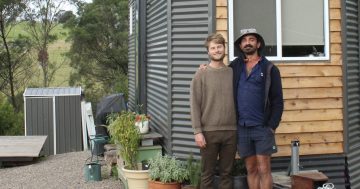
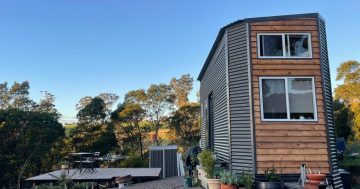
Josh Heins and Manu Bohn with their tiny home on wheels. Photos: Supplied.
Court-directed conciliation has failed to resolve the issue of whether a tiny home on wheels is a caravan or a building that requires a development application (DA). The matter will be heard in the Land and Environment Court in Sydney on 19 June.
What began as a housing choice for a young couple in the Bega Valley has turned into a legal battle that may help clarify both the status of tiny homes on wheels in NSW and the responsibility of local government agencies when exercising enforcement powers.
Josh Heins and his partner Manu Bohn have lived in their tiny home on wheels on rural land in the Bermagui/Cobargo area for several years. They opted for the tiny home as a practical response to housing affordability pressures and a commitment to sustainable living.
In 2025 Bega Valley Shire Council issued compliance orders requiring the removal of the tiny home on wheels and cessation of occupation, with potential penalties of up to $1 million for non-compliance. Council said the tiny home was a “building” that required development consent under the Environment and Planning Assessment (EPA) Act 1979 and therefore was not approved for habitation.
Mr Heins and Mr Bohn, along with the property owners whom they consider “family”, disagree. They said the tiny home on wheels was a “caravan” which did not require development consent under the EPA Act 1979 or council approval under the Local Government Act 1996. Their home was constructed on a registrable trailer and complies with size and weight requirements typically applied to caravans throughout Australia. They maintain it should be treated accordingly under NSW planning law.
After attempting to work meaningfully with council through a court-directed conciliation, the land owners are taking the matter to a contested hearing before the NSW Land and Environment Court.
“This case is bigger than one tiny house and it isn’t just about us,” Mr Heins said. “Across NSW, thousands of people are turning to tiny homes as a response to housing shortages and cost-of-living pressures. However, inconsistent interpretation of planning legislation across local government areas has created uncertainty for homeowners and landowners alike.”
He said a successful outcome in this case would assist in clarifying how tiny homes on wheels were treated under NSW planning law, the distinction between caravans and buildings, and the obligations of councils when exercising compliance powers.

The tiny home on wheels.
At its February meeting, council agreed to submit a motion at the Australian Local Government Association’s National General Assembly in June that called on the Commonwealth Government to provide national leadership to support the use of tiny homes and other small, affordable dwellings by working with state and territory governments to address planning, regulatory and policy barriers that currently limit their approval and deployment.
Mr Heins said challenging local council by-laws or their interpretations of legislation in the Land and Environment Court was complex and expensive. The landowners have already spent thousands of dollars to protect their right to have a tiny home on their rural land. Mr Heins and Mr Bohn have now launched a GoFundMe campaign to help raise funds for the final stage of their battle which is likely to cost more than $60,000.
The funds raised will assist with legal advice, court and expert fees in the Land and Environment Court proceedings and ongoing legal representation.
After rallying more than 30,000 signatures of support on Change.org. in 2025, which was noted by council in August 2025, Mr Heins and Mr Bohn hope to build on that support to fund their challenge, but also to create a clearer planning pathway for other tiny home on wheels owners in NSW.
“We are committed to full transparency and will provide updates to our supporters on the legal proceedings and running costs,” Mr Heins said. “If we are successful and full costs can be recovered, monies raised through the GoFundMe campaign will be re-donated to a charity supporting homelessness prevention in the Bega Valley region.”
Mr Heins and Mr Bohn said they had spoken with dozens of tiny homeowners facing similar compliance action by their local council. Australia-wide, thousands of people from all different circumstances were turning to tiny homes on wheels as an affordable, safe and flexible housing option. They said local government interpretation of the planning legislation and supporting regulations were applied inconsistently across local government areas, creating uncertainty for homeowners and landowners.
“We are determined that this case will set another important precedent for local government agencies and communities statewide,” Mr Heins said.