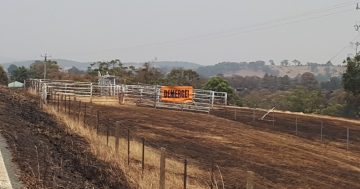
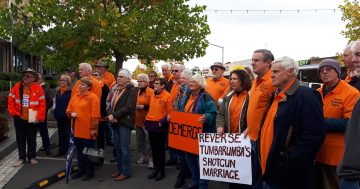
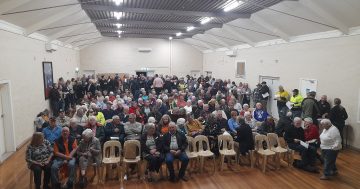
Planning for the Cootamundra-Gundagai demerger has gathered momentum, bringing two new councils closer to reality. Photo: Gundagai Council in Exile.
After years of debate and a formal decision to split, the detailed work of dismantling the Cootamundra-Gundagai Regional Council (CGRC) is now moving into one of its most complex stages — drafting the legal proclamation that will create two new councils.
Council leaders recently met with the NSW Office of Local Government (OLG) to discuss the process required to formally establish separate councils for Cootamundra and Gundagai, a step that will eventually turn the demerger from policy decision into legal reality.
CGRC Mayor Abb McAlister, interim general manager Roger Bailey and demerger transition manager Peter Bascomb recently met with OLG executive director Jennifer Hickey to discuss the work required before the proclamation can be prepared.
Councillor McAlister said the meeting focused on the information the OLG needed to begin drafting the proclamation — a highly detailed document covering the practical and legal issues involved in splitting one council organisation into two.
“A proclamation is effectively like an act of parliament,” Cr McAlister said. “It has to go through the same drafting and approval process involving the Office of the Parliamentary Counsel, the OLG and council.”
Among the matters to be addressed are contracts, the allocation of assets and resources, staffing arrangements and governance structures to ensure both new councils can operate effectively from the moment they begin.
The council has expressed concern about the expected timeframe once all the necessary information is provided.
It is estimated the drafting and approval process could take about six months before the proclamation is finalised.
Financial sustainability remains one of the most critical issues during the transition.
The council’s 2025 Financial Sustainability Plan, developed as part of the demerger proposal, outlined the financial settings needed to ensure both new councils remain viable.
Under that plan, the future Cootamundra council would require a special rate variation of 7.5 per cent above the rate peg for two years, while Gundagai would need a significantly larger increase — 25 per cent above the rate peg for three years.
The plan also identified the need for Gundagai to borrow about $1.5 million annually over three years to stabilise its finances.
These projections formed a central part of the evidence presented to the NSW Local Government Boundaries Commission (LGBC) during its assessment of the proposed demerger.
The commission recommended that the split proceed — advice that led to the NSW Government approving the demerger.
However, questions remain about how the proposed rate increases will be implemented.
Ms Hickey advised that special rate variations cannot be written directly into the proclamation, although alternative mechanisms may be available.
Some options may involve the Independent Pricing and Regulatory Tribunal (IPART), the body responsible for regulating council rate increases in NSW.
Mr Bailey told the meeting that involving IPART could create delays in the already complex transition process.
The council is now awaiting further clarification from the OLG about the steps required to ensure the additional income can be in place when the new councils begin operations.
While the legal framework is being developed, practical preparations for the split are being overseen by CGRC’s Demerger Transition Committee.
The committee, chaired by Cr McAlister, includes Deputy Mayor Rosalind Wight along with Crs David Graham, Penny Nicholson, Ethan Ryan and Gil Kelly.
Other councillors can attend meetings as observers.
Supported by Mr Bailey and Mr Bascomb, the committee has held meetings in January and February following an initial workshop in December.
Early talks have focused largely on governance and administrative matters that will underpin the transition.
One of the committee’s first major recommendations was the creation of a Demerger Transition Disputes Resolution Panel — an independent body that will act as referee if councillors cannot agree on a demerger-related matter.
The council adopted the recommendation at its February meeting.
The panel will consist of an independent chair and two members and will make binding decisions if required. The council has already committed to accepting the panel’s determinations.
Cr McAlister said the panel would help ensure transparency and accountability throughout the transition.
“The Demerger Transition Disputes Resolution Panel provides an independent, fair and structured mechanism to resolve matters if agreement cannot be reached,” he said.
“This is about maintaining momentum, protecting good governance and ensuring decisions are made in the best interests of both emerging councils and their communities.”
Expressions of interest have now been invited for suitably qualified and independent professionals to join the panel.
The council is seeking applicants with experience in local government, strong governance knowledge and the ability to provide impartial and balanced decisions.
The role offers what the council describes as a rare opportunity to contribute to a significant local government transition while helping shape the governance foundations of two new councils.
Further information on joining the panel is available on the council’s website.
Meanwhile, other practical planning work is continuing.
The transition committee has recommended that the two major software systems currently used by CGRC be adopted by both new councils.
Work is also underway to determine how existing council data can be securely separated and transferred while meeting privacy and data security requirements.
To streamline the process, the committee has adjusted its meeting schedule so its recommendations can move more quickly to formal council decisions.
Its next meeting is scheduled for 10 March.