‘Nobody would have ever expected we would become Australia’s most active, innovative, widely supported history society’ – Peter Lacey, South Coast History Society president. Photos: South Coast History Society.
Tin and aluminium traditionally mark a decade milestone. Diamonds in more modern thinking. Instant cameras and LEGO Minecraft for those celebrating their 10th birthday.
But what part does a single day play across a full marriage or 83-year lifespan (averaging out Australian Bureau of Statistics findings)? Viewing through a broader lens, how does one event impact an entire region?
It’s a question posed to Peter Lacey, South Coast History Society president as the group approaches its 10-year celebration this September.
Rather than talking up the anniversary, Peter reflects on challenges, changes and the unwavering support of society members and community donors across its catchment, stretching from Kiama to the Victorian border.
He’s also eager to explain the group’s role as a history society, not a historical society collecting objects or running a museum.
His group’s overarching goal: to shine a light on the region’s history.
“It’s our remit,” Peter says. “We don’t have a museum; we don’t have a library. Our role is to present history to anybody who might be interested.
“And there’s just so much interesting history here.”
From its first meeting on 25 September 2016, the society has filled a much-needed void.
“People were screaming out for information about South Coast history. Many weren’t born or raised here and didn’t have the advantage of learning the region’s basic history,” he says.
“We knew it’d be well received, but nobody would have ever expected we would become Australia’s most active, innovative, widely supported history society.
“We believe much of the South Coast’s interesting history sits in archives, filing cabinets and museums. Instead, it should be out there, shared with the wider community.”
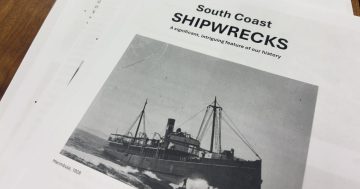
This take-it-to-the-streets approach includes walks, talks and tours; community projects; books and magazines; and the group’s comprehensive website featuring stories of notable women, shipwrecks, pioneers, towns and industries.


The society has also drawn community input from all ages and secured a $100,000 NSW Government grant to unveil 101 objects of importance for its project, Bega Shire’s Hidden Heritage.
The list reveals everything from the wooden-staved pipes providing evidence of Pambula’s 19th century water supply system to the Bunaan Rings resulting from Aboriginal rituals and ceremonial practices.
But not everything’s designed to help piece together the South Coast’s hyper-local jigsaw.
Peter says history knows no bounds and he often hosts talks at U3A meetings on topics as diverse as the 1960s sexual revolution and the Aztec Empire. The group also obtained a small grant to screen films of historical significance at The Picture Show Man in Merimbula, including The King’s Speech.
“We’re not confining ourselves to South Coast history. We’re engaging people in history.
“This helps explain a lot of things locally … What am I looking at in Bega’s main street? Why is dairying and shipping so important. How did they get from Canberra to Batemans Bay before the bridges existed?”
He says they’re questions – among a million others – that deserve full and careful attention to ensure we arrive at the most accurate, complete explanations amid a lightning-paced world that wants everything yesterday.

Peter Lacey packs the first issue of Recollections magazine in February 2017 (left); Page 1 of the most recent edition (available on the society’s website).
As the past informs the present, modern technology may in fact muddy and misinterpret the future – and it’s up to each of us to keep the digital age on the straight and narrow and not take it on trust.
“AI doesn’t necessarily question what’s in front of it. We can’t accept something that is wrong.
“Many very good histories have been written over the last 150 or so years and we accept a lot of them at face value.
“But we’re always happy to have people come back to us and say, ‘You’re wrong.’”
It’s also OK to say “I don’t know” – Peter’s answer when asked why Bega’s main thoroughfare is named Carp Street?
“One story tells of someone surveying the area going fishing and catching a carp,” he says. “But carp wasn’t introduced into Australia until later [in Tasmania, 1858]. Whatever they caught certainly wasn’t carp.
“If you find the answer to that one, we’d love to know.”

The South Coast History Society’s 384-page Extraordinary Histories, written by Peter Lacey. Distributed only on the South Coast, 4500 copies of the book were sold.
South Coast History Society will host free walks along Carp Street, Bega at 10 am on Tuesday 22 September and Saturday 26 September to help celebrate its 10th birthday. Bookings essential; phone 0448 160 852.
It’s also offering the chance to win one of 10 $100 bookstore vouchers. To enter, email ‘Happy Birthday’ to [email protected] before 25 September.