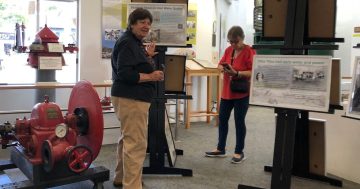
South Coast History Society president Peter Lacey is calling for better promotion of local history. Photo: Supplied.
Fascinating stories from the South Coast’s past are being researched and written, but too many are gathering dust instead of reaching the general community who would love to read them.
That’s the concern of South Coast History Society president Peter Lacey, who has called for local history societies to be given greater support to promote and share their work beyond their own memberships.
Peter spoke to more than 100 people at a Kiama Historical Society meeting, where he said good history was characterised by three things — it was well researched, well written and widely shared.
However, he said it was the final step where volunteer-run societies were struggling.
”The real problem is that the vast majority of local historical societies — and there are 1200 of them around Australia — either don’t know how to effectively promote histories, probably because none of their volunteers have any marketing skills or experience, or don’t have the resources available to be able to do so,” he said.
“And no encouragement is currently being provided to any of these societies to change that.
”This is an awful shame because there are many very worthwhile histories being produced that only ever reach a small fraction of those who would really like to know about them.
“For example, there are many good histories published in historical society newsletters or journals, but these newsletters or journals are only distributed to their very small number of society members.”
Peter said the South Coast History Society proved there was “an enormous unfilled demand within the community for more histories, particularly interesting local histories”.
He said that was demonstrated by the ongoing and ever-increasing demand for its free South Coast history magazine Recollections and its book Extraordinary Histories having clocked up 4500 sales on the South Coast alone.
“So, I’d like to see a program introduced that encourages and equips local history societies to effectively promote their histories,” he said.
Peter said that might include making newsletters or journals more widely available, regularly adding local history stories to the internet, partnering with radio stations to regularly broadcast interesting histories, or organising walks through towns and villages.
He said it might also be encouraging societies to organise regular history talks, such as what the Kiama Historical Society was effectively doing.
“And I’d like to see that successful promotion of history widely applauded and acknowledged,” he said.
“I find it quite odd that encouragement is currently given to historians to research and write up our history, but absolutely no encouragement is given — as far as I know anywhere in Australia — to anyone for actually sharing or promoting our history.”
Peter said the Prime Minister’s Prize for Australian History, the Australian History Prize awarded by the State Library of NSW, and the NSW History Awards, which were the nation’s most prestigious annual history accolades, were all bestowed on researchers and writers of histories.
He said they were not awarded to the successful promoters of history.
“So, our major awards, and the substantial cash prizes that go with them, can easily go to histories that may only ever be read by a relatively small number of people,” he said.
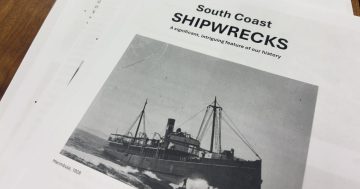
Peter was in Kiama to talk about the more than 200 shipwrecks that have occurred in waters south of Kiama.
The maritime theme will be continued at the next Kiama Historical Society talk on 19 September when the story of Robertson Basin, within Kiama Harbour, will be shared. This will be preceded by a joint Kiama Historical Society-Kiama Sea Shanty Club meeting on 16 September at Toby’s Hotel and by a Kiama Harbour history walk on 18 September.
Original Article published by Kellie O’Brien on Region Illawarra.