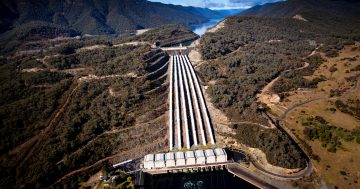
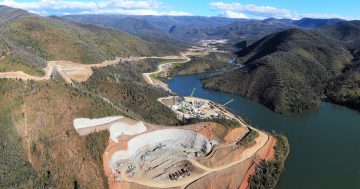
A tunnel in the Snowy Hydro 2.0 project – now set to be fully commissioned in late 2029. Photo: Supplied.
A review of one of the country’s biggest infrastructure projects has found it’s expected to cost up to $25 billion.
That’s the finding of a “line-by-line” cost reassessment of the Snowy Hydro 2.0 project.
The review, announced last year, has found the project is now expected to cost $22.2 billion, with about $3 billion set aside as a buffer.
While the project was initially set to cost $2 billion, Snowy Hydro announced that its cost had been revised to $12 billion in 2023.
In a statement, Snowy Hydro CEO Dennis Barnes said that while the finding was disappointing, the 2023 reset had limited the budget blowout.
“I have no doubt that moving from a fixed price contract, which was never suitable for such scale, uniqueness and complexity, has protected the project from an even greater cost increase,” he said.
“It’s also likely that under a fixed price contract, the project would again be stopped under the weight of billions of dollars of claims from the contractor, as it was prior to the reset.”
At the 2023 reset, it also announced the completion date was pushed out to 2028.
But the new review has pushed the finish line back by a year – to late 2029.
In its submission to a parliamentary inquiry about the project’s management, Snowy Hydro said various reasons were behind the growing price tag.
The company pointed to “design immaturity” and its “inherent complexity” (including its remote location in the Snowy Mountains) as reasons for the cost increase.
“Productivity underperformance and cost escalation have also been significant factors,” the submission outlines.
“Others have related to project-specific complexities that have developed during delivery.”
Meanwhile, principal contractor Future Generation Joint Venture (FGJV) said Snowy 2.0 wasn’t immune from cost increases across the construction industry.
“The project has not been spared from these pressures and there have been further increases from the cost estimated by the parties at the reset, caused by (among other things) necessary design changes, additional adverse geological and hydrogeological conditions and significant market and labour escalation,” its submission states.
The Australian National Audit Office (ANAO) examined the 2023 contract reset in a separate report.
It found that while the 2023 reset was driven by a “largely sound approach”, project management had only been “partly effective” since.
A project benefits analysis, prepared by engineering consultant GHD, was released alongside the review’s findings.
It found the Snowy 2.0 delivery would contribute $18.3 billion to the Australian economy and lower wholesale electricity costs by more than $7 billion by 2075.
Mr Barnes said that once completed, Snowy 2.0 would have significant long-term benefits for Australia’s energy reliability.
“The scale of Snowy 2.0’s energy storage is world-leading. More than half of the total energy storage the grid needs by 2050 will come from Snowy 2.0 alone,” he said.
“Like the original Snowy Scheme, which still underpins energy reliability more than 70 years on, Snowy 2.0 is a generational investment in our energy sovereignty and a national asset owned by all Australians.”
Once completed, the project will connect two reservoirs with underground tunnels and a new power station.
It’s expected to have a 2200 MW capacity, enough to power three million homes for a week.
According to the 2026 review, 65 per cent of tunnelling is complete, while cavern excavation is at 90 per cent.