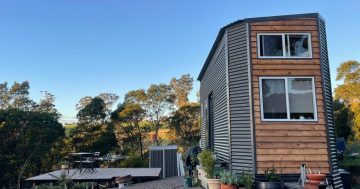
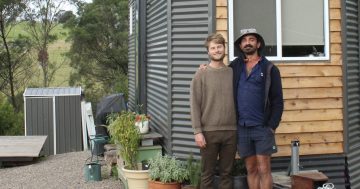
Shellharbour City Mayor Chris Homer. Photos: Shellharbour City Council.
Shellharbour City Council has paved the way for councils across NSW to exempt mobile tiny homes (MTH) from development applications (DAs) and quickly increase the supply of affordable housing.
Its two-year pilot of exempting MTH from the DA process began in September. The MTH must be built on wheels and on a registrable vehicle, located on suitable residential land, and comply with the eligibility requirements in council’s local approvals policy (LAP).
It’s in stark contrast to other coastal councils, one of which has taken the issue to the NSW Land and Environment Court.
Shellharbour Mayor Chris Homer said the changes implemented meant NSW’s other 127 local government areas did not need to reinvent the wheel if they were looking for permanent housing typology options beyond caravan policy.
“Any mayor or councillor can take this to their chamber and get it voted on to have MTH exempt from the DA process,” Mayor Homer said.
He worked on the initiative for two years. The two major pieces of work were changing the Shellharbour Local Environmental Plan (LEP) 2013 to facilitate MTH exemption from DAs and developing a LAP to sit alongside it.
“It is quite extensive and complex work to change the LEP and we had to have a gateway determination from the NSW Department of Planning, Housing and Infrastructure,” he said. “My director of planning had to develop the right mechanism because NSW only had caravan policy in place. This is a NSW-first progressive initiative because local government and the department broke new ground.”

A two-year pilot for mobile tiny homes is underway.
He said they eventually agreed the LEP could be modified to make MTH exempt from the DA process when they complied with the LAP. The LAP sets out the rules, compliance and restrictions.
The MTH must be connected to water, sewerage and drainage services so they operate in closer alignment with existing residential property.
The LAP specifies conditions, such as they cannot be installed in front of someone’s house in dense urban areas, and acreage properties in rural areas may allow a more front of property location.
“It is built in a way that we hope avoids negative feedback,” Mayor Homer said. “It is built for success and positive outcomes.”
He saw that tiny homes filled a gap in the housing supply chain. They can be constructed in eight to 16 weeks.
“Another key here is that the land being used has existing services, namely private land,” he said. “It is 60-70 per cent more expensive to build houses on greenfield sites due to public infrastructure costs.”

Housing was at the forefront of Chris Homer’s 2021 mayoral campaign.
The MTH pilot also means people with spare land at the back of their property can lease it out to the MTH’s owner.
“You don’t have to buy the MTH, just collect lease income,” Mayor Homer said.
The MTH can be used for both long-term and short-term rentals.
“Even using MTH as Airbnbs is still releasing opportunities for the housing market,” he said. “We need short-term accommodation too.”
The critical point is that MTH enable more Australians to have the basic human right of having a roof over their head, a cornerstone of mental health and human security.
“You get a sense of ownership,” Mayor Homer said. “There are some beautiful tiny homes around. It is very different from living in a caravan which is a very precarious way to live in NSW.”
He said by designing it as a pilot, the groundbreaking initiative would avoid derailment. “It is a de-risking measure to make sure it is built to last and built for success.”
Two days after council announced the MTH pilot’s start, the NSW Land and Environment Court ruled against a MTH on a rural property in Coolagolite in Bega Valley Shire.
In a statement to Region, Bega Valley Shire Council (BVSC) said the court’s decision reinforced its long-held position that where a dwelling is used to provide separate residential accommodation from the primary dwelling on a property, development consent is generally required, regardless of whether it is a conventional building or a moveable building.
“The court’s decision does not prevent the use of tiny homes or other innovative housing solutions. Rather, it confirms that where they are being used as separate dwellings, the appropriate planning approvals are required,” BVSC said.
Shellharbour City Council has proved councils have an alternative.
“Housing was at the forefront of my 2021 mayoral campaign. I have stuck with that and worked with the levers of local government,” Mayor Homer said. “If you stick with your commitments as a leader and think outside the box you can help with the housing crisis. We changed a lot of planning rules that are really hard to change.”