

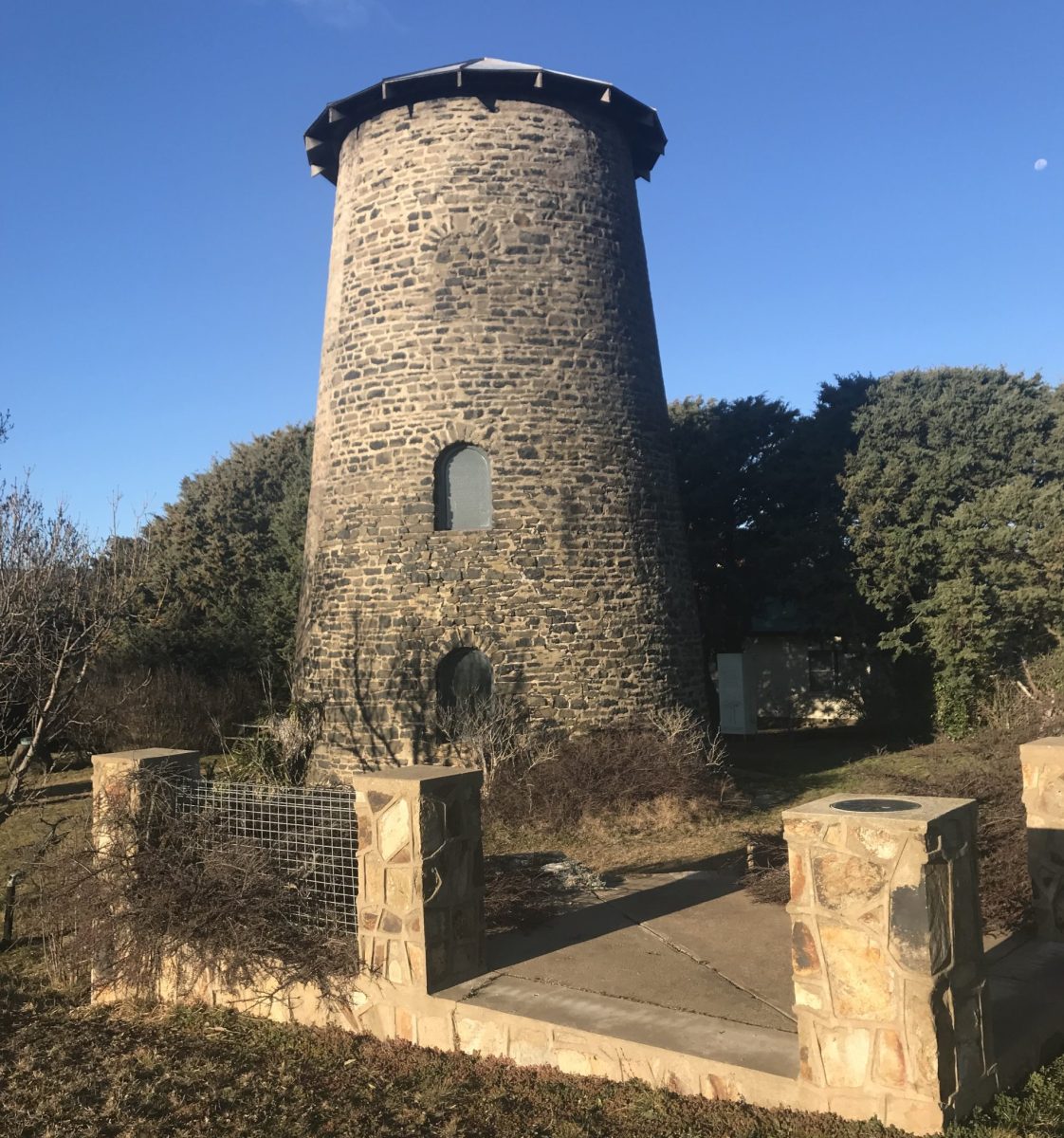
Standing sentinel over Nimmitabel for more than 160 years, the Geldmacher Mill is now undergoing repair assessments after storm damage closed the site in December 2025. Photo: Genevieve Jacobs.
It has weathered more than 160 years of Monaro winters, survived abandonment and outlasted the settler era that gave it life – all the more remarkable given its working days were over almost before they began.
Now, Nimmitabel’s beloved Geldmacher Mill is facing its latest test – and the community is watching closely as, again, the first steps toward its repair get underway.
Scaffolding is currently being erected at the historic site on the corner of Boyd and Clarke streets, after the mill and its immediate surrounds closed to the public in December 2025 due to storm damage.
Snowy Monaro Regional Council (SMRC) says the installation will allow specialist contractors to conduct repair assessments safely later this month, while also helping to protect the heritage building in the interim.
“The installation of scaffolding will ensure contractors can conduct repair assessments safely, while also helping to protect the heritage building while this work is underway,” a council spokesperson said.
For a building that has been central to Nimmitabel’s identity since the 1860s, it is a familiar, if unwelcome, chapter.
According to heritage records, the windmill tower was built between 1865 and 1872 by John Geldmacher, a German-born cabinet maker who constructed it practically single-handedly – patiently hauling, cutting and fitting together tonnes of rock over seven years to create a structure 40 feet high and 25 feet across at its base.
Designed to carry sails and power machinery for grinding locally-grown grain into flour, it was an ambitious undertaking for one man in a remote highland town.
But from the very beginning, it attracted controversy.
According to the Monaro Pioneers website, the law was not on Geldmacher’s side – soon after the mill was complete, he was informed he could not use it, with a 40-year-old act invoked to block him on the grounds that the structure stood too close to a public road and the shadow of the sails would frighten passing horses.
Undeterred, Geldmacher removed the wooden wings and replaced wind with horsepower.
Geldmacher’s mill ground flour until 1885 – old residents were recorded as saying that some fine flour was produced during those years, a small but meaningful contribution to a town that served as a vital stopover for miners and prospectors travelling from the coast to the Kiandra goldfields.
An unsuccessful attempt to convert it to a sawmill followed, after which the tower was used as a storehouse for many years before being abandoned altogether.
Geldmacher’s influence on the town stretched well beyond the mill.
He purchased the Commercial Hotel in 1902, a building now home to the Geldmacher House Museum, while the Bush Nursing Service he funded on his death – established on the site of his home, adjacent to the mill – is today used as the Community Health Centre.
Curiously, despite leaving such a visible mark on the town, he remains unnamed in the Monaro Pioneers register.
The mill itself was rescued from obscurity when Monaro Shire Council – recognising it as a rare physical record of early construction and manufacturing in the region – restored it in 1961.
Today it is considered one of only two wind-powered flour mills still standing in NSW, a distinction that has made it not just a local landmark but a structure of genuine state heritage significance.
That restoration cemented its place as a centrepiece of Nimmitabel’s heritage tourism offering – though keeping it that way has required ongoing commitment.
In 2022 the site was temporarily closed after visible structural defects raised safety concerns, prompting inspections by a structural engineer and subsequent repair work – contractors re-pointed the affected mortar and cleared vegetation from the mill’s base to improve drainage.
SMRC lifted the access restrictions in April that year and visitors returned.
The mill remains a fixture of the Nimmitabel Heritage Walk and one of the town’s most photographed spots – alongside The Nimmity Bell, George the Elephant, the stately Royal Arms Guesthouse and Nimmitabel Bakery’s famous “giant” sausage rolls.
Its appeal extends beyond heritage tourism. Steampunk @ Altitude, held on the first weekend of May, brings Victorian-era fantasy and imaginative costuming to the streets of Nimmitabel each year, and the mill has previously served as a performance venue during the festival – its 19th century industrial character a natural fit for the steampunk aesthetic.
Work is expected to be completed over the coming month, with timeframes subject to change depending on weather or other unforeseen circumstances.
Council has asked all residents and visitors to respect the fenced exclusion zone while assessments and repairs are underway.









