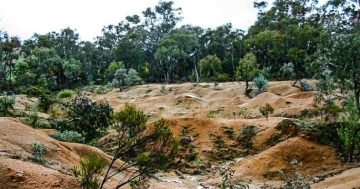
Boorowa relies heavily on the water from Boorowa River. Photo: Nick D/Wikimedia Commons.
Water restrictions in Boorowa have been eased back to Level 2 after recent rainfall and cooler temperatures improved inflows into the Boorowa Weir, bringing temporary relief to a town long accustomed to living with uncertain water supplies.
Hilltops Council confirmed the change this week, saying rainfall across the catchment had helped stabilise the system. Bore water continues to supplement the town supply and demand remains moderate under council’s Drought Management Plan.
But the easing follows the introduction of Level 3 water restrictions on 20 February, when prolonged dry conditions and falling inflows pushed the system close to critical levels.
Council is still urging residents to conserve water.
“Water is a precious resource,” the council said in a statement. “Despite the return to a lower restriction level, [we] continue to urge all users of Boorowa town water to conserve water, comply with the restrictions outlined below, and use water efficiently to help prolong supply for as long as possible.”

“It is dreadful”: Boorowa water woes were highlighted by Yass MP WF Sheehan during a 1930s public meeting on extending the south-west water scheme. The meeting was held in Binalong and reported in The Burrowa News. Photo: Trove.
For Boorowa, the cycle is a familiar one.
Historic records and newspaper reports show the town’s water supply has long been a case of feast or famine, with reliability and water quality at the centre of community concerns for more than a century.
A concrete weir was first constructed on the Boorowa River in 1902 to meet the needs of the growing township, but the supply soon proved unreliable.
A larger water scheme built in 1939-40 improved capacity but did not eliminate ongoing shortages or quality concerns.
Today the town still relies primarily on water drawn from the Boorowa River, supplemented by two local bores and treated at the Boorowa Water Treatment Plant, which was built in 1994.
Hilltops Council general manager Anthony O’Reilly said the plant used a series of treatment processes to remove impurities and ensure the water was safe to drink.
Modern monitoring and control systems at the Boorowa plant, recently upgraded with support from the NSW Government’s Advanced Operational Support Program, ensure the water meets all health-based targets under the Australian Drinking Water Guidelines, he explained.
Mr O’Reilly said the town water was safe to drink, but the natural quality of the river and bore supply meant it did not always meet aesthetic targets for hardness and total dissolved solids.
In simple terms, the water contains higher levels of natural minerals such as calcium and magnesium, which can affect taste and leave deposits on taps and appliances.
For many residents, the issue is not just reliability but the practical cost of avoiding the town supply altogether.
A 2023 ABC report found only about 18 per cent of Boorowa residents regularly drank tap water, with many relying instead on bottled water or rainwater tanks.
The town’s vulnerability was highlighted again in January 2024, when a major boil water alert was issued following heavy rain that compromised the filtration system.
The alert lasted more than 26 days, forcing residents and businesses to boil water before drinking.
Hilltops mayor Brian Ingram said the situation underscored the urgency of finding a long-term solution.
Responding to community frustration – including complaints that the town’s water was “third world” – Cr Ingram said it was unacceptable that a town just 90 minutes from the nation’s capital did not have a reliable drinking water supply.
For several years, a proposed Harden to Boorowa Pipeline has been identified as the most viable long-term solution.
The project would connect Boorowa to the Goldenfields Water County Council network, which supplies treated water sourced from the Murrumbidgee River at Jugiong to towns including Harden, Young, Jugiong and Galong.
Planning on the Harden to Boorowa Pipeline has been underway since at least 2017, and Mr O’Reilly said the detailed design is now essentially complete, meaning the project could proceed as soon as construction funding is secured.
The project is estimated to cost about $56 million, including connection costs to the Goldenfields network.
While the NSW Government has provided funding through the Safe and Secure Water Program for investigations and detailed design, construction funding has yet to be secured.
At its February meeting, Hilltops Council resolved to continue advocating – alongside Member for Cootamundra Steph Cooke – to state and federal governments for funding to build the pipeline and support its long-term operation.
Ms Cooke has previously backed the proposal, highlighting the need for stronger investment in regional water infrastructure.
“Hilltops Council has done the work, they are all but shovel-ready and good to go,” Ms Cooke said.
“The one piece that’s missing is the funding required, and that has to come from a combination of the state and federal governments.”
For now, however, Boorowa residents remain caught between rainfall cycles and infrastructure delays.
Even with restrictions eased back to Level 2, council says conservation remains critical as the community waits for a permanent solution to a problem that has lingered for more than a century.