Speakers at the inquiry included (from left) Queanbeyan Mayor Kenrick Winchester, Goulburn Mulwaree Mayor Nina Dillon, Yass Valley Mayor Jasmin Jones and Member for Goulburn Wendy Tuckerman. Photo: Yass Valley Mayor Jasmin Jones.
Community advocates and politicians have used a NSW inquiry to urge the State Government to abandon waste-to-energy plans.
The NSW Parliamentary inquiry has been investigating the use of the facilities.
Hearings were previously held in Parkes and Sydney, before its members headed to Goulburn for a two-day visit late last week.
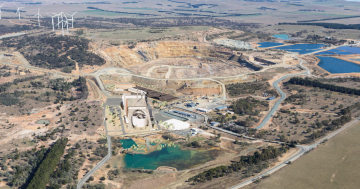
The area is home to the proposed Veolia Woodlawn Advanced Energy Recovery Centre at Tarago.
The project could process up to 380,000 tonnes of waste a year.
On Friday (15 May), Goulburn Mulwaree Mayor Nina Dillon said her local government area (which takes in the proposed facility) was facing an “over-significant burden” on its infrastructure.
“We have got solar farms, we have got extractive industries, we have got waste facilities … It is just accumulating and accumulating,” she said.
“I think the general community is overloaded. I think they feel that they have no control.”
Meanwhile, Queanbeyan Mayor Kenrick Winchester reaffirmed the council’s opposition to the proposal.
“[Queanbeyan-Palerang] communities have expressed consistent and widespread opposition to the project … [This is] an unequitable transfer of Sydney’s waste burden onto regional communities.”
Queanbeyan-Palerang Regional Council denounced it in 2022, while Yass Valley Council (YVC) has also flagged its opposition to the project.
Mayor Winchester pointed to the ACT, which had banned waste-to-energy incinerators indefinitely.
“I think it speaks volumes that the most progressive government, the most environmentally friendly government we have in all of Australia, has rejected waste-to-energy [technology],” he said.
Earlier this year, an ACT Government spokesperson told Region the policy had been extended in May 2025.
In her testimony, YVC Mayor Jasmin Jones called on the State Government to use the waste levy in a push to incentivise Sydney councils to reduce rubbish generation at the source.
She said regional councils simply didn’t have the economies of scale to develop alternative strategies and business models around waste management.
“Wouldn’t it be a joy to know that we could reverse those trains, send our waste to Sydney because they’ve come up with the next greatest thing since sliced bread, which doesn’t create these problems of the low-tech energy-burning facility?”

Member for Goulburn Wendy Tuckerman said waste-to-energy technology was at odds with a push towards recycling. Photo: John Thistleton.
Earlier that day, Member for Goulburn Wendy Tuckerman said waste-to-energy technology was at odds with a push towards recycling.
“[It] is carbon-inefficient, inconsistent with circular economy principles, and fundamentally inequitable,” she said in her opening statement.
“Viable alternatives exist … Energy-from-waste facilities rely on guaranteed waste streams, locking the system into ongoing waste production and directly contradicting the waste hierarchy.”
During questioning by the panel, she suggested possible increases to Environment Protection Authority (EPA) penalties for contamination or other environmental mismanagement.
“I don’t think the penalties are, certainly, large enough. This is a multibillion-dollar company, and I think one of the fines was $15,000,” she said of Veolia.
“I think that tells a story.”
Several speakers also raised concerns around the impact of Tarago’s existing landfill facility and how the incinerator technology would be managed and regulated.
On Thursday evening (14 May), one landholder told a community forum that the technology was “entirely inconsistent with common environmental standards”.
Other speakers said there had been a “persistent odour” and issues with wastewater contamination at the existing landfill, while a third alleged “disregard and negligence” by Veolia.
On Friday, Communities Against the Tarago Incinerator (CATTI) treasurer Thalia Sadumiano told the inquiry that in the week before the hearing, the group had received four odour complaints.
She also said others in the community were “burnt out”.
“They’ve done it really well, but they’re exhausted,” she said. ”I’ve always been a part of it, but when it gets too much, I have to take a step back and recover myself, mentally.”