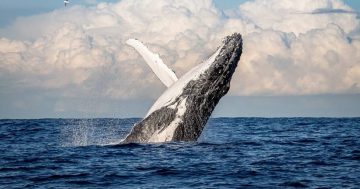
The whale was first seen near Batemans Bay on the NSW South Coast. Photo: NSW National Parks and Wildlife Service.
A humpback whale, slowed down by 13 kilograms of fishing line and other material, is now swimming freely after a weekend rescue.
The entangled whale was first reported to the Organisation for the Rescue and Research of Cetaceans in Australia (ORRCA) 24/7 Rescue Hotline after being seen near Batemans Bay, trailing fishing line and buoys.
It triggered a specialist response as teams tracked the whale northwards in the hope of freeing it.
By the time it reached waters near Ulladulla, they were able to mount a successful operation on Saturday (13 June) to free the whale.
NSW National Parks and Wildlife (NPWS) incident controller Andrew Wall said that was the outcome the rescuers trained for.
“This was a fantastic outcome for this whale, and a great example of the importance of rapid reporting and coordinated response efforts by a variety of specially trained teams,” he said.
During the rescue, the NPWS Large Whale Disentanglement Team (LWDT) removed 46 metres of trailing line, two buoys and seaweed from the whale.
The material weighed a total of 13 kilograms.


Following the disentanglement, the whale was observed moving faster.
Marine Rescue NSW Inspector Glenn Sullivan said units from the organisation’s Batemans Bay and Ulladulla units assisted in the operation.
“Marine Rescue NSW vessels act as the mothership during these complex responses, with Marine Rescue volunteers tracking the whale from Batemans Bay to Bawley Point, where they rendezvoused with Marine Rescue Ulladulla volunteers and the NPWS team,” he said.
“It was extremely rewarding to see the whale successfully freed and able to continue its journey unhindered.”
A drone pilot operating as part of the NSW Right Whale ID Program recorded aerial imagery of the humpback.
This captured valuable information on the type and configuration of entanglement, to help with the response.
Disentangling marine wildlife is a complex and dangerous operation that requires highly trained operators, specialist equipment and suitable conditions to safely approach and assist animals at sea.
ORRCA president Ashley Ryan welcomed Saturday’s rescue.
“ORRCA volunteers have already invested hundreds of hours this migration season tracking entangled whales and supporting response efforts,” she said.
“While not every situation presents an opportunity for intervention, it’s extremely rewarding to see a coordinated, full-scale response achieve a positive outcome when the conditions and circumstances allow.”
She encouraged anyone who sees an entangled whale to contact authorities.
“Whale entanglements remain one of the most significant threats faced by migrating humpback whales along our coastline,” Ms Ryan said.
“These incidents can quickly become life-threatening, which is why rapid reporting and a coordinated response are so critical.”
Whale-disentanglement training is supported by the NSW Marine Estate Management Strategy (MEMS).
If you see an entangled whale, report its location, direction and speed to NPWS on 1300 072 757 or the ORRCA Rescue Hotline on (02) 9415 3333. The public should not approach an entangled whale.