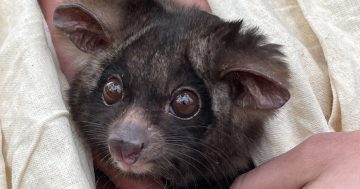
A wombat photographed within the 515-hectare Glenbog State Forest area proposed for logging. Photo: David Gallan.
Claims that logging had already begun in Glenbog State Forest appear at odds with statements from Forestry Corporation of NSW, which says a planned native timber operation in the forest remains in the planning phase and has not yet been approved.
The clarification comes amid escalating pressure from wildlife and conservation groups campaigning against harvesting across four forest compartments that they say support a significant wombat population and important greater glider habitat.
In a statement provided to About Regional on Thursday, a Forestry Corporation spokesperson said no harvesting had begun.
“A proposed operation for compartments 2312A, 2313A, 2314A, 2315A remains in the planning phase,” the spokesperson said.
“The planning needs to be completed and the plan approved before any work would commence.”
The corporation said the operation would proceed under the Coastal Integrated Forestry Operations Approval (CIFOA), which regulates native forestry operations in NSW, and any approved harvest plans would be published online through its Plan Portal.
The statement appears to conflict with recent claims by advocacy organisations that logging was due to begin on 1 May.
Adding further confusion to the timeline, the International Fund for Animal Welfare said this week the operation had now been delayed until at least 1 June following public pressure from environmental groups, although Forestry Corporation has not publicly confirmed that timeline.
Earlier this month, Humane World for Animals Australia launched a public action campaign calling on supporters to pressure the NSW Government to halt the operation in what it described as a rare high-altitude forest ecosystem.
Campaigners argue logging operations risk damaging wombat burrows and removing large old trees relied upon by hollow-dependent wildlife species.
The dispute has also reignited broader debate over the future of native forest logging in NSW, with conservation groups calling for a greater reliance on plantation timber and alternative wood products.
At the time, Humane World for Animals campaigns director Nicola Beynon said the organisation understood logging was expected to begin “in the coming days”.
“We understand that Forestry Corporation of NSW intends to commence logging in Glenbog State Forest in the coming days,” she said.
“This will have a truly devastating impact on native wildlife in the area, including for a substantial number of wombats who are already so impacted by shooting, car strikes and disease in NSW.”

Habitat within the proposed Glenbog State Forest logging compartments that conservation groups say supports wombats, greater gliders and other native wildlife. Photo: Wilderness Australia.
Meanwhile, Marie Wynan and her husband, Ray, who run Jarake Wildlife Sanctuary bordering Glenbog State Forest near Bombala, say they do not support the operation proceeding and believe the protections proposed for wombat habitat are inadequate.
Mrs Wynan is also a director and spokesperson for the Wombat Protection Society of Australia.
She said they had documented 1003 wombat burrows within the proposed logging area and provided GPS coordinates for all identified burrows to Forestry Corporation.
“To date, Forestry Corporation has not surveyed or identified any wombat burrows in the area,” Mrs Wynan said.
Forestry Corporation has said it previously worked with Jarake Wildlife Sanctuary to develop guidance material for the management of wombat burrows in Glenbog and that the guidance would be implemented during the operation.
However, Mrs Wynan said that should not be interpreted as support for the harvesting plan itself.
“We do not support the operation proceeding, and we have called on Forestry Corporation to abandon it entirely, given the high density of wombat burrows and the impossibility of conducting operations without destroying them,” she said.
Mrs Wynan said Forestry Corporation representatives met with staff in August 2025 and again in March this year to discuss wombat protections and proposed exclusion zones near the sanctuary boundary.
According to Jarake, the sanctuary requested a 20-metre exclusion zone around documented burrow sites, but Forestry Corporation declined.
“Forestry Corporation declined, stating they would ‘do our best to protect the entrances’. This is inadequate,” Mrs Wynan said.
“If logging goes ahead, wombat habitat will be destroyed and severely damaged. The network of burrows that is vital for their movement across their home range will be dismantled.”
She has also rejected suggestions wombats could be temporarily relocated during logging operations.
“During that meeting, their senior planner asked if we could bring the wombats into our sanctuary and then release them back once operations were complete,” Mrs Wynan said.
“After we explained the reasons this is not a viable option, she acknowledged it could not be done.”
Mrs Wynan said she believed logging would trigger disease outbreaks among surviving wombats due to habitat stress and fragmentation, pointing to what she claimed occurred following logging operations in Glenbog in 2014.
“The current population within the proposed logging area is mange-free and in very good health,” she said.
“In fact, the only mange recorded in Glenbog State Forest has occurred following the 2014 logging.”
The proposed operation has become the latest flashpoint in the broader debate over native forest logging in NSW, with conservation groups arguing forests such as Glenbog provide critical wildlife habitat, while Forestry Corporation maintains operations are conducted under strict environmental rules and sustainable forestry frameworks.