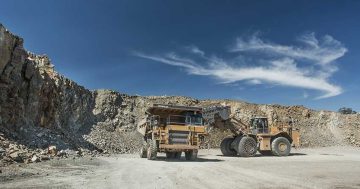
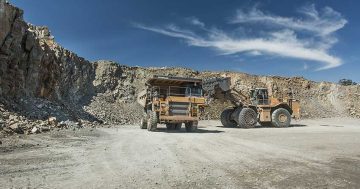
The Monaro Rock Quarry is proposed for near the NSW/ACT border. Photo: EIS.
Monaro Rock is expected to “become a valued part of the community” despite the vast majority of Royalla, Googong and Tuggeranong residents expressing their disapproval of its proposed hard rock quarry.
RWCorkey&Co prepared Monaro Rock’s response to the issues raised in submissions, outlining Monaro Rock was “confident” any concerns “have been addressed satisfactorily and that concerns and objections raised in submissions have been appropriately identified and addressed”.
A total of 514 submissions were received during the consultation period, including 488 from members of the public, 14 by organisations and 11 from government agencies.
Of these, 94.82 per cent objected to the project.
Frequently raised concerns were to do with risks associated with dust and air quality (63 per cent of objections), silica dust generation (61 per cent) and respiratory health risks (54 per cent).
Other key matters included traffic issues, biodiversity, general noise and threats to community lifestyle and character.
Those supporting the project pointed to local economic benefit generated by the project, including jobs, and the need for the project given declining resource availability in the area.

Principal components of the Monaro Quarry Project (including the sealing of the secondary access road). Photo: Report.
Two minor amendments have already been made to the project as the result of supplementary assessments: the sediment dams have been expanded to safely contain runoff during storms, and Monaro Rock has committed to seal the first 120 metres of the secondary access road (from the Mates Drive intersection) to reduce noise impact of regular road maintenance.
The report noted the updated air quality impact assessment “remain[s] comfortable” that 90 per cent of control efficiency for dust suppression on roads will be achieved.
“The updated modelling predicts marginally higher levels of odour than those presented in the original assessment, though outcomes remain well below the adopted criteria,” it stated.
The modelling now included emissions from diesel generators, use of storage tanks and handling and storage of materials for load out.
It continued to predict the project’s silica emissions would be low, and it would comply with predicted odour criteria and air quality requirements (even for worst-case emissions).
Construction of the access roads and initial site preparations are expected to take four months.
No material would be moved from the site for sale until the quarry access road (including the intersection with Monaro Highway about 3.4 km north of Old Cooma Road) was built.
The report noted construction noise levels from month one to month four were expected to exceed noise-affected levels for homes in the noise catchment area and just beyond.
“But [these impacts] would be mitigated by employing appropriate construction noise management practices,” it stated.
“Outcomes … continue to predict that noise levels and vibration impacts generated as a result of the operation of the quarry would comply with the relevant assessment criteria at all private residences (within NSW and the ACT).”
On traffic, new surveys were undertaken in November 2025 at key locations – including Monaro Highway, Old Cooma Road, and Monaro Station Road – to compare to 2021 data.
“It is noted that Old Cooma Road now shows more pronounced morning and afternoon peaks, likely due to the new residential development at Googong since 2021,” it stated.
“As a result of this analysis … the project’s transportation activities would have minimal impact on local traffic flows.
“Peak hour delays are expected to be negligible, and operational traffic would be infrequent.”
Monaro Rock couldn’t commit to avoiding the use of Old Cooma Road during school bus hours, but promised measures to “minimise potential interactions” between construction traffic and other road users would be put into a Driver’s Code of Conduct for the development.
All operational heavy vehicles would be directed to use the dedicated quarry access road onto the Monaro Highway rather than use Old Cooma Road – unless it couldn’t be helped.
“While occasional congestion may require pre-planned transport coordination, the chosen access road location significantly reduces conflict risks for local communities, and the intersection configuration remains the preferred option,” the report stated.
“Monaro Rock has regularly repeated its commitment that product despatch and heavy vehicle traffic would not use the secondary access road and would be comfortable that this be included as a condition of consent.
“The applicant maintains that the majority (95 per cent) of vehicles transporting quarry products would turn right at the intersection of the quarry access road and the Monaro Highway. However, it is also acknowledged that some traffic would turn left … [and go onto] Old Cooma Road.
“The use of Old Cooma Road for quarry haulage is not proposed unless customers must be reached by Old Cooma Road.”
It’s been predicted there will be up to 500 heavy vehicle movements per day, with half of those trucks fully laden.
The report stated in-principle agreement for the design and traffic outcomes of the quarry access road had been obtained from the ACT Government.
The report rejected concerns the project would impact on property values, stating the social impact assessment found no “irreversible impacts” to values were predicted.
“[However] the project should aim to operate without intruding on the community to the greatest extent possible,” it stated.
The economic assessment predicted it would deliver net economic benefit of $41 million to NSW. Assessments also identified that, without any new hard rock quarry approvals, demand would exceed supply from existing reserves from 2029 onwards.
If approved, this project would be the first greenfield quarry development for the region in 25 years.
The report concluded the suggested outcome remained unchanged to that from the environmental impact statement stage.
“That is, should the project be approved it would represent a modern and responsible approach to resource development that would deliver substantial economic and social benefits while maintaining a strong commitment to environmental best practice,” it stated.
“It is intended that the project would provide lasting benefits for the region, and that the people who work to develop it would become a valued part of the community.”
Given the amount of opposition, the development application will have to be determined by the Independent Planning Commission, acting under the delegation of the NSW Planning Minister.
The recent koala sighting at Theodore, about 1-2 km from the property on which the development is proposed, was noted in the report.
Koala surveys are being commissioned by Monaro Rock, to take place between now and December.
More information about the project can be found here.