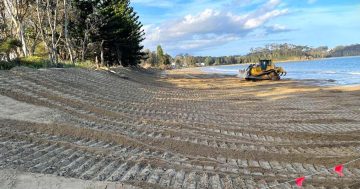
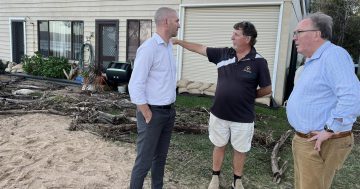
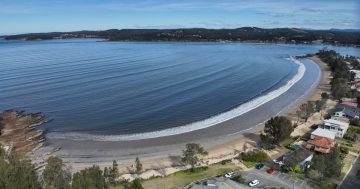
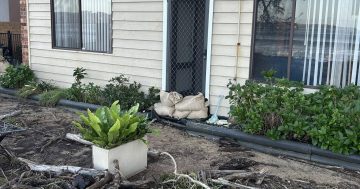
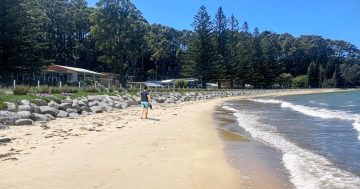
Work was carried out late last year to create a new line of defence against erosion at Surfside Beach. Photo: Eurobodalla Shire Council.
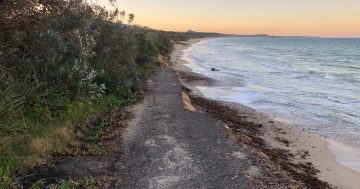
A protective dune was significantly damaged during recent wild weather, but there are no plans for further works in the battle against ongoing coastal erosion near Batemans Bay.
Late last year, Eurobodalla Shire Council (ESC) turned to “beach scraping” (a technique where sand from the intertidal zone is used to reshape the dune at the back of the beach).
Five thousand foreshore-compatible plants were also planted in an effort to revegetate the area.
Those works were an emergency response action under the Open Coast Coastal Management Program (CMP), which guides work on public land and identifies community infrastructure that needs protecting.
It was an operation off the back of ongoing erosion concerns from high tides, storm surges and severe weather events which have been eroding the remaining shoreline.
In April 2025, one long-time resident told Region her community felt like they were “waiting for the houses to fall in” after an east coast low.
“It’s right up to our back doors now and for a few of the houses here, it’s [the sea] getting uncomfortably close,” she said at the time.
In the aftermath of the system, residents also called for a natural disaster declaration as part of their push for further action.
The area was again smashed when a powerful low-pressure system swept across southern NSW and the ACT in late March, bringing with it damaging winds, heavy rain and large waves.
But a council spokesperson has confirmed that creation of the dune will likely be a one-off operation.
“Last year’s sand scraping at Surfside Beach was a temporary measure to protect the reserve in anticipation of sand accumulating on the beach following Transport for NSW dredging the Clyde,” the spokesperson told Region.
“The reshaped dune did its job, shielding nearby properties during several coastal inundation events over the past six months, but it was significantly damaged by the weekend’s storm and heavy seas.”
A spokesperson for Transport for NSW Maritime (TfNSW Maritime) said the initial dredging decision was made following the completion of a Review of Environmental Factors (REF) and with the goal of maintaining safe navigation at the entrance to the Clyde River.
“Dredging occurred in 2025 [and involved] removing approximately 30,000 m3 of sediment for the navigation channel. The sediment was placed strategically offshore from Surfside Beach to allow natural coastal processes to transport sand toward Surfside Beach – delivering some beach nourishment benefits.”
The TfNSW Maritime spokesperson said management of Surfside Beach was facilitated under NSW Crown Lands and ESC coastal management responsibilities.
“Future dredging at the Clyde River continues to be subject to statewide risk-based prioritisation of dredging works and available funding,” the spokesperson said.
Meanwhile, Eurobodalla Council’s spokesperson said that while council wasn’t planning further works at Surfside Beach, it would be keeping a close eye on the site.
“Council will focus on closely monitoring the dune and erosion and continuing discussions with residents, Transport for NSW and other relevant government agencies to assess the next steps,” the spokesperson said.
In August 2025, the council also announced work was starting to build a 250-metre rock wall along nearby Long Beach, after east coast lows also caused erosion that exposed the edge of Bay Road and the roots of nearby trees.
Further details on the works can be found on the council’s website, which has information on projects in the Batemans Bay area and how council manages coastal areas.