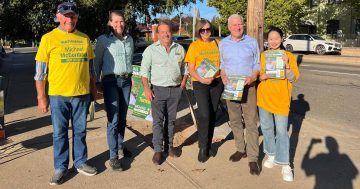
David Farley speaks to a crowd in Albury as Pauline Hanson looks on with admiration. Photo: One Nation.
One Nation has emerged as the trendsetter in the by-election race for Farrer, running a slick and energetic campaign that has drawn a huge crowd to its launch and built a dominant social media presence.
The announcement this week that Pauline Hanson’s party is likely to swap preferences with the Liberals could be the icing on the cake – the factor that delivers them their first federal Lower House win after more than 30 years of trying. It may also prove a strategic misstep for the Coalition by strengthening a party already eating into its base.
Voters ultimately decide how they number candidates under Australia’s preferential electoral system. But parties still wield significant influence through “how to vote” (HTV) cards handed out at polling booths. Many voters – particularly those less engaged in politics – follow these cards closely, meaning preference deals can determine the result.
We’ve already seen the power of this strategy. At the recent South Australian election, the Liberals recommended preferencing One Nation, and the minor party returned the favour.
Now, we can’t even call them a “minor party”. One Nation secured a higher primary vote than the Liberals and may even finish neck-and-neck with them on seats.
Pauline Hanson told media on Thursday (26 March) she’d be very happy to strike a similar deal in Farrer, and Liberal deputy leader Jane Hume has indicated the party would likely be open to it.
If it proceeds, it would be a major boost for One Nation candidate David Farley in what is shaping as a two-horse race against independent Michelle Milthorpe.
A recent Australia Institute poll has Farley leading on 28 per cent of the primary vote, with Milthorpe on 23 per cent, the Liberals on 19 per cent, and the Nationals, Greens and others a long way back. On those numbers, no candidate comes close to an outright majority, meaning preferences will decide the contest.
Liberal and National voters, guided by HTV cards, would likely direct a significant share of their preferences to Farley. He is also well placed to attract flows from right-leaning minor parties such as Family First.
Milthorpe, by contrast, faces a tougher path. At the 2022 election, she benefited from strong preference flows from Labor and Greens voters. This time, Labor is not running a candidate and the Greens vote appears minimal, depriving her of the preference base that previously kept her competitive.
In short, Farley is holding the stronger hand – and he’s playing it well. He has been articulate, disciplined, and on-message throughout the campaign. Rising petrol prices are also fuelling voter frustration – terrain that traditionally favours One Nation.
To be clear, this is not an endorsement of this party, but an assessment of the factors currently working in its favour.
Critics argue One Nation lacks substance, plays on people’s fears and can be a bit loose with the truth when campaigning, but none of this stopped it winning seats in South Australia.
Farrer betting markets are also shifting rapidly. Odds that once had One Nation as a long shot at around $5.50 have tightened dramatically to near $2, reflecting growing confidence in its chances. A formal preference would shorten those odds even further, creating a steep uphill battle for Milthorpe.
If Farley takes Farrer, it would be a landmark moment for One Nation. After decades on the political fringes, winning a federal Lower House seat would signal a transition from protest movement to parliamentary force. Donors would take notice, and so too would ordinary Aussies who previously dismissed them as a wasted vote.
And that is where the longer-term risk for the Coalition becomes clear. By preferencing One Nation now, the Liberals may be helping to build a more formidable rival – one capable of turning borrowed preferences into permanent support. They could end up facing the same dynamic seen elsewhere: insurgent movements reshaping the parties that once enabled them, whether it be Reform eroding Conservative support in the UK or Donald Trump’s movement transforming the Republican Party in the United States.
In politics, preference deals are often about short-term survival. But in in the electorate based around Griffith and Albury, the Liberals may be doing more than influencing a single result – they may be helping to write the next chapter of One Nation’s rise.
And if that rise culminates in victory, it will be a case of the Coalition discovering that when you feed the preference beast, it doesn’t always stay on a leash.
Original Article published by Oliver Jacques on Region Riverina.