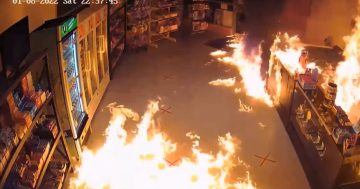
Illicit tobacco seized in Victoria last year. The current excise is just over $38 per pack of 25, or $1.53 per cigarette. Photo: Australian Federal Police.
One Nation has a solution to Australia’s illegal tobacco trade, and that’s for the Federal Government to slash the tobacco excise so people will start buying legal cigarettes again.
Pauline Hanson briefly outlined her party’s new policy on Tuesday (18 August), to cut the tobacco excise by 75 per cent and put a hold on indexation for three years.
Senator Hanson said the current management of tobacco sales has failed and only served to give a “multi-billion-dollar market to organised crime”.
She has found little love for the idea so far, with Labor saying law enforcement should be the priority, the Coalition insisting it has a better plan, and the Greens blasting One Nation for pushing big tobacco’s agenda.
One Nation’s Barnaby Joyce, however, said the minor party’s plan was just common sense; that the price of legal cigarettes should be lowered to match that of the illicit tobacco products.
“This is just absurd economics that if you keep on putting up the price of cigarettes you are going to get more excise,” Senator Joyce said.
“No. If you keep on putting up the price of cigarettes, you’re going to get more mafia. That’s what you’re getting, more mafia.
“The only way we can deal with the criminality, the mafia that also underwrites so many other drugs, is to bring back the price of legal cigarettes to the same realm as where illegal ones are.”
Tobacco excise has risen in Australia by more than 200 per cent over the past decade. A legal pack of cigarettes now costs around $65.
The current excise is just over $38 per pack of 25, or $1.53 per cigarette.
Slashing it would bring down the price of a pack by about $30, making it closer to the far cheaper illicit smokes imported from Asia and the Middle East.
Australian Bureau of Statistics data suggests about 80 per cent of tobacco products and vapes currently purchased are illegal.
Treasurer Jim Chalmers says the government has no plans to reduce the excise but acknowledges that illicit trade presents a serious challenge.
“For the government, our primary focus has been on providing hundreds of millions of dollars in extra resources for the police and other authorities to crack down on this big problem in our society and in local communities as well,” he said.
“Now, we’ve had some recent successes when it comes to that crackdown.
“We’ve seen some raids and some busts when it comes to some of this illegal supply. That’s a good thing. We want to see more of that.”
Shadow treasurer Tim Wilson said the Opposition would like to tackle the tobacco excise, but Labor is in the way.
“In principle, we want to cut out the black market and the organised crime that the Albanese government has let fester,” he said.
“What we know is, through pride, the Albanese government is ruling out any measure that would stomp down on organised crime, which is literally handing over the trade to criminals that’s then going on to do things like finance terrorism and hurt the Australian community.
“It’s time the Albanese government got past its pride, acknowledged, just like in their budget, that adding more taxes doesn’t always deliver, or definitely doesn’t deliver, better outcomes for the Australian people.”
Nationals leader Matt Canavan says the Coalition is open to cutting the excise, but he’s not going for One Nation’s plan, describing it as a thought bubble.
“I am critical of what has been, in the last week, a thought bubble upon thought bubble approach to policy from One Nation,” Senator Canavan said.
“Bubbles are fascinating, but they eventually pop.
“What we will do is come forward with a policy on vaping, on excise, on all these policy areas, that last.
“We will come forward with a very detailed, considered policy.”
Greens leader Larissa Waters was scathing of the One Nation policy, and accused Senator Hanson of toadying up to the tobacco lobby.
“It’s pretty clear that Pauline Hanson is doing precisely what big tobacco have been lobbying her to do,” she said.
“We see them haunting the halls of parliament here, trying to boost their profits.
“I mean, if you want to fight crime, fight crime. But don’t dress up fighting crime as just a premise to boost the profits of big tobacco.
“Anything that Philip Morris wants to do primarily revolves around them boosting their own profits off the pain of humans and the cancer and the devastation that they will wreak.
“So I don’t have a lot of sympathy for big tobacco, and I don’t think they should be influencing our politics.”
Original Article published by Chris Johnson on Region Canberra.