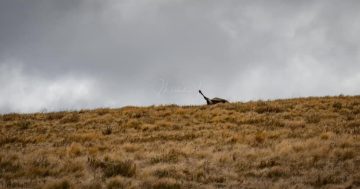
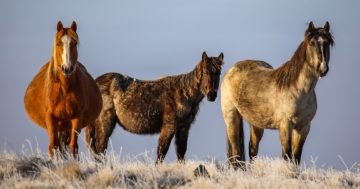
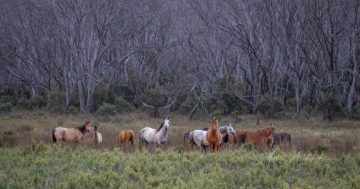
Wild horses in Kosciuszko National Park. A court has refused an urgent bid to halt the government’s culling program. Photo: NSW Environment and Heritage.
The NSW Land and Environment Court has today (9 July) rejected an urgent application from pro-brumby activists to halt the shooting of wild horses in Kosciuszko National Park, refusing to freeze the government’s culling program while a broader legal challenge is fought out.
The cull is being carried out under the park’s Wild Horse Heritage Management Plan (WHHMP), which was amended in 2023 to allow aerial shooting as one of the methods used to reduce the horse population to 3000 by 30 June 2027, with remaining horses confined to retention areas covering about 32 per cent of the park.
The environmental case for reducing horse numbers has been backed by a 2018 scientific determination that found feral horses were damaging alpine and subalpine habitats by trampling vegetation, compacting soil, degrading streambanks and affecting wetlands and bogs.
The applicants, Matthew Holland and Roxanne Phoenix, took the government to court on 5 July, arguing horses found dead after recent shooting operations had been killed cruelly and in breach of the park’s official horse management plan.
That period formed part of a broader operation, with NSW National Parks and Wildlife Service (NPWS) notices tendered in evidence saying aerial control operations targeting all feral animals, not just horses, were being conducted across the southern part of the park between 29 June and Saturday 11 July, 2026.
The applicants wanted the court to stop all aerial and ground shooting immediately, or at least stop shooting in designated horse retention areas, while their case was heard.
Justice John Robson heard the urgent application over two days this week.
In his judgement, Justice Robson considered evidence from three witnesses for the applicants – Cherie Smith, Diane Baxter and photographer Lovisa Sjöberg – who described finding dead horses between 25 June and 1 July, in the days after shooting operations near Kiandra.
Ms Smith said she had seen horses near the Kiandra courthouse on 25 June and later found dead horses in the area.
Ms Baxter gave evidence that on 30 June she travelled to the area after being told by Ms Smith about dead horses near the Eucumbene River, not far from Kiandra.
She saw a dead horse lying in the distance, with its head tucked underneath it and what appeared to be an aborted foal at the back of the horse. She said the damage to the horse’s back passage was extensive and may have been caused by wild dogs.
Ms Sjöberg said on 29 June she walked through a designated retention area near the Nungar Creek Fire Trail and found and photographed 10 dead horses around the Wild Horse Plain area.
They included three Kiandra grey horses, a bloodline recognised in the plan as having heritage value. She said one Kiandra grey mare was heavily pregnant and another mare was pregnant and had aborted a foal.
The applicants relied on an expert report from Emeritus Professor Ruben Rose, a former Dean of Veterinary Science at the University of Sydney, who was asked to assess photographs and video material, including the likely cause and timing of the horses’ deaths and whether there were signs of distress.
Professor Rose said spontaneous abortion after the first three months of pregnancy was unusual in mares and, in later pregnancy, would require the mare to be alive to expel the foal.
He said where a mare was wounded and took time to die, stress hormones and other physiological responses could lead to delivery of a foal if the horse was pregnant. He also said it would be difficult to consistently achieve accurate shots from a helicopter and impossible to know from the air whether a mare was pregnant.
However, Justice Robson found Professor Rose’s evidence could only go so far: while the professor raised concerns about what could happen if a pregnant mare was wounded and took time to die, he accepted the photographs alone could not prove exactly how the horses died, how long they took to die, or what happened during the shooting operation.
The department’s evidence came from NPWS Park Operations (Inland) executive director Robert Smith, who pointed to the plan, the standard operating procedures and the animal welfare measures used in the aerial shooting program.
Mr Smith said NPWS had developed a standard operating procedure (SOP) for aerial shooting of wild horses, with RSPCA input and after field assessment and preliminary programs.
The court was also told independent animal welfare assessments had been completed for previous aerial shooting operations in 2023 and 2024.
Mr Smith said a third independent assessment had been carried out between 4 and 6 July 2026 and was expected to be published in August.
He said he was not aware of any adverse animal welfare incidents and that no non-fatal wounds had been documented or discovered by NPWS, independent veterinarians or RSPCA NSW.
Justice Robson found the applicants had not established a sufficient likelihood of success to justify an injunction.
He accepted the evidence of the applicants’ witnesses was given honestly and reflected genuine concern and distress, but found it was not enough to establish a breach of the Prevention of Cruelty to Animals Act or the relevant standard operating procedure.
Finding a dead horse in an area where culling was taking place was not, of itself, proof the animal had been killed cruelly or unlawfully, the judge found.
Justice Robson also found that while Ms Sjöberg’s evidence suggested two horses may have miscarried, even if those horses had been shot in the culling process, that did not demonstrate the killing was unnecessary, unreasonable or unjustifiable.
He noted there was nothing in the plan or the standard operating procedure that prohibited pregnant horses from being shot.
Justice Robson said the SOP included guidance on experienced shooters, clear visibility, shot placement and a “policy of overkill”, but found the document was a guide and did not replace or override the legislation.
What was appropriate in particular circumstances depended on the skill and judgement of the shooter and pilot, he said.
The applicants also argued the shooting could cause irreversible loss of particular wild horse heritage values, including Kiandra grey horses.
Justice Robson accepted the department’s position that while the plan recognised some horse types had heritage value, it did not prevent those horses from being shot. Instead, he said, the plan protected heritage values by preserving 3000 horses in retention areas.
He also considered the practical fallout of stopping the operation, including helicopter bookings, lost operational days and the potential need to close the park again later.
Justice Robson referred to the environmental harm caused by feral horses, noting the NSW Threatened Species Scientific Committee had listed habitat degradation and loss by feral horses as a key threatening process under the Biodiversity Conservation Act.
He said he understood the strong feelings many people, including members of the local community, held about the culling of wild horses in KNP (Kosciuszko National Park).
However, he said he was not satisfied the evidence was sufficient to grant an injunction.
“Of course, my findings do not rule out the prospect that some operations may not have been fully compliant,” he said.
But on the evidence before the court, he said that possibility “would not rise above the level of speculation”.
The motion was dismissed and costs were reserved.
The case is due back in court for directions on Friday, 17 July, when the next steps in the broader challenge are expected to be considered.
Justice Robson also suggested the parties consider seeking an early hearing date, noting NPWS material before the court indicated further aerial control operations were planned for November.