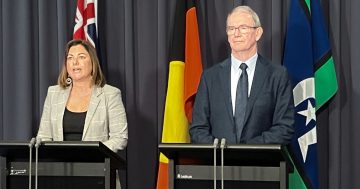
Monday’s AusAlert test wasn’t a complete success, but the government says it’s happy wth the result. Photo: Region.
Didn’t get the AusAlert on your phone Monday afternoon?
That’s ok, that was the plan all along. Apparently.
At 2 pm on Monday (27 July), phones blared around the country and their screens lit up with an emergency warning test.
Except not everyone’s did.
Many who didn’t get the alert began sharing that news immediately, asking why they missed out on something that had been touted as universal.
It was clearly promoted as nationwide blanket coverage for all.
Indeed, those with secret and concealed phones (mainly victims of domestic violence managing an exit strategy) were warned to turn their phones off or switch them to aeroplane mode so they wouldn’t go off and reveal their existence or location.
That’s how certain it was that everyone was going to get these alerts.
The reasons bandied around as to why some didn’t were initially because of the types of mobile phones in their possession.
Certain model iPhones and Apple watches etc were the problem, perhaps. Maybe it was just regional areas that had difficulties?
But no, Emergency Management Minister Kristy McBain made it clear that it wasn’t regional areas – it was in areas where telco towers were offline for maintenance.
Some people received the pop-up message on their phone screens but didn’t get the warning sound.
And as for those who had turned their phones off to avoid them being detected, many reported their phone blaring out as soon as they turned them back on – defeating the whole effort of keeping them concealed.
Of course, it was just a test, and that’s what tests are for. To sort out the teething problems before it goes live – in this case, in October.
But after all the pre-hype about how everyone was going to get this test warning, it was interesting to observe the minister deliver an excellent demonstration of how to positively spin something when things don’t quite go to plan.
“The national test of AusAlert, our new emergency warning system, has been successfully completed,” she said
“Advice from our telco partners is that 94 per cent of targeted cell towers successfully broadcast the AusAlert test messages to mobile devices around the country.
“This is above the National Emergency Management Agency’s target. Compatible devices across the nation have received the test alert, and it was effective across all states and territories.
“We have also been tracking public responses from the National Situation Room and reports are that test messages reached high numbers of mobile devices around the country.”
And before she made it clear that the 6 per cent who didn’t get the alerts was down to towers being offline for maintenance, the minister gave a more confused reason.
“Don’t worry if you did not receive an alert. This could be because you were not in a coverage area, your software was not up to date or your device was incompatible,” she explained.
“The fact that we have reached and exceeded the target that we set shows that the technology works.”
In other words, no one really knows yet why some phones received the alert and some didn’t.
And we don’t really know yet either how precise the “94 per cent” success rate figure actually is. In one line it was described as “almost” 94 per cent.
“There is no one avenue of communication that we currently have that is 100 per cent successful,” McBain said
“It is so important that communities continue to look out and look after each other. We’ve always done that as Australians and we always will do that as Australians.
“This technology is more reliable than the current text-based technology. But as I said, this is just another tool in the toolkit for emergency service agencies who are doing a really good job in communicating to communities that are at risk during a natural disaster.
“They will continue to do that. They’ve just got an extra tool now to help get that message out.”
It’s very interesting how the language has changed after the test, compared to the hype before.
Yesterday’s exercise brought to mind the 2008 test of the “Clean Feed” internet filter trial when Kevin Rudd was PM.
It was meant to protect children from illegal and inappropriate material by filtering out automated keywords and blacklisted content.
Stephen Conroy was the Labor communications minister at the time, and the whole trial was a spectacular failure.
But it was at the actual test launch briefing for media and interested parties at Parliament House that was embarrassing for the minister.
With token school kids in the room looking on as IT boffins showcased what the system could do, a highly offensive word was typed into the keyboard, with the promise that it wouldn’t show up on the giant screen overhead, nor would any links to sites related to that word.
Except it did show up for all to see.
I was in the room, and we all had a good laugh – especially the kids.
Original Article published by Chris Johnson on Region Canberra.