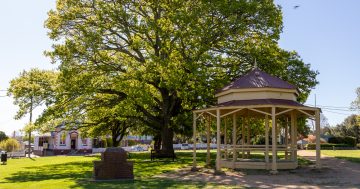
Braidwood’s Ryrie Park is an icon for the town — but the local council is preparing for change. Photo: Michelle Kroll.
Queanbeyan’s council has reviewed its predictions for Braidwood, as it prepares for a future with fewer people and fewer growth areas.
Drafting work on the Braidwood Structure Plan (BSP) started in 2023-24 by Queanbeyan-Palerang Regional Council (QPRC), but it ran into a roadblock.
Changed predictions meant the council had to go back to the drawing board and develop a new version of the BSP to account for a smaller population and concerns around the town’s water access.
These new estimates mean QPRC now expects the town’s population to grow by 2108 to 2732 people by 2051, rather than the estimate of between 2033 and 5056.
Meanwhile, a 2025 issues paper found secure water yield from the Shoalhaven River will be able to facilitate a total population of 2400.
In the new version of the plan, QPRC has reduced the areas initially identified for future growth from nine to five, which means it’s looking to investigate areas around Station Street, south of Glenmore Road, the Braidwood council depot, 43 Lascelles Street and 51 Elrington Street for future growth.
However, these come with land ownership issues, the need to upgrade the nearby water network, potential contamination and the requirement for a site-specific flood study.
The BSP also flags ongoing concerns around stormwater management (especially at Wallace Street), parking during holiday periods and the appetite for a possible public transport route between Braidwood and nearby regional centres.
Seven vacant lots along Lascelles Street and McKellar Street have also been identified as sites that could be developed as future commercial land.
The document also notes that eight hectares of E3 Productivity Support-zoned land is unoccupied and could be put to future commercial uses.
According to the updated Braidwood Structure Plan, the town has two cemeteries, with one (Braidwood Lawn Cemetery) nearing capacity and the other (Old General Cemetery) closed.
During a recent meeting, Councillor Katrina Willis noted no funding was committed in the 2026-27 operational plan to start work on finding a new lawn cemetery site.
“Now the report itself, the Structure Plan itself, says that the cemetery is nearing capacity,” she said. ”It doesn’t give any more detail than that … I wouldn’t like to see us end up in the situation in Braidwood that we’re now confronting in Queanbeyan.
“[That is] where a site that was purchased 10 years ago, after a lot of work, effort and expense, is found to be unsuitable for the regulator’s approval and we have to scramble to find another place.” (In July 2025, councillors voted unanimously to abandon plans for their chosen site, south of Googong, after finding issues with its groundwater, and search for an alternative.)
The BSP states that an expansion of the SP1 Special Activities Zone would be necessary for another cemetery site to be identified and pursued.
Cr Willis said that, when QPRC’s operational budget was next before councillors, she would push for funding to be put towards this issue.
“It would be quite unsatisfactory if council ran out of time to provide a new lawn cemetery for Braidwood.”
Plans to run an expressions-of-interest process to find a new cemetery site are listed as an action item in the final BSP.
These action items also propose limiting dwelling growth to 309 (to manage water availability), planning for a mixed-use zone along Lascelles Street and ensuring new residential areas come with appropriate recreation areas.
Cr Bill Waterhouse called for his fellow councillors to support the amended document and thanked Braidwood residents for their engagement with the council during the BSP process.
“I note there’s still concerns about a bypass, and that will continue, but there’s great optimism about the fact there is a five-yearly program to reassess where things are up to in five years’ time,” he said.
The updated document states that while it is believed there is no need for the project (either now or in the near future), it does not rule it out forever.
“However, as the regional population continues to grow and the Kings Highway remains the primary route to the coast from Canberra, the need may become more pronounced and will be monitored as part of the Implementation and Monitoring Action Plan,” it says.
“Council will continue to work with Transport for NSW to negotiate further study and determine a viable route option.”
The final document is available on the council’s website.