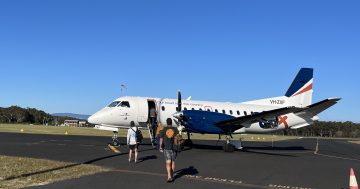
Eurobodalla Council has approved a new plan for Moruya Airport. Photo: Kim Treasure.
Eurobodalla Shire Council has adopted a 10-year masterplan for Moruya Airport which includes an area for future commercial development, plus a concept for a new terminal if required.
Council staff Andrew Greenway and Sheldon Jones gave councillors an overview of the masterplan at a recent workshop before councillors adopted it at their latest council meeting.
Staff said a new terminal was not currently needed. The most likely trigger for a new one would be the need for security screening, rather than an increase in the size of passenger service aircraft or a significant increase in passenger numbers.
They said a new terminal could not be located in the current location because it was too close to the runway. Much of the land was environmentally sensitive in the biobank, plus there were Aboriginal heritage considerations and the need to manage tree height.
Regional Express (REX) is the biggest user of the airport with its aircraft that carry up to 35 passengers. The airport has the capacity to accommodate aircraft that carry up to 75 passengers such as Qantas’ turbo prop aircraft.
However aircraft carrying more than 130 passengers could not use the airport because the runway would have to be widened from 150 metres to 280 metres. George Bass Drive and tree clearing are restraining factors.
Mr Jones said regulatory changes restricted council’s future ability to ‘upgrade’ the airport. “A grandfathering clause recognises that most regional airports would not comply with the requirements for a new airport,” he said.

Moruya Airport Facilities Development Plan. Photograph: Eurobodalla Shire Council website.
“Anyway, the demand from airlines, based on passenger numbers, isn’t there. We are lucky to have three flights a day. If there were larger planes, there would likely be fewer flights.”
Nevertheless, the masterplan reconfirmed that industry factors meant planning for a new terminal now is prudent. The draft terminal concept plan allows for a phased development to manage costs depending on demand.
In the meantime the masterplan includes an area on the George Bass Drive side of the runway for future commercial development.
Council has added 24,000 square metres of commercial space since the original 2015 masterplan. Six new leases have been signed and others are in negotiation. There are 19 leases, 10 businesses on the site and it employs 30 people.
Council’s general manager Mark Ferguson said the airport was a critical asset as an economic driver. He said the masterplan was intended to improve the terminal and the airport’s viability. “At the moment it is costing ratepayers to operate. It should be breaking even.”
Excluding depreciation and overheads, the net operating cost for airport operations in 2025-26 was $125,665, below the $142,000 average cost over the past five years, which staff said indicated greater efficiency.
Hangar income from leases, predominantly corporate, increased from $126,000 in 2018 to $246,600 in 2025-26.
“People are looking at Moruya as a potential base because they don’t want to go into Sydney,” Mr Jones said. “Others want places across the country, and there is private interest. Someone could build a hangar for three or four aircraft and lease them out. It is a lot more expensive to have a hangar in Blacktown than Moruya.”

Moruya Airport Terminal preliminary concept plan. Photo: Eurobodalla Shire Council website.
The airport is used for freight and emergency services, as well as for medical, charter and Defence Force flights.
Councillors Laurence Babington and Amber Schutz said the masterplan should be looking further into the future.
Cr Schutz asked if the council could look for another site for the airport that was not constrained and redevelop the existing site for housing.
Council’s director of community, arts and recreation services Kathy Arthur said that was outside the masterplan’s scope. “This is planning for the next five to 10 years,” Ms Arthur said.
“This is asking us to lock in one option,” Cr Schutz said. “Investors could have invested millions and we would be expected to buy it back.”
Council received five submissions when the masterplan was on exhibition. Four were supportive. The other raised concerns about process including consultation and transparency, and financial justification of current and future expenditure.
Next steps include further developing plans for the next stage of development, working with NSW Health to deliver the Air Ambulance Station, sourcing funding for the next phase of development and preparing the associated business cases while increasing lease revenue and the number of leases.
Councillor Sharon Winslade said in the meeting that any non-essential projects at the airport should be thoroughly assessed including a business case and opportunity cost of spending ratepayers’ money on the airport rather than community infrastructure. Ms Arthur said every project would have to be triggered by demand.