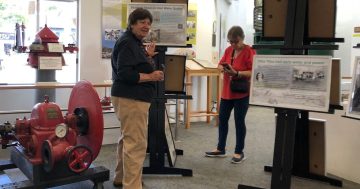
Narooma School of Arts president Jenni Bourke, Narooma Historical Society vice-president Gero Mitchell and president Laurelle Pacey. Photo: Supplied.
This year is the centenary of the official opening of Narooma’s Memorial Hall, built by the community as the district’s memorial to its First World War soldiers. The hall was the hub of Narooma’s life for much of the 20th century. It hosted balls, dances, ANZAC Day services, flower shows, live theatre, musicals and public meetings.
Part of the building has been used as the town’s library and a space for Narooma’s arts community. Films have been screened in the hall since 1927, making it one of NSW’s longest running movie theatres.
The hall has always been run by Narooma’s School of Arts which was formed in around 1895. Narooma was gazetted in 1886.
In 1895 land where the petrol station is today was dedicated for the original School of Arts Hall. Narooma Historical Society’s president Laurelle Pacey said in the early years, people had to use the halls at Tilba Tilba and Bodalla. “The growing community desperately needed a venue where they could gather.”
In 1919 the School of Arts Hall became an emergency hospital when soldiers returning from World War I brought the Spanish flu to Australia.
Tourism in Narooma boomed after the war. The School of Arts Hall had become too small for dances and the town wanted a new hall. At the same time people wanted to commemorate all those who had served in the war. “So, they built a town hall which was also dedicated as a war memorial,” Ms Pacey said.
The names of those who served in the war are engraved in two granite memorial tablets on the building’s front facade while additional names feature on a wooden memorial plaque inside.

Narooma Kinema team members outside the hall. Photo: Jade Griffiths.
Early on travelling ‘picture men’ with projectors sometimes showed films there. “From 1927 onwards the hall was a cinema and in 1932 we got talkies,” Ms Pacey said.
In the 1960s licensed clubs started putting on events so there was a bit of a question about what to do with the hall. “A lot of communities lost their hall around that time,” she said.
Fortunately, Bill and June Bardsley-Smith arrived on the scene. They leased the hall, put in fixed, tiered seating and ran it as a cinema from 1971 to 1976. The main auditorium has been leased to an independent cinema operator since 1971.
Ron and Doreen Cambourne followed and leased it for 10 years.
Then came cinema and theatre lovers Dennis Davis and Stephen Walsh who saw the hall’s potential.
“They realised if the cinema was to survive it had to have something special,” Ms Pacey said. “They introduced some art deco touches and their collection of cinema memorabilia.”
The men turned the place around, made a lot of changes and called it the Kinema. They brought back theatre to the hall and had a great relationship with the Montague Choristers who put on musicals.
The men held the lease for 15 years. Eden and Emma Morris held the lease from 2001 until John and Janette Griffiths took over in 2003. Their granddaughter Jade Griffiths continues to hold the lease.

John and Janette Griffiths (front) with Jade Griffiths, owner and manager of Narooma Kinema and Jenni Bourke, president of Narooma School of Arts. Photo: Narooma School of Arts.
The hall has been extended and changed considerably. It was first extended in the early 1930s, and a supper room was incorporated. In the 1950s the available floor space was increased by around 50 per cent, including a new supper room.
Council had rented the old supper room for the town’s library from the early 1980s to about 2002. It then rented the room as a space for the arts community including Montague Art and Craft Society (MACS).
Around 2005, the Griffiths approached the hall’s management committee about making a second cinema. This saw the Griffiths turn the old supper room into a second cinema theatre while council transferred its lease to the School of Arts Cottage for MACS and other arts groups to use.
Ms Pacey said the whole precinct, including the new Narooma Arts Centre being built, was worth more than $10 million. Throughout its life it has been community-owned and community-run.
Although the hall is leased to an independent company, the School of Arts is responsible for its upkeep and ensuring it is safe for public use.
“That real estate belongs to the community, not to council and not to the state government, and our community is responsible for it into the future.”
To mark the centenary, the Narooma School of Arts commissioned an emotive short film and Ms Pacey wrote a book about Narooma School of Arts’ history through Narooma Historical Society.