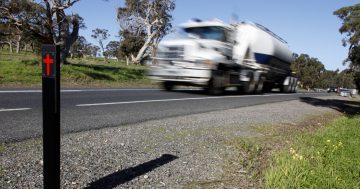
Average speed cameras on the Hume Highway between Coolac and Gundagai have recorded more than 13,600 light-vehicle speeding infringements in 12 months. Photo: Transport for NSW.
More than 13,600 speeding infringements were issued to light vehicles on the Hume Highway between Coolac and Gundagai during NSW’s first trial of average speed camera enforcement for cars, motorcycles and other light vehicles.
Transport for NSW figures obtained by About Regional show 13,637 infringements were issued on the 16-kilometre section between 1 July 2025 and 30 June 2026.
Of those, 281 involved vehicles detected averaging more than 20 km/h above the speed limit, including 51 more than 30 km/h over and 10 more than 45 km/h over.
Transport for NSW declined to reveal the highest average speed recorded at the site, saying the figure was not publicly available.
The Coolac-Gundagai cameras formed part of a 14-month NSW Government trial that also included a 15-kilometre section of the Pacific Highway between Kew and Lake Innes, near Port Macquarie.
The trial was due to finish on 30 June this year, but Transport for NSW has confirmed light-vehicle enforcement will continue at both sites while it completes its review.
But preliminary results across the two locations show a 76 per cent improvement in light-vehicle compliance compared with pre-trial data.
That figure applies to the two trial sites combined, with Transport for NSW not providing a separate 12-month compliance improvement figure for Coolac–Gundagai.
Legislation passed in late 2024 allowed average speed cameras, previously used in NSW only to enforce speeding offences involving heavy vehicles, to be used for all vehicle types.
Rather than introduce light-vehicle enforcement statewide, the NSW Government selected the two regional locations to test the road safety benefits of extending the system to cars, motorcycles and other light vehicles.
The sites were chosen based on factors including their regional setting, crash history and whether the existing camera infrastructure could be modified for light-vehicle enforcement.
The government has previously said almost 80 per cent of fatalities and serious injuries recorded on NSW’s existing average speed camera routes between 2018 and 2022 did not involve heavy vehicles.
Unlike fixed speed cameras, which record a vehicle’s speed at one point, average speed cameras measure how long it takes to travel between two locations and calculate the average speed over that distance.
The trial began at both locations on 1 May 2025 with a two-month warning period, before fines and demerit points took effect from 1 July.
While 13,637 infringements were issued at Coolac-Gundagai over the following 12 months, they represented only a small proportion of the light vehicles using the highway.
In July 2025, about one in every 213 light vehicles passing through the site was caught speeding.
By June this year, that had fallen to about one in every 270.
The improvement had already begun during the pre-trial warning period.
Across May 2025, about one in every 138 light vehicles checked at Coolac-Gundagai was detected speeding. By July, when fines kicked in, that had fallen to about one in every 214 vehicles.
A total of 912 infringements were issued at the Hume Highway site that month, with the NSW Government saying non-compliance had fallen by more than a third since May.
When the first enforcement results were released, NSW Roads Minister Jenny Aitchison said the early figures pointed to improved driver behaviour.
“The trial is having the desired effect, with speeding offences almost halving across both locations,” she said.
The Coolac-Gundagai section was selected partly because of its crash history.
Between 2018 and 2022, eight crashes not involving a heavy vehicle were recorded along the route, including four serious-injury crashes.
Across both trial sites, the NSW Government said six people were killed and 33 seriously injured over the same five-year period.
Crash data for 2025 and 2026 has not yet been finalised, meaning the effect of the trial on crashes and serious injuries at Coolac–Gundagai is not yet known.
Transport for NSW’s final review will consider speeding offences and trends, average light-vehicle speeds, the estimated impact on crashes and road trauma, and the cost of the trial.
The results are to be tabled in NSW Parliament.