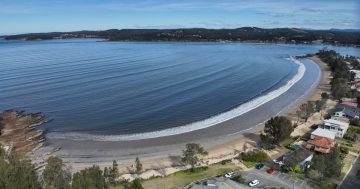
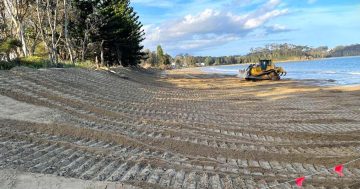
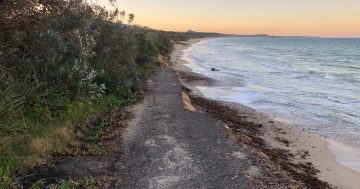
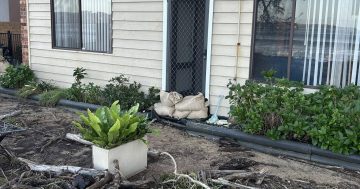
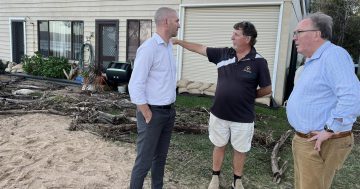
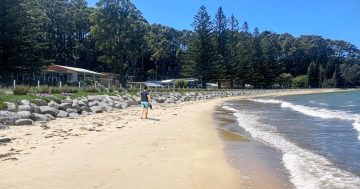
Beach scraping at Surfside’s East Beach. Photos: Eurobodalla Shire Council.
Batemans Bay community groups are asking Eurobodalla Shire Council for considered and coordinated action on the erosion that is threatening the homes of some residents at Surfside Beach.
Newly formed Friends of Surfside Beach asked council to allocate funds for sand scraping and to actively pursue further funding sources for short- and long-term erosion mitigation solutions.
Batemans Bay Boaters Association criticised the latest attempt to shore up Surfside’s defences against erosion. It called for a long-term solution for the northern shore of the Clyde River estuary, the development of a marine infrastructure study and a dedicated marine infrastructure committee.
Representatives of the two groups addressed councillors at council’s public access meeting on 9 June.
Jason Ford is president of Friends of Surfside Beach which was incorporated in April 2026. It has 120 members so far and Mr Ford expects membership to grow given there are around 750 residences and 1700 residents in the area.
He said it was a community advocacy group with an environmental focus. It aimed to protect and enhance Surfside Beach’s coastal environment, including its dune systems, wildlife, nature reserve and residential foreshore. It would do that by supporting effective erosion mitigation and prevention solutions, community education and environmental conservation projects.
The group is registered with the Australian Charities and Not-for-profits Commission which enables it to accept donations. They will fund their work through donations, membership fees and applying for grants.

An aerial photo of Surfside Beach in August 2025.
Mr Ford said the group was interested in practical solutions and intended working with local, state and federal governments collaboratively and constructively.
“Community members raise the issue, council says yes, understand the problem but there is no funding and we will advocate to the State Government,” he said. “The detail of that advocacy is often unclear to the community.”
There was emergency sand scraping in September 2025 but after recent storms the protective buffer is almost entirely gone, leaving Surfside Beach vulnerable again.
Mr Ford asked council to make funding for further sand scraping a priority, it being a practical and cost-effective way to buy time for longer-term planning. That could be ongoing nourishment, a revised coastal management plan, engineered protection measures or a combination.
“Prevention is cheaper than emergency response,” he said. “Maintaining the dune today is significantly more effective and economical than waiting until larger intervention becomes unavoidable.” He pointed to the example of the rock wall being built at Long Beach.
Harry Watson Smith, president of Batemans Bay Boaters Association, said without a marine infrastructure strategy, the community and council moved from one crisis to the next.
He said the dredging done in September 2025 had dumped the sand 600 metres offshore instead of where it was needed.
The dumped dredging material changed the wave behaviour so that it generated strong lateral currents running parallel to Surfside Beach, so contributing to erosion there.
In contrast, dredged material was deposited on the Wharf Road east beach to widen the shoreline.
“Many years later, that sand remains in place and continues to form the backdrop to the stone rockwall mound currently under construction,” he said. “Placing sand where it is needed is very different from placing it 600 metres offshore and hoping natural processes eventually move it into position.”
The association wants council to scrape sand into a protective dune along the property boundary during the June and December low spring tides and investigate a long-term structural solution of extending the northern rock wall eastwards from the caravan park to protect Surfside Beach. “If you understand the storm, flood and tidal movements within the estuary, it becomes the logical solution,” Mr Watson Smith said.
He asked council to establish a marine infrastructure committee and develop a marine infrastructure strategy for the shire and its 21 boat ramps. Such a strategy would help secure funding, improve planning and prevent those assets from falling further into disrepair.
The committee would ensure the strategy was informed by those using the infrastructure daily and by bringing in local knowledge, avoid unintended consequences.
Mr Watson Smith said the current bridge piles on the northern end were incorrectly aligned, resulting in a buildup of sand there and a river that no longer meandered.
When asked if there had been a hydrology study conducted since the bridge was constructed, he said they had been flawed and the only one was the modelling done by GHD when the bridge was proposed. He said neither the government nor council had contacted his association, although the State Government had contacted Marine Rescue.