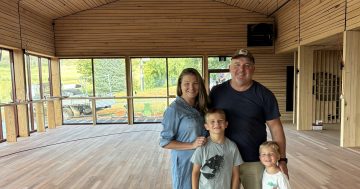
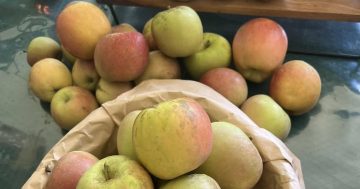
Cider maker Gary Sully says that of the almost 50 apples he’s tested, a few have been “quite exciting”. Photo: Jack Watkins-Sully.
To the untrained eye, one apple can look very similar to another – but Gary Sully can spot the differences.
Part of the Braidwood cider maker’s job is finding – and testing – apples to determine whether they’re a lost variety.
Once identified, the different varieties bring “quite exciting flavours” to his products.
“We’re very traditional – we make cider using English and French cider varieties, which are quite rare in Australia,” he said.
“Having done that, we then realised there’s quite a lot of apples imported into the country before biosecurity – and some after as well – that are pretty rare cider apples.”
Alongside his international colleagues, he traces the long and often convoluted history of apples around the world.
Investigations start with an invitation to someone’s property, where Mr Sully takes a clipping from their orchard.
“Usually there’s not too much growth on those trees … [which means we] graft a bud onto a new tree.
“The old trees don’t really bear true to form that much because they’re so neglected.”
Once a tree bears fruit, he compares the fruit’s morphology with other apples, as well as the known history of the area and nursery records.
“There’s tens of thousands of varieties, so you really need to narrow it down a bit,” he said.
“The final step, if we’re really excited about it, is to send it over to the UK and get it DNA tested.”

Mr Sully works with a worldwide network to identify lost apple varieties. Photo: Gary Sully.
Mr Sully said that while some apples turned out to be known varieties, others couldn’t be identified.
“If it’s not picked up in the DNA test, then you’re probably looking at a lost variety,” he said.
“That takes a lot more work … You’ve got to prove it was there, beyond all possible doubt. It takes a long time.”
One of the industry’s most recent discoveries was the Rymer cooking apple, which was confirmed at properties near Majors Creek and along Cooma Road.
Mr Sully first visited the property in the early 2000s and ultimately put together a report on the trees for a colleague in the UK.
He said it meant Australia was the fourth country where their presence had been confirmed.
Other populations have been found in the UK, the United States and India.
He also identified a tree in the Braidwood area that is a Gipsy King variety.
“The only other Gipsy King that we found since 1870 was in Shropshire, so there’s only two found in the world,” he said.
While each discovery brings more eyes to their work, Mr Sully said several people have reached out about testing apple trees on their property.
“There’s always something going on … Some will never be solved – but we can try,” he said.
He said that while there was a lot of research to identify and track lost varieties, there were plans for further investigations.
“We’ve been collecting all these varieties from local regions since 2007. We’ve got an orchard full of them,” he said.
“That’s what we’re testing at the moment, all those different ones.”
Mr Sully said their efforts were a race against time, with climate change and natural disasters affecting how apples grew.
He pointed to a bushfire that swept through orchards near Braidwood.
“You don’t know what was in there,” he said of the area.
“It could have been something pretty special … People came here in the gold rush [of the 1800s] and they brought what they liked to eat.”
Find out more about Sully’s Cider and follow further discoveries through its Facebook page or website.
A cellar door at The Old Cheese Factory, 92 Sawyers Ridge Road at Reidsdale (near Braidwood) is only open by appointment.