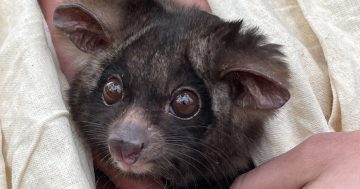
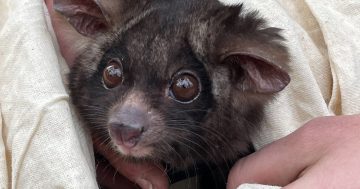
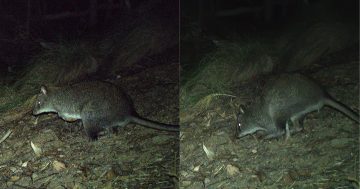
A wombat in Glenbog State Forest, where the Wombat Protection Society of Australia has mapped more than 900 active burrows. Photo: Wilderness Australia.
Forestry Corporation of NSW (FCNSW) has told conservationists its logging plans for Glenbog State Forest will be good for wombats. The wildlife sanctuary it cited as a partner disagrees.
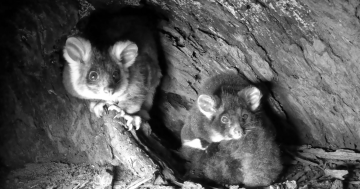
After a meeting on 12 March at which conservation scientists presented evidence of 122 greater glider den trees and more than 900 active wombat burrows in the 515-hectare area of Glenbog earmarked for logging, FCNSW acknowledged the findings but declined to pause its planning process.
Dr Renae Charalambous, Program Manager, Wildlife at Humane World for Animals Australia, said the corporation’s position was difficult to comprehend.
“They acknowledged everything – the 120 Grade A glider den trees, the 900 active wombat burrows – but despite all that scientific research showing the clear relationship between logging and the decline of greater gliders, they pretty much stated they’re still going to go forward with it. It was an extraordinarily disappointing response,” she said.
She said FCNSW told the meeting thinning the forest was beneficial for the forest itself and for wombats, by promoting grass growth – a narrative, she suggested, FCNSW continually relied on, and one conservationists and scientists in the room immediately rejected.
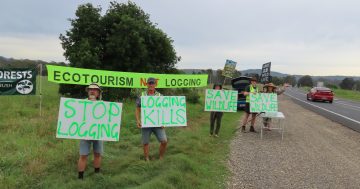
She said she would immediately convene a meeting of conservation NGOs to determine next steps, with direct ministerial lobbying a priority.
“Glenbog State Forest is so special. It blows my mind that industry can be so reckless.”
Located south-east of Cooma, Glenbog is one of the few remaining high-elevation cloud forests in southern NSW.
As well as one of the highest densities of bare-nosed wombats in the region, it provides critical habitat for the nationally endangered greater glider, the vulnerable yellow-bellied glider, endangered gang-gang cockatoos and vulnerable flame robins.
In a statement, an FCNSW spokesperson said timber harvesting in Glenbog remained in a planning process that took months, and all required environmental searches and protections would be completed before any harvesting began.
They said all harvesting operations must comply with NSW environmental regulations developed with input from expert scientific panels, including requirements to identify and protect threatened species habitat.
“In particular, broad area habitat searches will occur immediately before harvesting, where trained staff search throughout the area to identify and protect features such as drainage lines, threatened plants, steep slopes, raptor nests, caves and habitat trees.”
FCNSW said it followed the specific parameters for nocturnal greater glider searches set in the Coastal Integrated Forestry Operations Approval (CIFOA) as developed by the regulator, and third-party searches were not subject to the same parameters and therefore elicited different results.
FCNSW said it was engaging with local stakeholders and considering community-provided information while planning continued.
As part of that process, it said it had reached an agreement with Jarake Wildlife Sanctuary to implement guidance material for the management of wombat burrows in Glenbog – material developed in conjunction with local landowners during a previous harvesting operation in the area.
Marie Wynan runs Jarake Wildlife Sanctuary and is a spokesperson for the Wombat Protection Society of Australia.
She said FCNSW’s claim that logging would benefit wombats was without foundation.
“The corporation has never conducted before-and-after surveys of wombat populations in logged areas and has no evidence to support it,” she said.
She’s been GPS-marking wombat burrows in Glenbog for many years, and her own surveys of the area currently proposed for logging confirm it supports a healthy wombat population with no signs of mange or disease.
Ms Wynan has seen what logging does to a forest. In 2014 she and her colleagues mapped more than 150 burrows and negotiated a voluntary burrow protection protocol with FCNSW requiring loggers to avoid burrows where identified. It wasn’t enough.
“When we walked into the forest, it was like a bomb had hit,” she said. “It was absolute carnage.”
Survey markers were removed, burrows were crushed, backfilled or blocked by debris, wombats largely disappeared, and at least one was found dead beneath logging debris.
Around 30 per cent of burrows were damaged, she said, and surviving wombats abandoned the area because their food sources had been destroyed.
In adjacent areas, mange subsequently took hold – requiring months of treatment and supplementary feeding.
Ms Wynan said wombats were adapted to coarse native vegetation, and lush grass – such as that found on cleared or agricultural land – could negatively affect their health when it became their primary food source.
“These observations directly contradict the claim logging and thinning benefit wombat populations,” she said.
“The available evidence indicates logging leads to habitat destruction, population decline, and increased disease risk.”
Wilderness Australia operations manager Andrew Wong, who led the citizen science surveys in Glenbog, rejected each of FCNSW’s claims.
“The key to understanding what they are saying is the rules allow for a lot to be done to protect wildlife, but only require a very small amount to be done,” he said.
“FCNSW, of course, always do the absolute minimum they can get away with. They are allowed to do far more, but never choose to do so.”
He said a series of successful prosecutions by the NSW EPA demonstrated FCNSW often did even less than the minimum requirements.
Since the 2019-20 Black Summer bushfires, FCNSW faced more than 50 investigations and more than $3 million in fines, costs and penalties – including $360,000 in 2024 for cutting down 53 eucalypt trees on the NSW South Coast, and $30,000 in 2025 for failing to protect critical habitat in Conglomerate State Forest near Coffs Harbour.
The numbers in Glenbog told the story: his team identified 122 greater glider den trees while FCNSW’s surveys found four.
Both survey approaches meet the CIFOA standard – which requires a greater glider to be observed entering or exiting a hollow before a den tree can be recorded – but the similarity ends there.
“FCNSW sends two people to walk one kilometre of road on two separate nights, shining a torch and recording what they see, effectively covering around five per cent of the forest,” he said.
His team surveys 100 per cent, spending up to four nights on individual trees and conducting extensive daytime work alongside night surveys.
“Their statement about impacting the validity of our results is a nonsense statement that doesn’t mean anything,” he said.
Concerns about the rigour of FCNSW’s wildlife surveys aren’t new, after the corporation admitted searching for the nocturnal greater glider during daylight hours at Tallaganda State Forest east of Canberra when the animals were asleep inside hollow den trees. The EPA changed the rules in 2024 to require night-time surveys.
But conservation groups say the new rules only require surveys along logging roads and tracks, leaving 95 per cent of a logging compartment unsurveyed.
On FCNSW’s assurance that forthcoming broad area habitat searches would address remaining gaps, Mr Wong was blunt: “There will be exactly zero effort put in to find greater glider den trees. This answer makes it sound like they will do more work on greater gliders, but they definitely won’t.”
Mr Wong also rejected FCNSW’s claim that thinning would benefit wombats through grass growth.
“Wombat populations are at their healthiest when surrounded by native vegetation,” he said. “Anywhere we see them in areas dominated by grass, they are in crisis – attacked by feral predators, infected with mange, their natural population dynamics disrupted or non-existent. In the long term, they will crash.”
He said the claim alone was reason enough to question whether FCNSW should have any responsibility over ecological issues or environmental management.