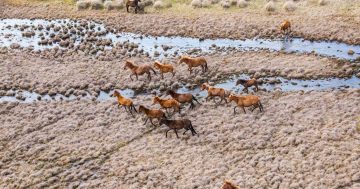
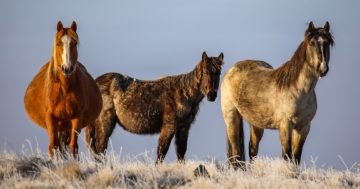
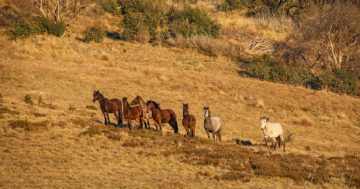
Wild horses in Kosciuszko National Park, where shooting has been paused while authorities await the results of another population survey. Photo: NSW Department of Climate Change, Energy, the Environment and Water.
Wild-horse shooting in Kosciuszko National Park (KNP) will remain suspended into 2027 while authorities await the results of another population survey following a winter operation that removed 1039 horses.
The NSW National Parks and Wildlife Service (NPWS) has confirmed the pause covers aerial shooting, ground shooting and shooting in trap yards, while passive trapping for rehoming continues.
November’s aerial operation will instead target feral deer and pigs, with parts of southern KNP closed on weekdays from 9 to 27 November.
The continuation of trapping has prompted concern from Brumby Action Group founder Marilyn Nuske, who has called for it to stop during foaling season.
She warned that foals could be separated from their mothers or crushed in trap yards.
“It is unacceptably cruel and unsupported by the national Standard Operating Procedures,” she said.
That guidance published by PestSmart, an information service managed by the Centre for Invasive Species Solutions, says capture and handling should be avoided when mares are foaling or have dependent young.
It warns that unweaned foals left outside a trap could starve, while those caught inside could be trampled.
Meanwhile, the future of the state’s wild horses was back before the NSW Legislative Council last week when Independent MLC Mark Latham asked Environment Minister Penny Sharpe whether the pause on aerial shooting in Kosciuszko would become permanent.
Ms Sharpe said aerial control would remain part of the government’s approach to managing invasive species, including horses, “under very strict independent oversight and with animal welfare checks”.
“We do not like to do it; my preference would be that we did not. That is why we also have a rehoming program for horses and a range of other control methods,” she said.
Ms Sharpe said removing invasive species was necessary to protect Kosciuszko’s fragile ecosystems and threatened species.
The following day, Mr Latham introduced his Wild Horses Bill 2026, proposing a statewide ban on aerial shooting, a state management council and local committees.
In his second-reading speech, Mr Latham said the bill would give communities a greater role in managing wild horses and require a statewide plan based on independent population counts and scientific evidence.
He also raised concerns about shooting’s effects on pregnant mares and dependent foals, saying aerial observers might not see every foal in difficult terrain or vegetation.
The bill would give priority to non-lethal measures, including retaining horses where they are, fertility control and humane trapping and rehoming.
“The killing of wild horses must be only a measure of last resort,” Mr Latham said.
He acknowledged the bill was unlikely to be fully debated or voted on before the March state election, describing it as a template for the next Parliament. The second-reading debate was adjourned.
An independent veterinary report commissioned by NPWS in 2025 found fertility control was not feasible across the park’s entire wild horse population, but could be a longer-term option for small, low-density herds isolated from incoming horses.
The peer-reviewed report found no current method could reliably ensure long-term infertility after a single treatment.

A mare stands outside a trap yard while her foal remains inside. The pair is understood to have been reunited for rehoming. Brumby advocates are calling for trapping to stop during foaling season. Photo: Supplied.
Another push to protect wild horses is gathering support through a petition on the NSW Parliament website.
Started by brumby advocate Carmen Jackson, the petition calls for permanent statewide bans on shooting and trapping and the compulsory removal of wild horses, as well as statutory protection of their heritage value.
Ms Jackson is also challenging, in the NSW Land and Environment Court, the legal authority of staff carrying out passive trapping in KNP.
At a hearing before Justice Sarah Pritchard on 1 October, barrister Declan Roche SC, representing the NSW Department of Climate Change, Energy, the Environment and Water, told the court eight staff were authorised to undertake the trapping, which was for rehoming horses.
The court confirmed on 26 October that Justice Pritchard’s judgment remained reserved.
A separate challenge brought by brumby advocates Matthew Holland and Roxanne Phoenix is listed for hearing in the court on 17, 18 and 19 February, 2027.
The pair unsuccessfully sought an urgent injunction in July, alleging horses had been killed cruelly and in breach of the park’s management plan.
Justice John Robson found the evidence then available was insufficient to justify temporarily stopping the shooting while the broader case was heard. The February hearing will consider the continuing proceedings.
The existing management plan provides for 3000 horses to remain in designated retention areas covering about 32 per cent of the park, recognising their heritage value, while requiring horses to be removed from the remainder by 30 June, 2027.
The heritage legislation was repealed in 2025, but the existing management plan remains in place while NPWS prepares an updated park management plan, due by 1 November, 2027.
NPWS says wild horses damage vegetation, waterways and threatened species habitat.
Its published figures record 10,012 horses removed between 24 November, 2021, and 30 June, 2026, including 6673 shot from the air and 1259 rehomed.
How many horses remain is contested. NPWS advised on 9 October that the next annual population survey would likely take place in late October, with results published in 2027.
The 2025 survey put horse numbers in the survey blocks at between 6476 and 16,411, with a best estimate of 10,309. The previous year’s estimate was 3885, within a range of 2131 to 5639.
NPWS says the difference does not indicate a rapid natural population increase, attributing it to some natural growth and other factors, including horses being harder to detect during the 2024 survey.
The 2025 survey was independently peer-reviewed before the final report was published in May.
And while reviewers praised the researchers’ expertise, they raised questions about differences between observers, statistical modelling and estimates for areas that could not be surveyed.
One reviewer said differences in how observers searched could potentially inflate the estimate and another questioned applying average horse densities to steep, unsurveyed areas where fewer horses were likely to live.
The final report acknowledged variation between observers and recommended further training.
It also presented an estimate of 8191 horses in the survey blocks, using an alternative statistical model, compared with 10,309 using the preferred model.
Earlier this year, approved rehomers, the Australian Brumby Alliance and Tarcutta-based sanctuary Umbango South, called for a further independent review of the survey methodology before more aerial shooting.