Koorin Campbell releases a koala in the Murrah Flora Reserve. Photo: Adam Baus.
In a major conservation win, koalas have been detected in multiple locations in Wadbilliga National Park for the first time after the most comprehensive koala survey ever conducted in that section of the rugged escarpment of the Far South Coast.
The survey was managed by Gadhu Bagan, the Southern-Yuin Firesticks team of cultural fire practitioners, in partnership with the NSW Department of Climate Change, Energy, the Environment and Water.
It took the team of 12 three weeks to put specialised acoustic monitors in 48 selected spots across the rough and remote landscape.
The work forms part of two projects, the Southern-Yuin Koala Project and the government’s NSW Koala Strategy.
Djiringanj man Koorin Campbell has worked with the national not-for-profit Firesticks for four years. He said the Southern-Yuin Koala Project began in 2018, helped by a Protecting Our Places grant.
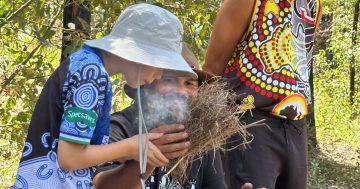
The care of Country by Mr Campbell and his fellow Gadhu Bagan cultural fire practitioner Durramah Parsons Campbell is reshaping how koala conservation is understood and delivered across the Murrah, Biamanga, Kooraban, Gulaga and broader Wadbilliga landscapes.
Last December for example, they led a cultural burn to support the healing of koala habitat that was damaged by the October 2023 Coolagolite Road bushfire. The burn was on private land near the home of one of the last remaining coastal koala populations between the Illawarra and Victoria.

Koorin Campbell and Durramah Parsons Campbell of Gadhu Bagan, the Southern-Yuin hub of Firesticks. Photo: Bella Laifoo.
Working alongside them in December were rangers from three local Aboriginal land councils, people delivering the NSW Koala Strategy with Firesticks, members of World Wildlife Fund Australia, and volunteers from the Far South Coast Koala Action Network and Landcare.
For the Wadbilliga survey the highly sensitive microphones recorded whatever called out over a two-week period. The data was analysed by government agencies and reported back to Gadhu Bagan.
The area surveyed is quite large, extending from the Brogo River and dam to north-west of Belowra where the Black Summer bushfires tore through.
Historically, koala records in Wadbilliga National Park have been scarce, with most detections previously concentrated along the park’s western fringe.
Considering the damage from the Black Summer bushfires, detecting koalas in locations including Green Hill Fire Trail, Jillicambra Fire Trail, the western end of Wadbilliga Road and Razorback Fire Trail is extremely encouraging.
Importantly, none of the sites where koalas were detected were impacted by last December’s Brassknocker bushfire, indicating key habitat areas remain intact to support the koala population.
Mr Campbell said they hoped to do a follow-up drone survey in the next 12 months.

One of the koalas released in the Murrah Flora Reserve this year with the vet. Photo: Adam Baus.
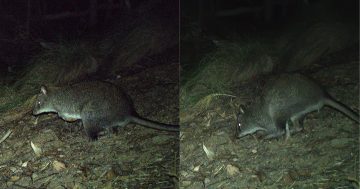
“We believe the absence of cultural fire has had a massive impact on some of our threatened species like koalas and potoroos,” he said. “You have the wrong plants coming up including introduced weeds, invasive natives like wattle and she-oak, and logging creates monocultures of silvertop ash.”
In good news, native grasses have returned to where they did the cultural burn in December, along with mushrooms, indicating there are good bacteria and micro-organisms in the soil.
Generally though, large areas of koala habitat in the south-east are very unhealthy.
“I think that is why the bushfires tore through,” he said. “It is very sick Country so cultural fire is the medicine needed to restore health.”
Mr Campbell is elated about the koala detections in Wadbilliga National Park.
“We were hoping they would be there and we found them,” he said. “It is ground-breaking for us because the koala songlines reach out that way from the South Coast to northern Yuin Country up Nowra way.”
He hopes they continue to secure grants to continue their conservation work, in particular cultural burns to restore forest structure, encourage regeneration of key food trees and reduce the risk of high-intensity bushfires across koala habitat.