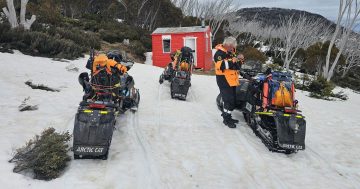
Sunday’s rescue took about three hours to complete. Photo: NSW SES.
A weekend walk turned into a cautionary tale when a group of seven people were left stranded on the NSW South Coast.
The tourists had become stranded on the rocks near the North Head campground (south of Durras) on Sunday morning when they became caught in a large swell.
They climbed to a ledge about 10 metres above the water and made a call for help.
The group became stuck at about 9 am, with NSW SES receiving the call and arriving at about 11 am.
Members of the SES Batemans Bay and Moruya units were on scene.
For NSW SES Eurobodalla local commander Peter Collins, it was an unusual rescue.
“Upon arrival, with one look at the high seas and where these people were stuck, [we realised] this was a very dangerous situation, a very unusual situation.”
While their initial plan was to use a helicopter to lift them off the cliff, Mr Collins said it quickly became clear that approach wouldn’t work.
“The helicopter was still there on-site at that stage [when SES units arrived] … They said that it was too dangerous to try and winch them off using the helicopter.
“We were going to use vertical rescue techniques – which is, basically, where we lower a person down to them … and we pull them up one at a time.”
They started by sending down Michael Day, who checked on the group.
“He basically calmed them down, organised them [into] what order they were going to be rescued,” Mr Collins said.
“There was a young girl who had been wet for three hours. She was starting to suffer, so she was going to be first.
“We started hauling them one at a time. … The whole rescue took about three hours from the time we got there to the time we finished.”


While it was a long rescue, Mr Collins praised the work of his team and said they “performed outstandingly”.
“Once I saw it was seven people, I knew it wasn’t going to be a quick one.”
He believes the group became trapped when conditions changed unexpectedly.
“I’d say they were just walking along the bottom of the cliff face, thinking everything was good, and there were extremely high tides and very large swells coming in from the south of New Zealand.
“I’d say that was unexpected. They just started to climb and got to a shelf [until they were rescued].”
Following their rescue, the group was checked over by NSW Ambulance paramedics, who had also been called to the scene.
“[The young girl had] been wet for about three hours, and she was quite cold and suffering from a slight hypothermia.
“We started treating her, and the ambulance has arrived, and they got wrapped in blankets and warmed.”
Mr Collins said the group were doing well when the two SES units left.
“They had never been in a situation like this before – they were very worried,” he said.
“Once they got to the top, you could almost tell that they were very relieved.”
Mr Collins urged anyone else thinking of heading out for a hike or walk along Australia’s beaches to check the weather conditions.
He said that while most rescues near cliffs commonly involved injured fishermen, hikers could also run into trouble.
“There are a lot of walks that go along the bases of cliffs, and something that you’ve always got to be very aware of is the tides.
“It’s very easy to start walking one way, the tide comes up, and it closes where you’re hoping to walk to. It’s not a highly usual [kind of] rescue that we get, but they do happen.”